Walk down any retail aisle and watch how people actually shop: most don’t read labels first, they scan shapes and colors, then stop at whatever catches their eye. That half-second of visual interest is often the entire sales pitch a product gets before a customer decides to pick it up or walk past it. Custom display boxes exist to win that half-second — and to keep working for the brand after the sale, too.
Here are seven concrete reasons custom display packaging earns its cost, plus a practical look at the types available and how to choose the right one.
1. It Increases Shelf Visibility
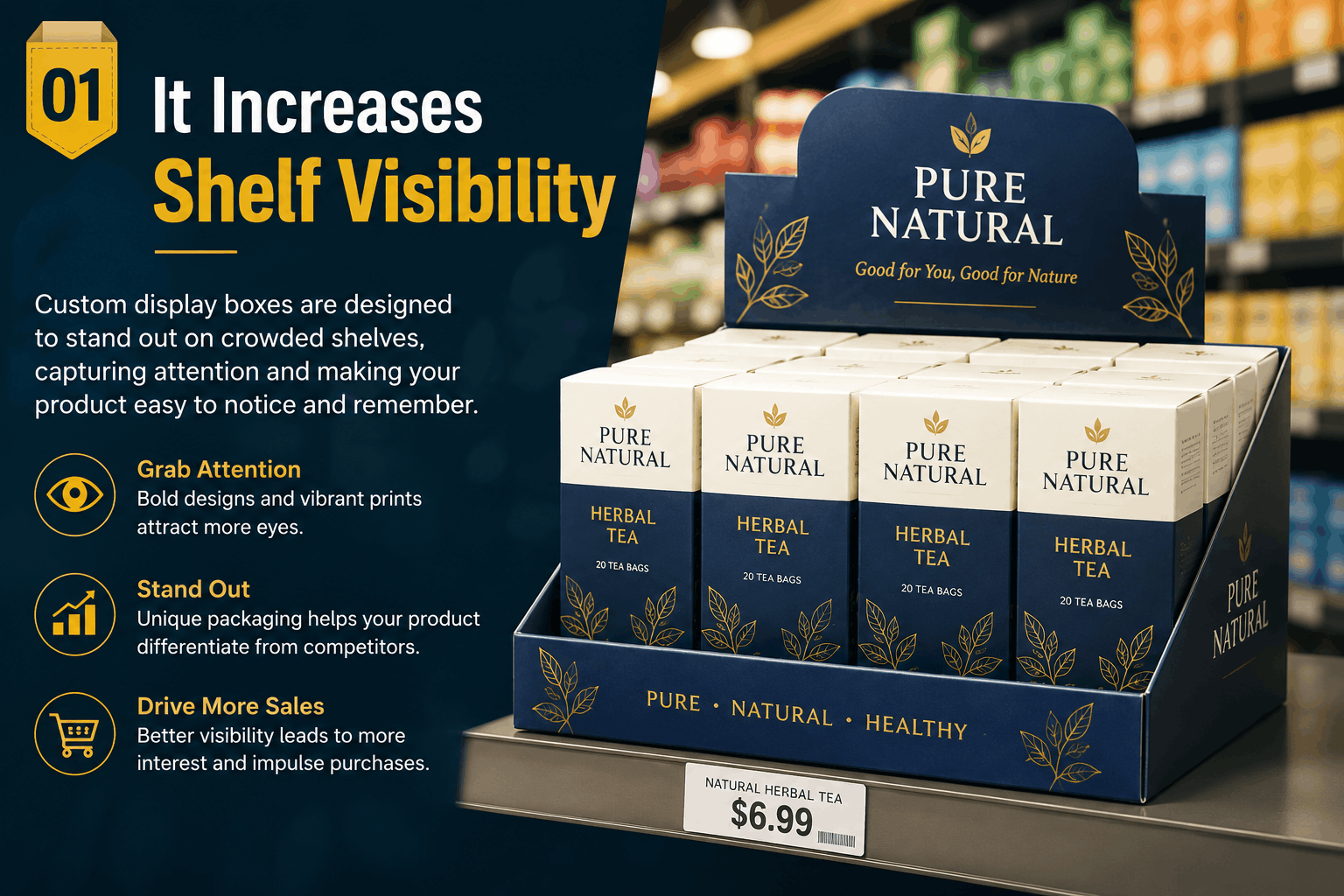
Standard shipping cartons are built for storage and transport, not for standing out. Display boxes are engineered specifically to be seen — with open fronts, tiered interiors, and eye-level sightlines designed for retail environments. On a crowded shelf where dozens of products compete for the same three seconds of attention, a well-designed display box is what actually gets noticed first.
This matters even more at points of impulse purchase — countertops, checkout lines, and endcaps — where a product has to sell itself with zero help from a salesperson.
2. It Builds Brand Recognition Over Time
Every display box is a branding surface: logo placement, color palette, typography, and messaging all reinforce what a customer associates with your product. Consistency here compounds — a shopper who sees the same distinct display style across multiple store visits starts recognizing the brand before they even read the label, the same way people spot a familiar cereal box from across a store.
This is one of the most underrated returns on custom packaging: it’s marketing that keeps running on the shelf without any additional ad spend.
3. It Increases Perceived Value
Packaging shapes perception of quality before a customer ever touches the product. Two identical items in different packaging can be perceived — and priced — completely differently based on how considered the presentation feels. A generic box signals a generic product; a well-designed display box signals that a brand cared enough to think through the details, which customers subconsciously extend to the product itself.
This is particularly powerful for categories where trust matters at first glance — cosmetics, food, and gifts especially — since customers often can’t evaluate quality directly before buying.
4. It Drives Impulse Purchases
A large share of retail purchases aren’t planned before the customer walks into the store — they happen because something on the shelf prompted a decision in the moment. Display boxes are built to prompt exactly that decision: clear visibility of the product, a design that communicates value quickly, and placement that puts the item directly in a shopper’s path.
Countertop and floor-standing display boxes in particular are designed around this behavior, since they’re placed deliberately in high-traffic areas like checkout counters, where customers are already primed to make a quick add-on decision.
5. It Improves the Customer Experience
Good display packaging isn’t just about the shelf — it also makes the product easier to shop. Well-designed interiors keep items organized, upright, and undamaged, and open-front or windowed designs let customers see exactly what they’re getting without needing staff to open anything. That reduces friction at the point of decision, which matters more than most brands assume: even small hesitations (not being able to see the product clearly, having to ask an employee) cost sales.
6. It Protects the Product While Still Showing It Off
There’s a common misconception that display boxes trade protection for visibility. Done well, they don’t have to. Structural elements like corrugated backing, tiered interior trays, and reinforced bases keep products stable and protected in transit and on the shelf, while open-front or window designs still let the product be seen. The goal is packaging that does both jobs — protect and present — rather than sacrificing one for the other.
7. It’s a Cost-Effective Marketing Tool
Compared to paid advertising, in-store display packaging is a one-time production cost that keeps generating impressions for as long as the product sits on the shelf. There’s no recurring ad spend, no bidding against competitors for attention — just a physical asset doing marketing work every time a customer walks past it. For small and mid-sized brands with limited marketing budgets, that makes custom display boxes one of the more efficient dollars spent per impression.
Common Types of Custom Display Boxes
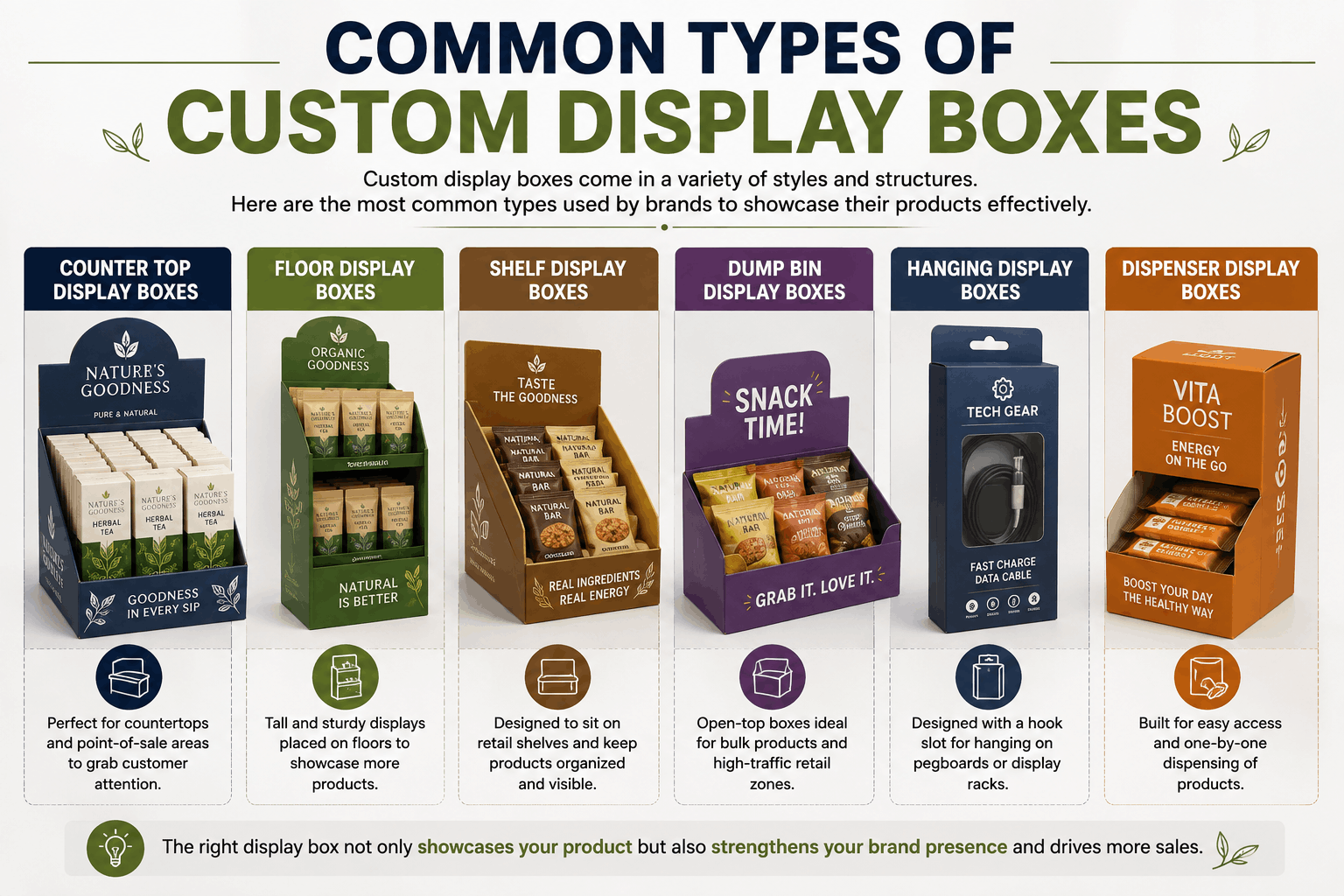
Not all display packaging serves the same purpose. A few common formats:
- Countertop display boxes — small, compact boxes designed to sit near checkout counters, ideal for low-cost impulse items like snacks, candy, or small accessories.
- Floor-standing display boxes — larger units designed to stand independently on the retail floor, often used for promotional or seasonal product pushes.
- Tray-style display boxes — open-top boxes that keep products organized and visible in neat rows, common for cosmetics and food items.
- Window display boxes — closed boxes with a die-cut window, balancing protection with product visibility.
- Gable/tiered display boxes — multi-level interiors that let several product sizes or variants sit in one unit, common for retail assortments.
Materials and Finishes Worth Considering
- Corrugated cardboard — the standard choice for most display boxes, since it balances strength with low weight and cost, especially for floor-standing units that need to hold their shape under product weight.
- Cardstock — lighter and more suited to countertop displays where heavy structural support isn’t as critical.
- Printing and finishing — full-color CMYK printing, matte or gloss lamination, and spot UV highlights all help a display box hold up visually under store lighting, where flat or dull finishes tend to blend into the background.
How to Choose the Right Display Box for Your Product
A few practical questions to work through before finalizing a design:
- Where will it be placed? Countertop, floor, or shelf placement each call for different sizing and structural needs.
- How many units need to fit? Interior layout should match the product count without leaving the box looking sparse or overcrowded.
- Does the product need protection, visibility, or both? This determines whether an open-front, windowed, or fully enclosed design makes the most sense.
- What’s the expected shelf life of the display? Seasonal or promotional displays can use lighter, less durable materials than a permanent retail fixture.
- Does the design work at a glance? If a customer can’t tell what the product is or why it matters within a couple of seconds, the design needs simplifying, not adding to.
Final Thoughts
Custom display boxes do more than hold a product — they sell it, protect it, and reinforce a brand every time a customer walks past. In a retail environment where attention is scarce and competition is dense, packaging that’s designed specifically to be noticed is one of the most reliable ways to convert a passing glance into a sale.
If you’re exploring display packaging options for your product line, [Your Brand Name] can help you figure out the right format, material, and design for where your product will actually be sold — get in touch and we’ll help you map it out.