
No matter if you’re creating a unique playing deck, constructing an exhibit case, or wanting to know why particular cards seem “uncomfortable” to hold, comprehending how much space something will occupy is crucial. By knowing how much space an object takes up, you can create high-quality print and play designs.
Playing card sizes are standardized across the industry; however, this can vary depending on how they’re used. Below you will find detailed information on various playing card sizes.
History of Playing Card Games
The roots of playing cards can be traced back to ninth-century China, and since their invention they have gained worldwide popularity. Playing card games have grown significantly since their early days due to increased development by companies who add new game mechanics and play styles. Globally there are an estimated 1,000 to 10,000 different types of card games played today, whether within the comforts of your living room enjoying time with friends or at family gatherings during major holidays gifting card decks to one another—their ability to connect people remains timeless.
But as the manufacturing industry grows, so does competition for the attention of both new and existing customers. In this crowded marketplace, generic designs won’t do any longer; rather success now depends on precision (how your cards measure exactly) and the ability to create unique designs that appeal specifically to your customers’ needs and preferences.
How Many Cards Are in a Deck?
Most games utilize two additional joker cards, bringing the card count to 54; however, joker cards are also sometimes removed depending on the rules of the individual card game.
Standard Dimensions of Various Card Games
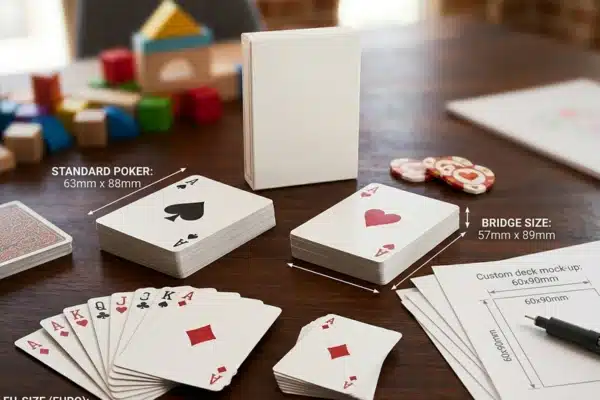
. The only difference between them is that the width influences the ease of fanning. Poker Size ($2.5″ \times 3.5″$): These cards are perfect for games such as Texas Hold’em, Blackjack, and Magic: The Gathering, due to their large surface areas for artwork.
Bridge Size ($2.25″ \times 3.5″$):
Since in Bridge and Canasta games players need to hold numerous cards in their hands at once, the width of these cards is $0.25$ inches smaller.2. Specialty and Niche SizesThere are some special sizes that exist because of certain games’ peculiarities:Tarot Cards ($2.75″ \times 4.75″$):
These are much bigger and have enough space for vertical illustrations needed for Tarot cards.Minimalist Cards ($1.75″ \times 2.5″$):
Used in travel-sized or miniature games or secondary cards for more complex board games, such as “Dungeons & Dragons
.”Square Cards ($2.5″ \times 2.5″$ or $3.5″ \times 3.5″$):
Modern board games increasingly use square cards instead of traditional playing cards.3. European standardsEuropean cards differ from the American ones in terms of size. Usually, this applies to Skat, Quarter games and other specific games:German/French Standard: Usually, these cards are $59 \times 91$ mm in size.
Specialty Game and Oracle Card Dimensions
Dimensions of Specialty Cards and Oracle CardThere are several unique types of cards that come in various dimensions, unlike a standard deck.
Specialty Cards – Magic:
The Gathering (MTG)For example, a highly popular trading game called Magic:
The Gathering is known for its specific back-side printing and high-quality finish. As these cards are used to make personalized designs or wedding favors, it’s vital to know about the exact dimensions. As MTG cards are considered “standard”, then they should be made in poker dimensions, which amount 2.5 x 3.5 inches (fitting into standard sleeves).
Oracle Cards
DifferencesThere is no standard size for Oracle cards; they differ depending on the brand and the designer preferences, depending on how complex the graphics on the card are, or how the deck is meant to feel. The following five are the most typical formats for Oracle cards.
Traditional Oracle Cards
These standard-sized decks will amount the following dimensions – 2.7 x 4.7 inches ($70 \times 120$ mm). As far as boxes for this type are concerned, they will need to be slightly bigger, at least 4.72 x 2.74 x 0.75 inches.
Tall FormatCards that are tall-oriented and vertical will have the following dimensions – 3.5 x 5.7 inches.
Kid’s Playing Card Dimensions
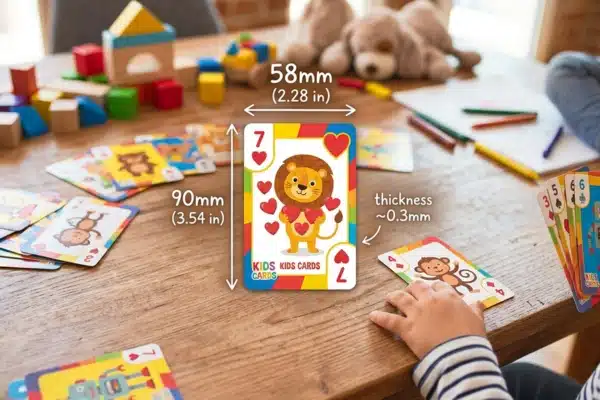
In choosing the sizes of playing cards for children, the usual option is the Bridge card size, which is 2.25 inches by 3.5 inches (57 mm x 89 mm). The Bridge card size is usually selected over the larger Poker card size since its narrow width makes it easier for small hands to hold and fan out the cards. On the other hand, if the playing cards are intended for younger toddlers or for travel purposes, Miniature cards are used. These are normally 1.5 inches by 2.375 inches (38 mm x 60 mm) in size.
Traitors Abroad
The game “Traitors Aboard,” sometimes also known as “Traitors on Board,” is a card-based social deduction game that pits players into two opposing camps of secret identities — Pirates who are loyal and Mutineers who are traitors.
Slap Jack
Slapjack (or sometimes known as Slaps) is a very active and fast-paced card game which is popular among children due to its simple rules and emphasis on reflexes rather than strategy. The traditional form of the game requires a deck of normal playing cards, although there are many child-friendly versions that use specially designed picture cards.
Old Maid
Old Maid is an old and popular card game known as “Matching and Shedding Game.” It is mainly intended to help kids learn the skills of matching patterns, taking turns, and maintaining poker faces by hiding a certain card from the other players.
Crazy 8s
The Crazy Eights game is a very common card game of the shedding genre that forms the basis of modern games such as Uno. The game is extensively applied in educating kids about color and number matching, and even strategy formulation.
Standard Thickness of Cards
While thickness may vary greatly depending on the type and use of playing cards, the average thickness for typical card stock is in the range of 0.25mm to 0.35mm. Of course, while thickness is important, it is usually defined not only by its size but also by its weight – in Grams per Square Meter or simply GSM – with the majority of standard card decks falling within the range of 300-310 GSM. This gives playing cards enough snap or flexibility to return to their former condition after bending due to shuffling while also being thin enough to hold easily in one’s hand.
Card Thickness/Weight:
As a rule, a standard 310 GSM playing card is about 0.30 mm thick; casino cards (330 GSM and above) are a bit thicker and denser.
The Inner Layer:
High-quality playing cards come with an opaque Black/Blue core – a layer of glued paper that gives them additional density and prevents players from viewing through cards in well-lit conditions.
Height of Stack:
The average height for a deck of 52 playing cards should be around 16 mm to 18 mm, a critical parameter when creating custom card packs.
Get Customized Playing Cards to Enhance Visual Appeal
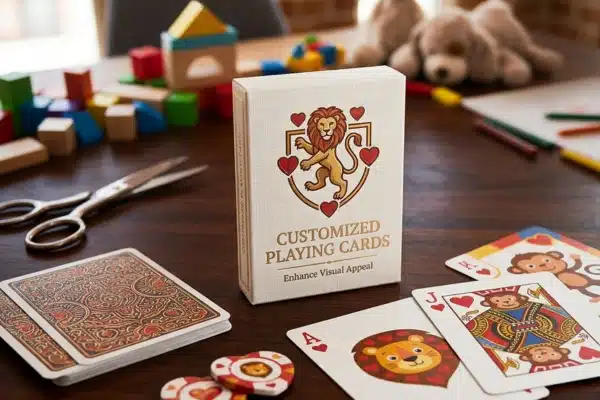
Finishes & Textures
The finish can make or break a professional looking deck. The finish determines the shine and even the feel of the deck.
Linen Finish:
The linen finish creates a crisscrossing texture across the deck. It creates micro air pockets between the cards for a smooth glide (air cushion effect) but gives off the look of a matte finish.
Spot UV:
For a contrasting effect, create a gloss finish only for select parts of the cards (such as logos or a character’s eyes) with a matte background to create an interesting “pop” effect.
Foil Stamp: Gold, silver or holographic stamping to the card back and box edges will instantly transform any regular deck into one that is deemed “premium” or “collector”.
Selecting Colors Wisely
Color plays a very important role in creating visual impact and is often the determining factor in a themed deck.
Four-Color Decks: Not only are these aesthetically pleasing, but they improve gameplay since they help differentiate between suits. In a themed deck, there is the option to incorporate four distinct colors (such as Blue Diamonds, Green Clubs).
Full Bleed Cards: Unlike normal cards which have white borders, full bleed cards extend the image
Choose Accurate Box Size for Your Playing Cards
When picking the best size for your playing cards’ box, you need to consider the technicality involved in making sure that your playing cards are not damaged in any way and ensure a professional experience for the user.
Establishing the Internal Dimensions
To make sure that you have selected the best one for your use, it is advisable that you make the internal dimensions of your box bigger than the size of your playing cards. This means that at least 1mm to 2mm of extra space must exist between your playing cards and your box’s internal dimensions.