
Picking the wrong envelope size is one of those mistakes that feels minor — until it is not. A letter that does not fit without extra folding. A package that costs double to ship. An invitation that arrives bent because the card had too much room to shift around inside. These are real problems, and they all trace back to one thing: not knowing the right dimensions before you order.
This guide covers every standard envelope size used in the United States, plus international formats, postal regulations, and a clear breakdown of which size works for which situation. Whether you are mailing business letters, wedding invitations, product catalogs, or legal documents, you will find exactly what you need here.
Why Envelope Dimensions Matter More Than You Think
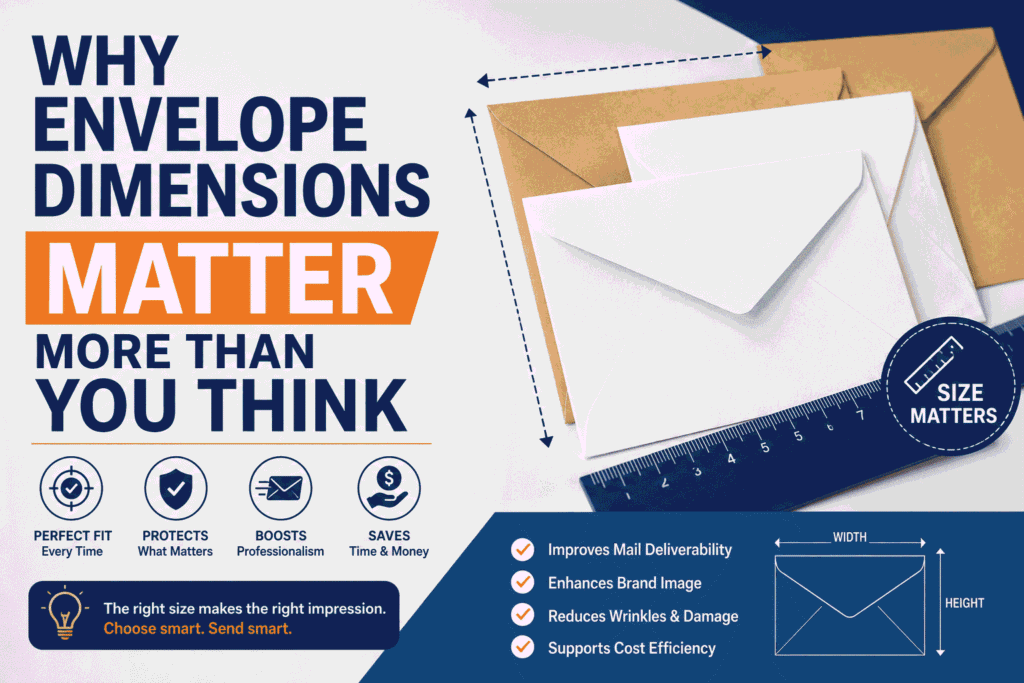
Most people grab whatever envelope is sitting in the desk drawer without giving the size a second thought. That habit works fine for casual mail. For anything professional, promotional, or time-sensitive, it can quietly create real problems.
Here is what envelope size actually affects:
• Postage cost — the USPS charges different rates based on length, height, and thickness. An envelope that falls outside standard letter dimensions can push you into the flat or parcel category, which is noticeably more expensive.
• Machine processing — standard sizes run through automated postal sorting equipment smoothly. Non-standard shapes and sizes get flagged for manual handling, which slows delivery.
• Document fit — when a letter folds too many times to fit an envelope, it looks unprofessional. When it slides around inside an oversized envelope, it can arrive creased or damaged.
How Envelope Dimensions Are Measured
Understanding the industry’s use of envelope measurements can benefit one before entering into specific sizes.
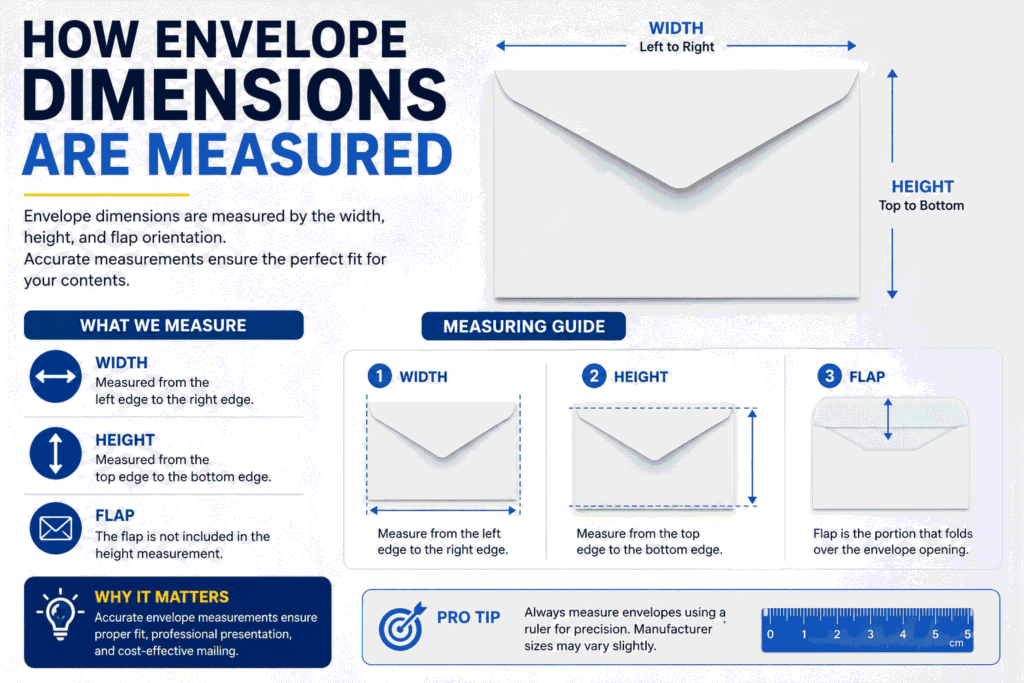
The size of an envelope is always stated in the width and height dimensions. The width is the side measuring horizontally (when the envelope is laid flat, face up and the flap at the top). The length measured from the bottom edge to the base of the flap is called height.
It is applicable to all categories, business, announcement, catalog, and international. Seeing a #10 envelope listed as 4.125 x 9.5 inches means that the envelope is 4.125 inches high and 9.5 inches wide. The width is always the second number, and the height is always the first number.
A quick note on units: measure is usually in inches in the U.S. and in millimeters in Europe and elsewhere. This guide uses both throughout the tables below and can be used for working in either unit your printer, manufacturer, or postal service would prefer to work in.
Business Envelope Sizes
Business envelopes are used for most business-related correspondence, such as bills and statements, contracts, checks, letterhead, and all other office mail. They are machine compatible, widely available and will accept standard 8.5 x 11-inch letter paper.
| Envelope Type | Width x Height (inches) | Millimeters | Best For |
| #10 (Standard) | 4.125 x 9.5″ | 104.8 x 241.3 mm | Business letters, invoices |
| #9 | 3.875 x 8.875″ | 98.4 x 225.4 mm | Reply envelopes |
| #6-3/4 | 3.625 x 6.5″ | 92.1 x 165.1 mm | Personal letters, checks |
| Monarch (#7-3/4) | 3.875 x 7.5″ | 98.4 x 190.5 mm | Letterhead correspondence |
| DL | 4.33 x 8.66″ | 110 x 220 mm | A4 folded in thirds |
10 Envelope: The Default Standard
The #10 is the most widely used envelope in American business. Its 4.125 x 9.5 inch dimensions are designed specifically to hold a standard letter-sized sheet folded into thirds — the fold most people make automatically when putting a letter in an envelope. It works with virtually every desktop printer, fits through standard postal processing, and is sold in bulk at every office supply store.
If you are mailing business letters, invoices, statements, or checks, the #10 is almost certainly the right choice. Window versions are also widely available if you need the recipient address to show through the envelope face.
9 Envelope: For Reply Mail
The #9 is slightly smaller than the #10, which means it fits neatly inside a #10 envelope. This makes it the standard choice for reply mail — inserting a pre-addressed return envelope inside your outgoing correspondence. Charities, subscription services, and businesses that need responses from customers use the #9 for exactly this reason.
The DL Envelope: International Business Standard
The DL envelope (110 x 220 mm) is the dominant business standard outside the United States. It holds an A4 sheet folded in thirds — the international equivalent of what the #10 does for US letter paper. If your business corresponds with partners or clients in Europe, the Middle East, or Asia, you will encounter DL frequently.
Catalog Envelope Sizes
Catalog envelopes are a flat open envelope designed for mailing catalogs that should not be folded. They are used for reports, brochures, product catalogs, annual reports, legal documents, and any marketing items, where presentation is important and it is not acceptable to do some creasing.
| Size | Dimensions (inches) | Millimeters | Use Case |
| 6 x 9 | 6 x 9″ | 152.4 x 228.6 mm | Small catalogs, flyers |
| 9 x 12 | 9 x 12″ | 228.6 x 304.8 mm | Documents, reports |
| 10 x 13 | 10 x 13″ | 254 x 330.2 mm | Large booklets, brochures |
| 10 x 15 | 10 x 15″ | 254 x 381 mm | Oversized documents |
6 x 9: Small Catalog Standard
The 6 x 9 catalog envelope is just the size for small booklets, folded flyers, and promotions that do not require the size of a 9 x 12. It fits in the hands well, but isn’t too small to create an awkward fold.
9 x 12: The Workhorse for Documents
For business, the 9 x 12 size is the most common size used for catalogs. It can hold 8.5 x 11 paper without folding. Legal documents, multi-page reports, presentation materials and press kits ship easily in a 9 x 12. This size is a must for companies that send documents to clients regularly.
10 x 13 and 10 x 15: Large Format
If you have something that’s a little bit bigger than a standard 8.5 x 11 sheet (such as reports bound in a binder, oversized brochures, or printed materials with bleed edges), then you need the 10 x 13 and 10 x 15 sizes. They also come in handy when sending several documents to each other that would exceed the standard size of 9 x 12.
Announcement and A-Style Envelope Sizes
Announcement envelopes (also known as A-style envelopes) are used for greeting cards, cards of invitation, and personal correspondence, and are square-flap envelopes. Their classic design makes them the go-to option for weddings, birthdays, holidays, and beyond when presentation matters, in addition to being clean.
| Size | Dimensions (inches) | Millimeters | Best For |
| A2 | 4.375 x 5.75″ | 111.1 x 146.1 mm | Small invites, thank-you cards |
| A6 | 4.75 x 6.5″ | 120.7 x 165.1 mm | Greeting cards, photos |
| A7 | 5.25 x 7.25″ | 133.4 x 184.2 mm | 5×7 invitations, wedding cards |
| A9 | 5.75 x 8.75″ | 146.1 x 222.3 mm | Large announcements |
| A10 | 6 x 9.5″ | 152.4 x 241.3 mm | Oversized cards |
A2: Compact Cards and RSVPs
The A2 is the standard note card size of 4.25″ x 5.5″ and is often used for RSVP cards, small thank-you notes, and small invitations. This is one of the smaller A sizes, making it an understated look.
A6: Greeting Cards and Photos
The A6 size is 4.5 x 6.25 inches, which is the standard size for greeting cards and 4 x 6 photographs. One of the most versatile sizes for announcement cards which can be used for birthday cards, holiday cards, save the date, and photo mailers.
A7: The Wedding Invitation Standard
A7 is the standard size for wedding invitations, formal party invitations, and 5 x 7 photos. It measures 5.25 x 7.25 inches, which is big enough to accommodate the proper size invitation, plus inner envelopes, tissue and enclosure cards. If you’re planning an event and you want to have printed invitations, you’re almost certainly going to be working with the A7 size stationer.
A9 and A10: Oversized Announcements
The A9 and A10 are used when you need a larger presence — event programs, oversized announcements, or card sets where multiple pieces need to travel together. The A9 fits a 5.5 x 8.5-inch card comfortably, while the A10 handles a 6 x 9.5-inch piece.
International Envelope Sizes
If you need to send mail to other countries or deal with foreign suppliers or manufacturers, it is important to be familiar with ISO envelope standards. The system is based on ISO 216, which states that a C series envelope fits an A series paper exactly.
| Standard | Dimensions (mm) | Dimensions (inches) | Region / Use |
| C4 | 229 x 324 mm | 9.02 x 12.76″ | Europe — unfolded A4 |
| C5 | 162 x 229 mm | 6.38 x 9.02″ | Europe — A4 folded once |
| C6 | 114 x 162 mm | 4.49 x 6.38″ | Europe — A4 folded in quarters |
| DL | 110 x 220 mm | 4.33 x 8.66″ | Global — A4 in thirds |
| B4 | 250 x 353 mm | 9.84 x 13.90″ | Japan — B4 paper |
| B5 | 176 x 250 mm | 6.93 x 9.84″ | Japan — B5 paper |
The C-Series: Europe’s Standard
The C4, C5 and C6 envelopes are intended to fit A4 paper, which is used in most of the world, including Europe and Asia. C4 is holding an unfolded A4 sheet. A4 is folded once into C5. A4 is folded into quarters in C6. The C4 is the right envelope for those mailing documents to European clients that shouldn’t be folded.
DL: The Universal Business Envelope
The DL envelope (110 x 220 mm) is in between the sizes of C5 and C6, and contains an A4 sheet folded in thirds, similar to the US #10. It’s known and accessible worldwide. When you’re looking for one business envelope format that’s good for all countries, it’s the safest choice.
Specialty Envelope Sizes
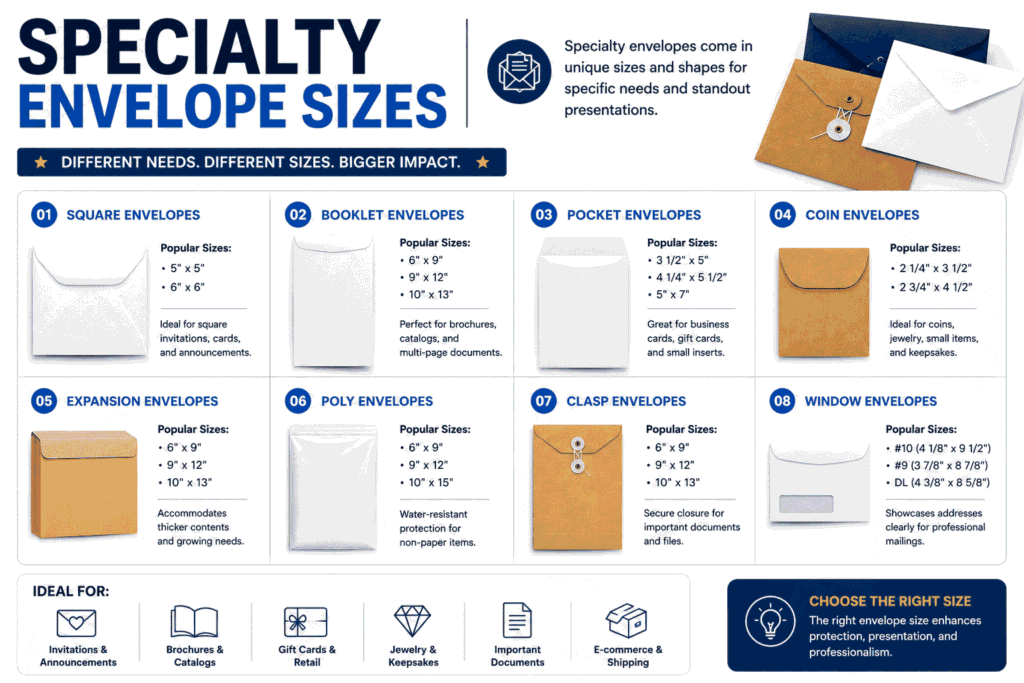
In addition to the usual categories, there are a few mail specialty formats to be familiar with for particular mailings.
Booklet Envelopes
Booklet envelopes open the longest side first, perfect for any booklet, catalog with lots of pages, or things that you don’t want to pull out, but want to slide out of a booklet envelope. They come in sizes from 5 x 7.5 to 9 x 12 inches.
How to Choose the Right Envelope Size
There are many choices to choose from and when determining the right size, it’s all about a few simple questions.
What are you mailing?
The bottom line is whether or not your contents fit without folding too much and without too much room to move while in transportation. Take the measurements of your document, card, or objects and add about an eighth of an inch (1/8″) clearance measurements on all sides. This is the smallest envelope size you can have.
Does it need to be mailed flat?
Documents and printed materials that cannot be folded must be in catalog envelopes or booklet envelopes. Ordinary business or announcement size can be used for letters, personal cards, and correspondence that can be folded.
What is the occasion or purpose?
Business letters are directed to 10, 9, or DL. A7 is used for wedding invitations and formal occasions. Greeting cards are A2 or A6 size. Large document mailings are catalog 9 x 12 or 10 x 13. The presentation is important, and so is the matching of the envelope style with it.
Are you mailing internationally?
If the recipient is outside the United States, consult to determine if C-series or DL sizing is required to conform to the local paper standard. Also, check the postal size restrictions of the destination country because these differ from country to country and can impact the ability to send an envelope without additional fees.
Custom Envelope Sizes: When Standard is Not Enough
Standard sizes handle the majority of mailing needs, but there are legitimate reasons to go custom. A packaging company might want envelopes sized specifically for their product mailers. A luxury brand might need an unusual dimension that stands out in a recipient’s mailbox. A direct mail campaign might use a non-standard size deliberately to grab attention.
Final Thoughts
The size of the envelope is a subtle detail that has a long-lasting effect. The right size safeguards your documents, sets the right content, keeps your postage costs working, and helps your mail run smoothly through the postal system with no problems or surcharges.
This guide includes tables and size breakdowns for all of the most common envelope types, both domestically and internationally. So, whether it’s for business envelopes in bulk, a wedding invitation run, or shipping out product catalogues to customers, you have all the answers to make the right choice — and avoid the common pitfalls of getting the wrong envelope simply because it’s the one you saw first.
Not certain which size will work for the project you have in mind? Call us, and we can help you determine the type of envelope that suits your requirements.