
You’re about to experience the joys of packing a big family meal into a small bag — or handing a customer a single cookie in an oversized bag — and you know what we’re about to say here!
The size of your takeout paper bag can have a major impact on every aspect of your business, from transport to food containment to branding to package costs. This guide explains all sizes, all dimensions, and all the scenarios, so that you can make the right call all the time!
What Is a Takeout Paper Bag?
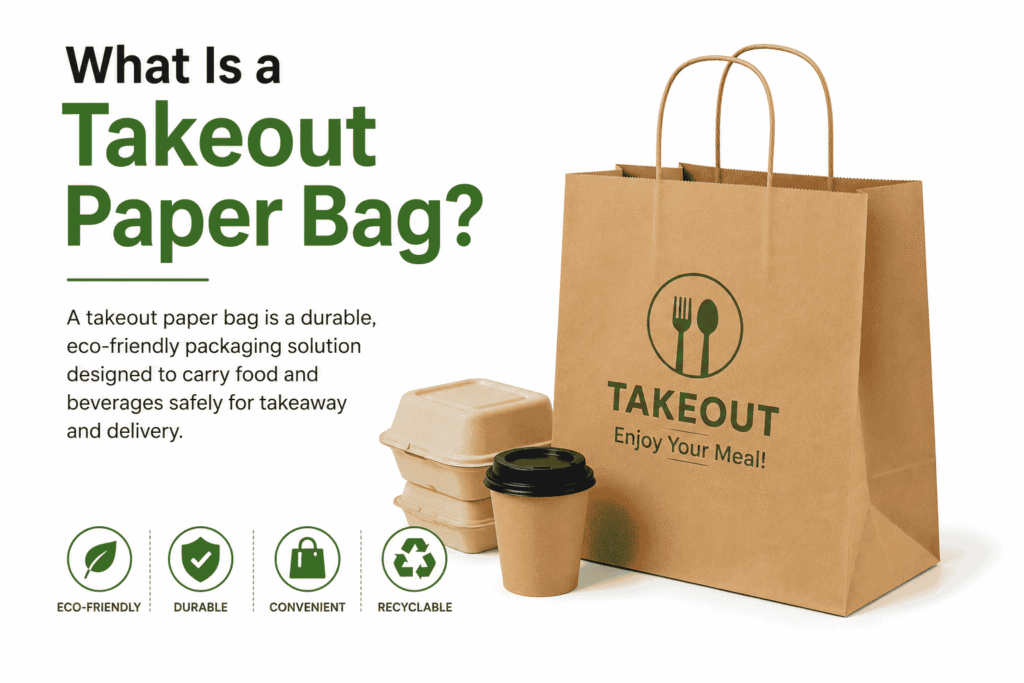
A takeout paper bag is a paper bag designed to store restaurant and café orders safely and neatly, with your brand, for pickup. Take-out bags are designed to withstand the weight of food containers, the heat of hot food, and the inevitable grease that comes from a great meal, unlike a plain retail bag.
Most are made of kraft paper, either natural brown or bleached white, and have either a flat handle (for lighter orders) or a twisted rope handle (for heavier orders). Some have added reinforcing to the bottoms, grease-resistant coatings or gusseted sides to keep everything standing.
The food packaging market is a growing market. The global takeout market size is estimated to be $2,681 billion in 2024 and will surge to $2,936 billion by 2025 with a growth rate of 9.5%. Restaurants also: Your packaging is as important as your food.
How to Measure a Takeout Paper Bag
Before you start looking at sizes, it’s important to understand how bag sizes are measured. Three measurements that are important:
- The horizontal dimension of the front of the bag is when spread out flat.
- Depth (Gusset) — side-to-side expansion fold; this gives a bag its capacity when opened.
- The distance from the bottom of the bag to the top opening.
- Most suppliers will give the size as: Width × Depth × Height (or sometimes Length × Width × Height).
Standard Takeout Paper Bag Sizes (Inches and Centimetres)
Here’s a full reference chart covering the most commonly used sizes across restaurants, cafés, and fast food chains:
| Size | Dimensions (Inches) | Dimensions (CM) | Best For |
| Extra Small | 5″ × 3″ × 8″ | 12.7 × 7.6 × 20.3 | Single pastries, cookies, small snacks |
| Small | 8″ × 4.75″ × 2.5″ | 20.3 × 12.1 × 6.4 | Sandwiches, biscuits, sweets, bread |
| Standard / Medium | 8.25″ × 6.25″ × 3.75″ | 21 × 15.9 × 9.5 | Burgers, wraps, single fast food orders |
| Medium | 10″ × 8″ × 4″ | 25.4 × 20.3 × 10.2 | Combo meals, boxed lunches, pastry sets |
| Large | 12″ × 9″ × 5″ | 30.5 × 22.9 × 12.7 | Family portions, multi-container orders |
| Extra Large | 16″ × 12″ × 5″ | 40.6 × 30.5 × 12.7 | Catering trays, party platters |
| Jumbo | 18″ × 24″ × 12″ | 45.7 × 61 × 30.5 | Bulk catering, large restaurant deliveries |
Takeout Paper Bag Sizes Broken Down
Extra Small & Small Bags (5″–8″ Range)
Small takeout paper bags are ideal for counter service and quick-grab items. You’ll find these at bakeries, coffee shops, and anywhere that sells single portions.
Best for: Croissants, cookies, muffins, cake slices, a single sandwich, small bags of sweets or nuts, and individual beverages.
Why size matters here: Small bags aren’t just about fitting the item — they also help with portion psychology. Research shows that smaller packaging encourages customers to perceive their portion as complete, reducing waste and improving satisfaction.
The compact footprint also keeps items from sliding around. A cookie in a too-big bag arrives looking like it’s been through a tumble dryer.
Standard / Medium Bags (8″–10″ Range)
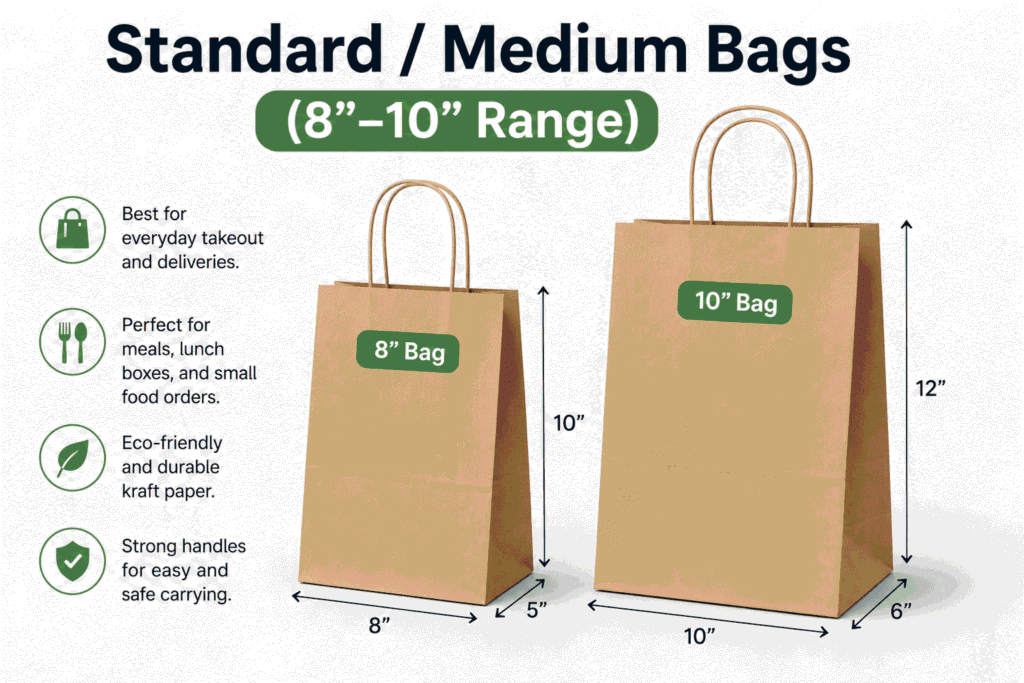
The 8.25″ × 6.25″ × 3.75″ bag is the workhorse of the food service industry. It’s the first thing most fast food chains turn to, and for good reason. It’s big enough for a burger and fries, a sandwich wrapped up, or a couple of donuts — but not so large that it appears the order has been scant.
Worst for: Pizza, salad, pasta, appetizers, sandwiches, and side dishes.
Medium bags will be range of 10″ × 8″ × 4″ for slightly larger orders. Typically, these are the ones you’ll find in deli stores, lunch cafes, and casual restaurants where you usually get a main dish and a side.
Ideal for: Boxed Lunch, Lunch Combo, Salads, medium pastry packs, Macarons, Brownies, Bento Lunch.
The extra gusset depth in this range is what makes a medium-sized bag a good medium bag versus a great medium bag. If the container doesn’t have gusseted sides, it will not hold up, and sauces will migrate.
Large Bags (12″–16″ Range)
Takeout bags are large enough to accommodate multiple orders. A large bag holds everything together, it’s easy to take with you, and it’s properly supported, if somebody is buying a dinner for two, or the office is ordering in.
Best for: Full family meals, 2 or more food containers, Pizza slices, Fried chicken orders, Sushi sets, Steaks, Salads in larger containers.
A 12″ × 9″ × 5″ bag will generally fit two medium food containers side by side, and a 16″ × 12″ × 5″ bag will easily hold catering-sized food containers!
If you’re serving food that can be delivered out, it’s vital that it comes in large bags with reinforced bottoms. A square base helps prevent containers from tipping and reduces complaints of mess and improves review scores!
Extra Large & Jumbo Bags (16″+)
These are built for catering, group orders, and anything that won’t fit in the standard lineup. Many suppliers offer custom dimensions in this range, so you’re not locked into a fixed size.
Best for: Catering trays, family meal bundles, party platters, restaurant-to-event delivery, bulk baked goods.
Jumbo bags (like the 18″ × 24″ × 12″ format) are often reinforced with thicker paper walls and stronger seams. They can hold more than 10 kg when made from quality kraft stock. If you’re regularly dispatching large orders, investing in heavy-duty handles — twisted rope rather than flat paper — is worth it.
How to Measure Your Food Items Before Ordering Bags
Getting the sizing wrong on a bulk order is expensive. Here’s a simple process to measure before you commit:
- Measure your containers — Take the widest point (usually with the lid on) and note length, width, and height.
- Add 1–2 inches of clearance — This is the breathing room that lets you pack and unpack cleanly.
- Consider stacking — If you pack multiple containers in one bag, measure the combined height and width when stacked or placed side by side.
- Test before you order in bulk — Ask your supplier for samples. Pack your most common order and check for stability, fit, and weight distribution.
- Check handle type — For heavier orders (over 2 kg), twisted rope handles are far more reliable than flat paper ones.
Material Matters as Much as Size
Even a perfectly sized bag fails if the material can’t handle the food inside. Here’s a quick breakdown of common paper bag materials:
| Material | GSM Range | Best For | Notes |
| Natural Kraft Paper | 70–100 gsm | Most takeout orders | Biodegradable, strong, earthy look |
| White Kraft Paper | 70–100 gsm | Premium branding, colorful printing | Same strength as brown, cleaner appearance |
| Greaseproof / Coated Paper | 80–120 gsm | Saucy, oily, or fried foods | Prevents leaks, not always recyclable |
| Recycled Kraft | 70–90 gsm | Eco-conscious brands | Good for lighter loads; check weight limits |
| Bagasse Paper | Varies | Compostable packaging | Made from sugarcane pulp, fast to biodegrade |
Gusseted vs. Non-Gusseted Bags: What’s the Difference?
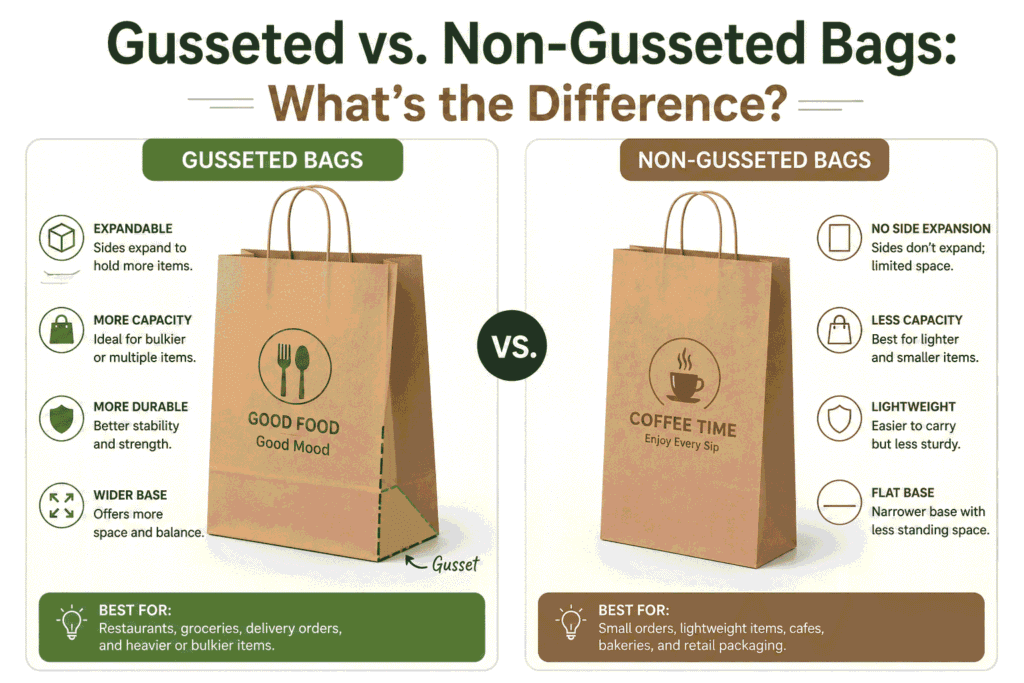
A gusset is the folded side panel that allows the bag to expand when open. It’s one of the most overlooked details when choosing takeout bags.
Gusseted bags:
- Open wider when loaded, so containers sit flat and stable
- Hold bulkier or irregularly shaped items with ease
- Are less likely to tip over during transport
- Work better for multi-container orders
Non-gusseted (flat) bags:
- Better for thin, flat items like bread, wraps, or single sandwiches
- Lighter and cheaper to produce
- Less useful for anything with volume or an awkward shape
The Branding Opportunity You Might Be Missing
Fact: 60% of restaurants are still using paper bags, and each paper bag is an advertisement as it leaves the door.
A bag with your logo, your colours, and a clean design not only protects your food, but it does more. It ensures your brand sticks in the customer’s mind, communicates quality and leaves a positive impression on everyone who sees it while it’s in motion.
The simplest of the designs is generally the best: a logo and restaurant name stamped clearly on a kraft bag in one colour. Simple, concise and memorable.
In general, there’s a minimum order quantity to purchase branded bags. Big restaurants tend to buy in bulk for the sake of reducing per-unit costs. If you are a small business, you can find suppliers that can provide you with a lower minimum, but the price per bag will be higher.
Eco-Friendly Options: What to Consider
Sustainability is far from a passing fad. The eco-friendly food packaging market has been growing at 8.2% CAGR, and business practices which make an eco-friendly decision are highly noticeable to the consumers.
Options to consider:
- Industrial Wastes: 100% recycled kraft paper – widely recyclable; made from post-consumer waste
- FSC certified paper – From responsibly managed forests
- Bagasse bags are made of sugarcane fibre and are compostable and fast biodegradable.
- Compostable liners — For greasy foods without the negative environmental impact of plastic liners
Common Mistakes When Choosing Takeout Bag Sizes
Using one size for everything. It seems efficient until a small cookie gets lost in a family-meal bag, or a full dinner order bursts out of a medium. Stock two to three sizes and match them to your menu categories.
Forgetting the gusset when measuring. A bag listed as 10″ wide might only be practical for items up to 8″ wide without the gusset. Always check expanded dimensions, not flat ones.
Ignoring weight limits. Paper has limits. Heavy orders — bottles, multiple containers, dense food — need thicker paper (80–100 gsm minimum) and reinforced handles. Test before you’re committed to 5,000 units.
Confusing dimension order. Some suppliers list W × D × H, others use L × W × H. A mix-up here means bags that are the wrong shape entirely. Always confirm the format in writing.
Skipping samples. This is the most expensive mistake. Always request samples before bulk ordering. Pack your actual products, carry the bag, and simulate the journey your food takes.
Final Word
Choosing the correct takeout paper bag size isn’t something that you could easily overlook; it’s a part of the customer experience. A well-fitting bag keeps food safe, adds to your professional image, and conveys to your customer that you care about the entire experience – not what you’re putting on the plate.
If you’re considering purchasing a bulk quantity, begin by measuring your most used containers, adding your clearance, and then testing before you make the final purchase. Use the proper material and type of handle for your food weight, and don’t overlook the value of a clean, branded design.
If you don’t know where to begin, give us a call — we will gladly help you determine the best size and type of menu for you.