
Introduction
If you’ve ever ordered custom packaging or tried to ship a product and found yourself staring at a blank order form asking for “L × W × H,” you’re not alone. Box dimensions seem simple — three numbers — but getting them wrong costs money, causes damaged products, and creates headaches at the shipping counter.
Whether you’re a small business owner ordering custom boxes for the first time, an e-commerce seller trying to cut down on DIM weight charges, or someone packing up a house for a move, this guide covers everything you need to know about box dimensions: what the measurements mean, how to take them accurately, the standard sizes used across the industry, and how dimensions affect your bottom line.
What Are Box Dimensions?
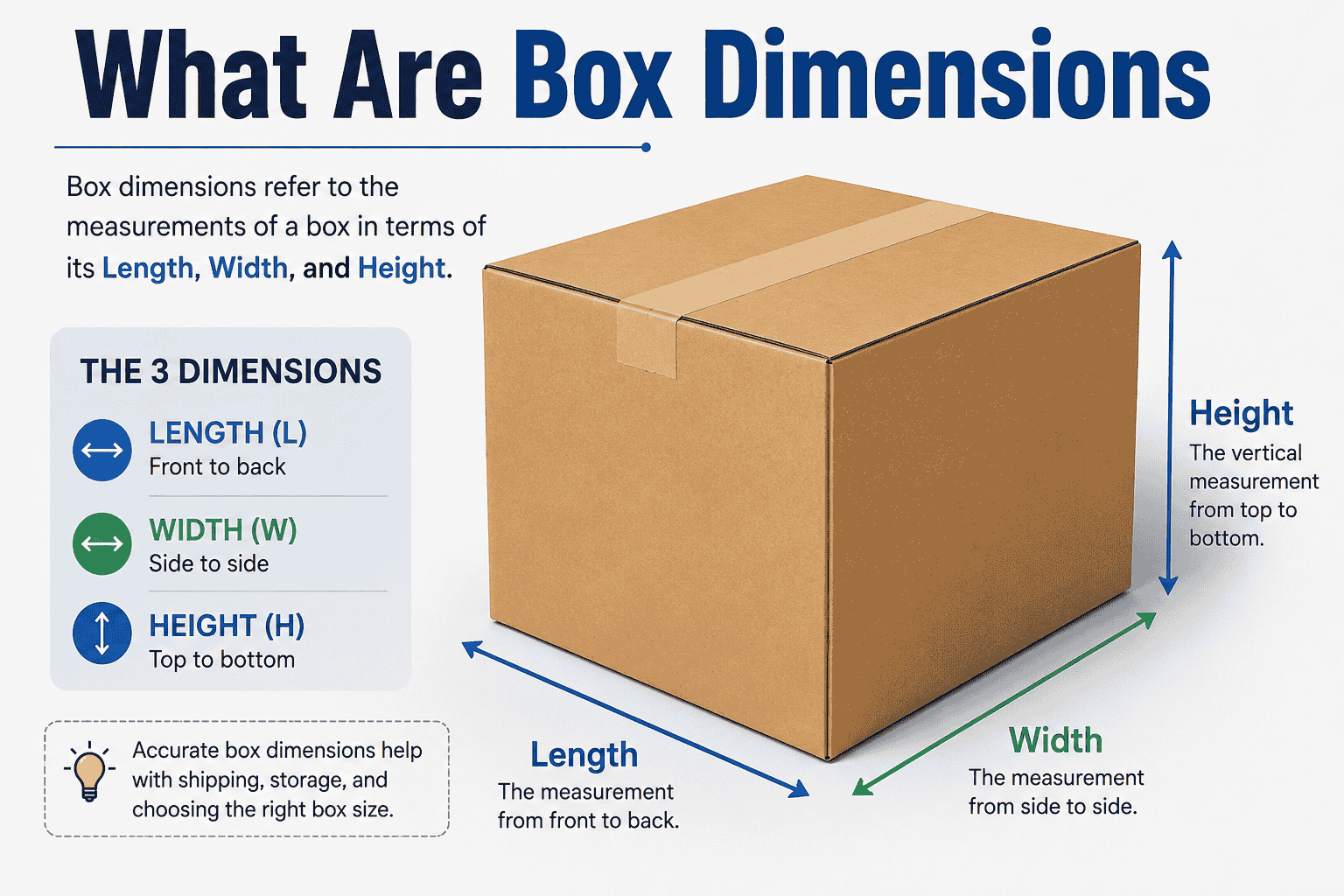
Box dimensions are the length, width, and height (also known as depth) of a box. These three numbers give you the size of a box and its capacity.
All boxes are accepted in the following format:
Length × Width × Height (L × W × H)
Therefore, if you spot a box that is given as 16 x 12 x 8 inches, it indicates:
- Length: 16 inches
- Width: 12 inches
- Height: 8 inches
It is the same format for all manufacturers, carriers such as FedEx and UPS, and warehouses all over the world. Its purpose is to remove ambiguity and to make sure that everyone, from the order taker to the factory that cuts the corrugated board, is referring to the same measurements.
Inner vs. Outer Box Dimensions: Why Both Matter
This is where a lot of first-time buyers get tripped up. A box has two sets of measurements:
Inner (interior) dimensions — the usable space inside the box. This is what actually matters for fitting your product. When you specify dimensions for custom packaging, inner dimensions are almost always what you want.
Outer (exterior) dimensions — the total size of the box, including the cardboard walls. These are used by shipping carriers to calculate dimensional weight and by warehouses for stacking and storage planning.
For standard single-wall corrugated cardboard, the difference between inner and outer dimensions is typically 3–5 mm (about ⅛ inch) per wall. That gap might seem tiny, but it adds up on all six sides. If you’re designing a box for a snug-fit product — think cosmetics packaging or a rigid gift box — you need to account for that wall thickness precisely.
Rule of thumb: When ordering custom boxes to fit a specific product, always measure your product and specify inner dimensions to your packaging supplier.
How to Measure Box Dimensions: Step-by-Step
You don’t require special equipment. Most boxes can be easily measured with a basic tape measure or ruler. Here’s how to do it right…EVERY TIME!
What You’ll Need
- A flexible tape measure (for large or irregularly shaped boxes)
- A ruler (small boxes or exact measurements)
- A pen and a notepad
- A level surface on which to place the box
What is the length?STEP 1: What is the length?
Rest the box on a horizontal surface so that the box opening is facing upward. Measure the longest side of the opening (this is your ‘length’). Extend the tape from one end to the other and write the number down.
Now measure the Width. Now measure the width (Step 2).
Turn the tape 90° and measure the smaller dimension of the opening, that is, the width. It extends from the front of the box to the rear of the box.
The height is measured in Step 3.
Place the box on its side, stand the tape measure up, and measure from bottom to top. For boxes with flaps, measure the height of the box with the flaps closed (or folded flat).
Standard Box Sizes: A Reference Chart

Most packaging suppliers and carriers work with a range of standard box sizes. These sizes exist because they cover the most common product types, stack efficiently on pallets, and fit standard storage shelves without wasted space.
Here are the most frequently used sizes and their typical applications:
| Box Size (L × W × H in inches) | Common Use Cases |
| 6 × 4 × 3 | Jewelry, cosmetics, small electronics accessories |
| 8 × 6 × 4 | Small books, handmade crafts, mugs |
| 8 × 8 × 8 | Compact cube items, small gifts needing cushioning |
| 10 × 8 × 6 | Candles, paperback books, small clothing items |
| 12 × 9 × 6 | Medium electronics, bundled items |
| 12 × 12 × 6 | Apparel, flat household goods, medium electronics |
| 12 × 12 × 12 | Shoes, small appliances, kitchen items — one of the most versatile sizes |
| 16 × 12 × 8 | Bulk orders, mid-size retail products |
| 18 × 14 × 12 | Medium-to-large e-commerce shipments |
| 20 × 16 × 12 | Larger household items, clothing bundles |
| 20 × 20 × 15 | Large retail items, premium gift sets |
| 24 × 18 × 18 | Large domestic shipments, appliances |
Small, Medium, and Large: How Box Categories Break Down
Small Boxes (up to 12 × 12 × 12 inches)
Small boxes are the workhorses of e-commerce. They’re used for everything from jewelry and cosmetics to small electronics. The most common small sizes are 6 × 6 × 6, 8 × 6 × 4, and 10 × 7 × 4 inches.
If you sell lightweight, compact products through an online store, small box sizes are where you’ll spend most of your time — and where getting dimensions right matters most for DIM weight calculations.
Medium Boxes (12 × 12 × 6 to 18 × 14 × 12 inches)
Medium boxes handle a huge range of products: clothing, books, small kitchen appliances, bundled goods, and subscription box assortments. The 12 × 12 × 12 cube and 16 × 12 × 8 rectangle are the most versatile sizes in this range.
Large Boxes (18 × 18 × 16 inches and up)
Large boxes are used for bulkier products, multi-unit retail shipments, and moving. The 18 × 18 × 16 is often cited as the most versatile large box size across industries. Beyond that, you’re typically looking at freight or pallet shipping rather than standard parcel carriers.
How Box Dimensions Affect Shipping Costs
This is the part that directly hits your budget, so pay close attention.
Dimensional Weight (DIM Weight)
Most major carriers — UPS, FedEx, DHL — don’t just charge by how heavy your package is. They charge by whichever is greater: actual weight or dimensional weight.
Dimensional weight is calculated using the box’s volume:
DIM Weight = (L × W × H) ÷ DIM Divisor
- UPS and FedEx use a DIM divisor of 139 (for inches)
- USPS uses a divisor of 166
So a box measuring 16 × 12 × 8 inches has a volume of 1,536 cubic inches. Divide by 139 and you get a DIM weight of approximately 11 lbs. If your actual product weighs 4 lbs, you’ll still be billed for 11 lbs.
The takeaway: Choosing a box that’s even 1–2 inches smaller on each dimension can meaningfully reduce your shipping cost per package. Over hundreds or thousands of shipments, that adds up fast.
Carrier Rounding Rules
As of 2025, UPS and FedEx round fractional measurements up to the next whole inch. A box that measures 12.3 × 9.7 × 4.2 inches bills as 13 × 10 × 5 inches. Always factor this into your size selection.
Inner Dimensions: How to Choose the Right Size for Your Product
When selecting or ordering a box for a specific product, follow these steps:
- Measure your product — length, width, and height at its widest points.
- Add cushioning allowance — for most products, add 1–2 inches on each dimension to leave room for bubble wrap, foam inserts, or packing paper. Fragile items may need more.
- Match to the closest standard size — find the smallest standard box that accommodates your product plus cushioning.
- Check DIM weight — calculate the DIM weight of that box size against your carriers’ divisors before placing a bulk order.
Special Considerations for Different Box Types
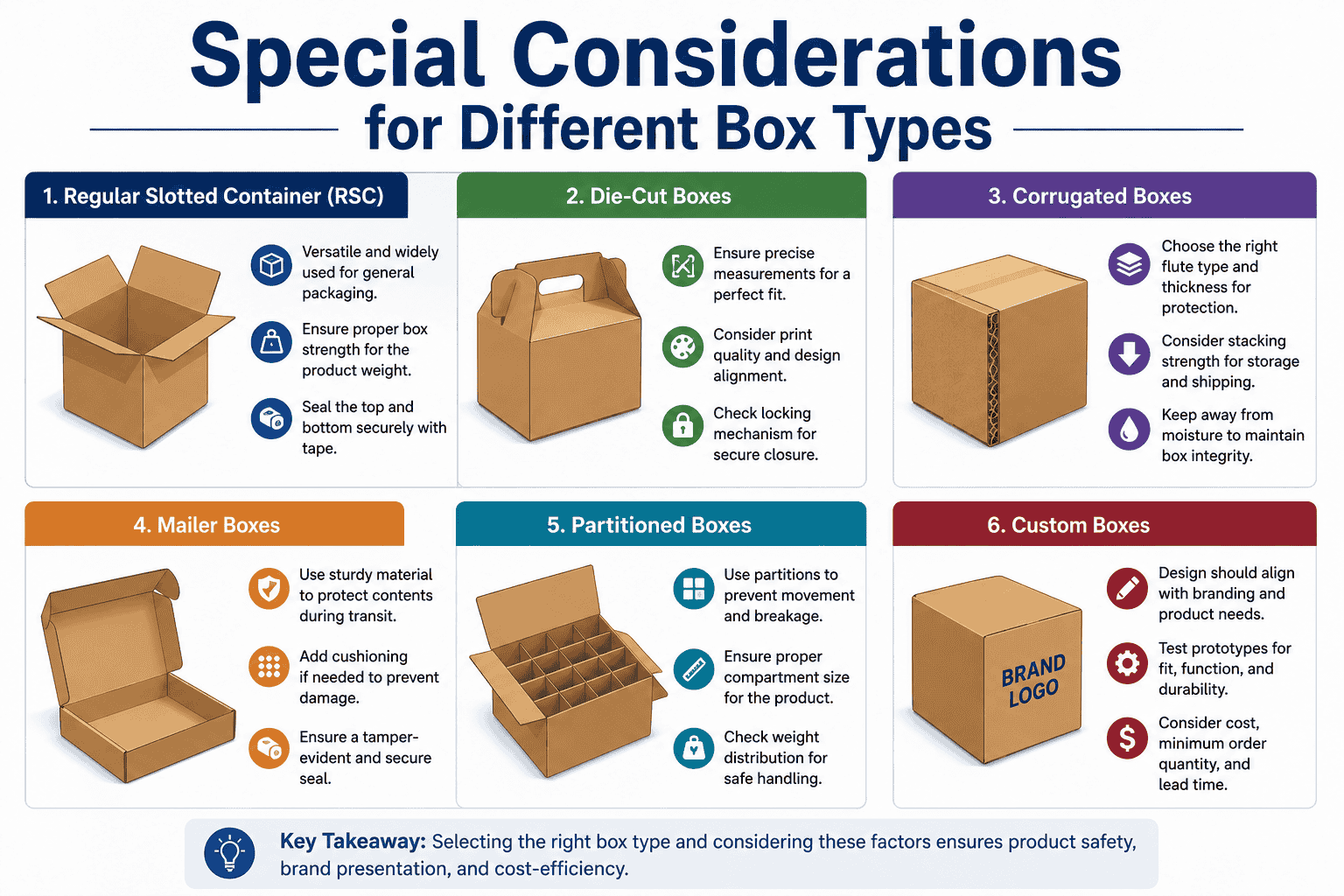
Mailer Boxes
Mailer boxes (the lid and tray boxes used in subscription boxes and high-end e-commerce) are sized by the same unit — L × W × H — but the height is often also a measurement of the depth of the box when it is closed, not just the depth of the box.
Corrugated shipping boxes (RSC).
The most popular shipping box shape is Regular Slotted Containers. When the flaps are closed, they join in the middle. In industry convention, dimensions are always taken on the inside.
Rigid Boxes
Rigid boxes (luxury packaging) have much thicker walls than corrugated. This is particularly important as the difference between inner and outer dimensions may be up to ¼ – ½” per wall!
Moving Boxes
Instead, standard moving boxes are named as follows: small (1.5 cubic feet), medium (3 cubic feet), large (4.5 cubic feet), and extra large (6+ cubic feet). Common sizes include 16 × 12 × 12 for small and 18 × 18 × 16 for medium/large.
Final Thoughts
Determining the dimensions of the boxes isn’t glamorous, but it is one of the most practical ways to help preserve your products, minimize waste, and manage shipping costs. There’s a reason for the standard L × W × H format: it helped to establish a common language between businesses, manufacturers, and carriers that would remove the ambiguity.
Measure carefully. Determine inner or outer dimensions. Select the smallest size box that can contain the product safely, using the right amount of cushioning. Be sure to check your DIM weight first before making a large purchase.