Introduction
Your beauty product might be extraordinary. But if the packaging doesn’t communicate that before a customer opens it, you’ve already lost half the battle.
In a category where consumers make purchase decisions within seconds — at a retail shelf, on an e-commerce listing, or when they receive a delivery — packaging boxes are doing enormous commercial work. They protect your product, carry your brand identity, drive impulse purchases, and create the unboxing experience that generates social shares and repeat orders.
The problem is that most beauty brands either default to whatever’s cheapest or try to copy what bigger brands are doing without understanding why those styles work for those products.
The Two Layers of Beauty Packaging You Need to Design
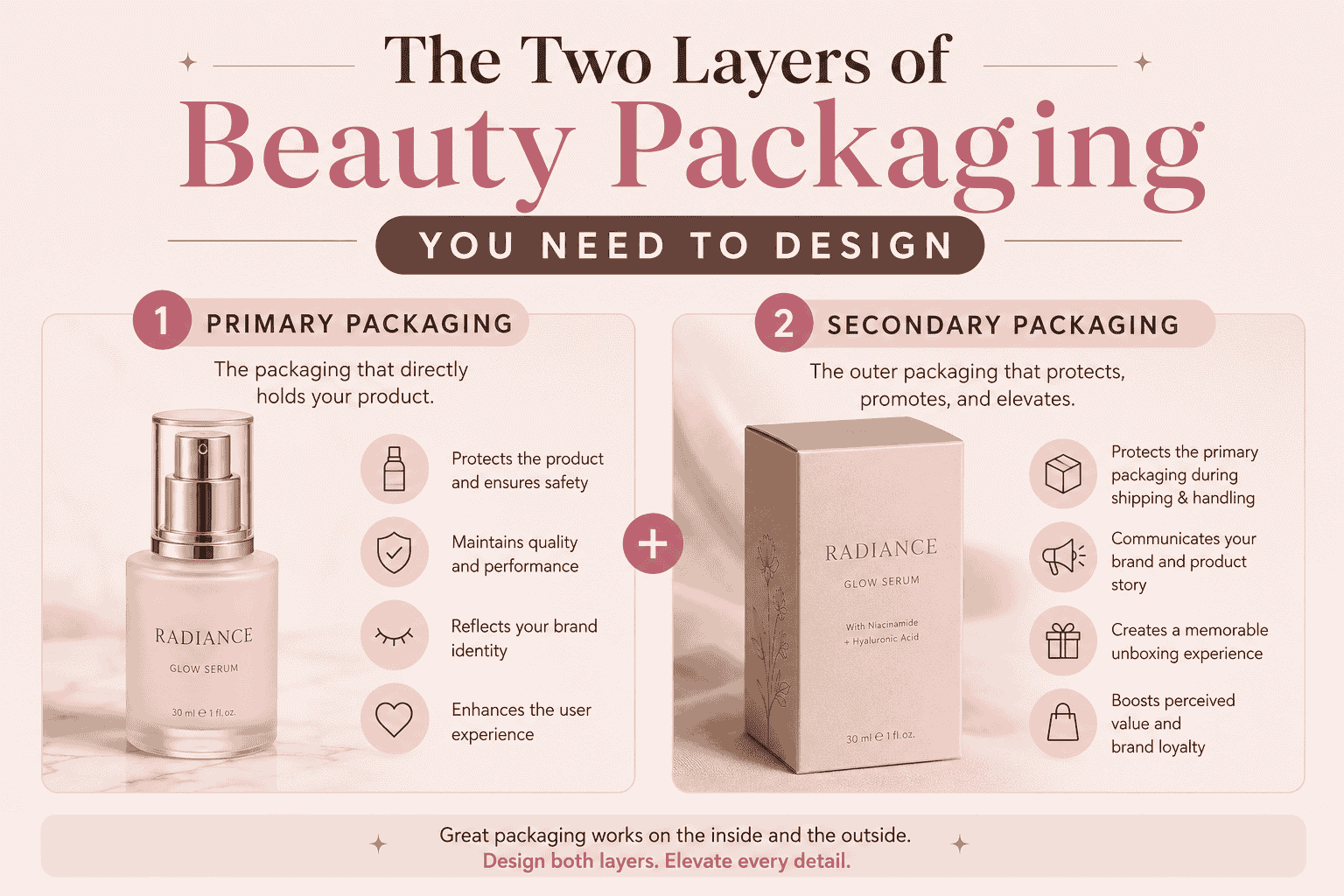
Before choosing a box style, it’s important to understand the two packaging layers in beauty:
Primary packaging is the container that directly holds the product — the glass bottle, the jar, the compact, the tube. This is what the consumer actually uses.
Secondary packaging is the box that contains and presents the primary package. This is what most people mean when they say “beauty packaging boxes.” It’s what sits on the retail shelf, goes into a subscription box, or arrives in the mail.
Both matter, but this guide focuses on secondary packaging box styles — because that’s where your biggest opportunity to differentiate lies, and where most brands make their most costly mistakes.
10 Packaging Box Styles for Beauty Products
1. Rigid Two-Piece Boxes (Base and Lid)
What it does: A heavy-duty box with a separate, removable lid. Also known as “set-up box” or “luxury rigid box.
Ideal for: Luxury skin care, high quality serums, gift industry, perfumes, high quality cosmetic collections.
For what reasons beauty brands opt for it: Rigid boxes are considered the benchmark for luxury positioning. The box’s weight and construction are clues to quality, before the box has been opened. Brands such as La Mer, Charlotte Tilbury and Dior choose to use rigid box packaging because of its ability to enhance the value of the products.
2. Magnetic Closure Rigid Boxes
What it is not: A box that isn’t magnetic. A modified version of the two-piece rigid box.
Ideal uses: Luxury gift packages, collectible gift editions, cosmetic packs for skincare, cosmetic refill packaging.
Why brands make use of it: The satisfying magnetic snap that provides a tactile moment and enhances the premium quality. These boxes also promote re-use — customers keep them on their vanities so you can continue to market your brand after they buy it.
3. Tuck-End Boxes (Straight Tuck and Reverse Tuck)
What it does: It’s a box that looks like a single piece of paperboard, with flaps at the top and bottom that fold inwards to seal it. The most popular box design in the beauty industry.
Ideal for: Lipsticks, mascara, foundations, eyeshadows, single skin care products, serums, creams.
Two main styles:
- Straight tuck-end: Both flaps tuck in the same direction (front to back). This provides a clean and seamless appearance on the front panel which is perfect for retail use.
- Reverse tuck-end: Top tuck end is tucked backwards and bottom tuck end is tucked forwards. It’s a little easier to open and close, well suited for products the consumer opens regularly.
4. Sleeve and Tray Boxes (Slider Boxes)
What it does: It is a two-part piece, comprising a fitted outer tube that slides over an inner tray. The product is in the tray, and the sleeve is pulled out (or slides out) to show the product.
Ideal for: Makeup palettes, gift sets for skin care products, perfume, quality lip products, foundation compacts.
Why brands use it: The sliding reveal effect is a great moment of discovery for the user. When the sleeve is removed, the product is readily noticed and wonderfully displayed in the tray. This is great content for unboxing videos.
5. Window Boxes (Die-Cut Window Packaging)
A tuck end or other folded box with a custom die-cut opening, which has a transparent PET film placed over it, and the product inside visible through the film.
Ideal for: Cosmetic products such as skin care products, nail polishes, lip glosses, eyeshadow compacts, bath products, and more, all packaged in an appealing way.
Their appeal to beauty brands: In a retail setting, the ability to view a product before opening it greatly boosts the customer’s confidence and intent to buy. Window boxes are also a way to have the product’s main packaging (the glossy color of a lip gloss, the texture of a soap) “sell” the product.
6. Clear Boxes (Transparent PET or PVC Boxes)
It is a clear box which can be viewed from all directions, and it can be constructed of PET (polyethylene terephthalate) or PVC (polyvinyl chloride).
Ideal for: Soaps, bath bombs, candles, perfume bottles, gift items, and accessories.
Why beauty brands opt for it: Maximum product visibility while using a minimum of packaging. Boxes allow a beautiful product or a decorative item (such as a soap in a unique form, a candle with multiple colours) to be the star of the show.
7. Pillow Boxes
It is a box that is made from a single sheet of paperboard or kraft paper folded into an oval cross-section, generally closed at the open ends with tuck-in flaps.
Ideal for: small jewelry, sample-sized beauty products, travel accessories, gift inserts, hair accessories.
Why beauty brands love it: Pillow boxes are affordable, unique, and light. They look great on a shelf or gift table due to their shape. They are widely used for sample programs, gift with purchase, and influencer PR packages.
8. Lid Boxes (Hinged-Lid Boxes)
What it is: A “book” or “chest” that has a rigid lid. May have a rib or stopper inside to keep the lid standing up.
Ideal for: luxurious skin care packages, perfumes, beauty kits, gift boxes.
So, why have beauty brands selected it: The standout feature of the box is its hinged lid, which allows it to open up in a dramatic way — the lid pops up to expose the product, without needing to remove the lid from the box. It helps create a sense of intentionality and elevation in the unboxing. The lid does not detach, as it’s practical for consumers who want to re-close and store the product.
Things to consider: The hinged-lid boxes involve more complicated manufacturing than a two-piece lid and base box. Costs are comparable to the high-end rigid boxes. The placement of the spine must be built into the structural design from the beginning.
9. Shoulder-Neck Boxes
What it is: A three-part design featuring a base (shoulder), inner collar (neck), and lid. The neck piece has been glued in the shoulder to be seen above the edge with the lid closed.
Ideal for: Ultra-premium skin care, prestige fragrances, collectible cosmetics, and gift packaging.
Why beauty companies select it: The obvious collar around the rim offers a clear visual detail that instantly identifies top-tier. It is not possible to reproduce this feature with simpler box structures, as the product is framed by the collar when the lid is opened.
10. Gable Boxes
What it is: A box with a built-in carrying handle, created from the top panels of the box folding into a peaked gable shape, similar to the classic barn or house roof.
Ideal for: Gift sets, subscription boxes, travel kits, holiday collections, PR boxes.
Why it is a popular choice for beauty brands: Gable boxes are already gift ready, thanks to the built-in handle, so there’s no need to add a ribbon or carrier bag. They are attention-catching and unusual when it comes to the beauty industry, helping them to stand out in retail displays or as gift packaging for celebratory events.
Packaging Materials for Beauty Boxes: What You Need to Know
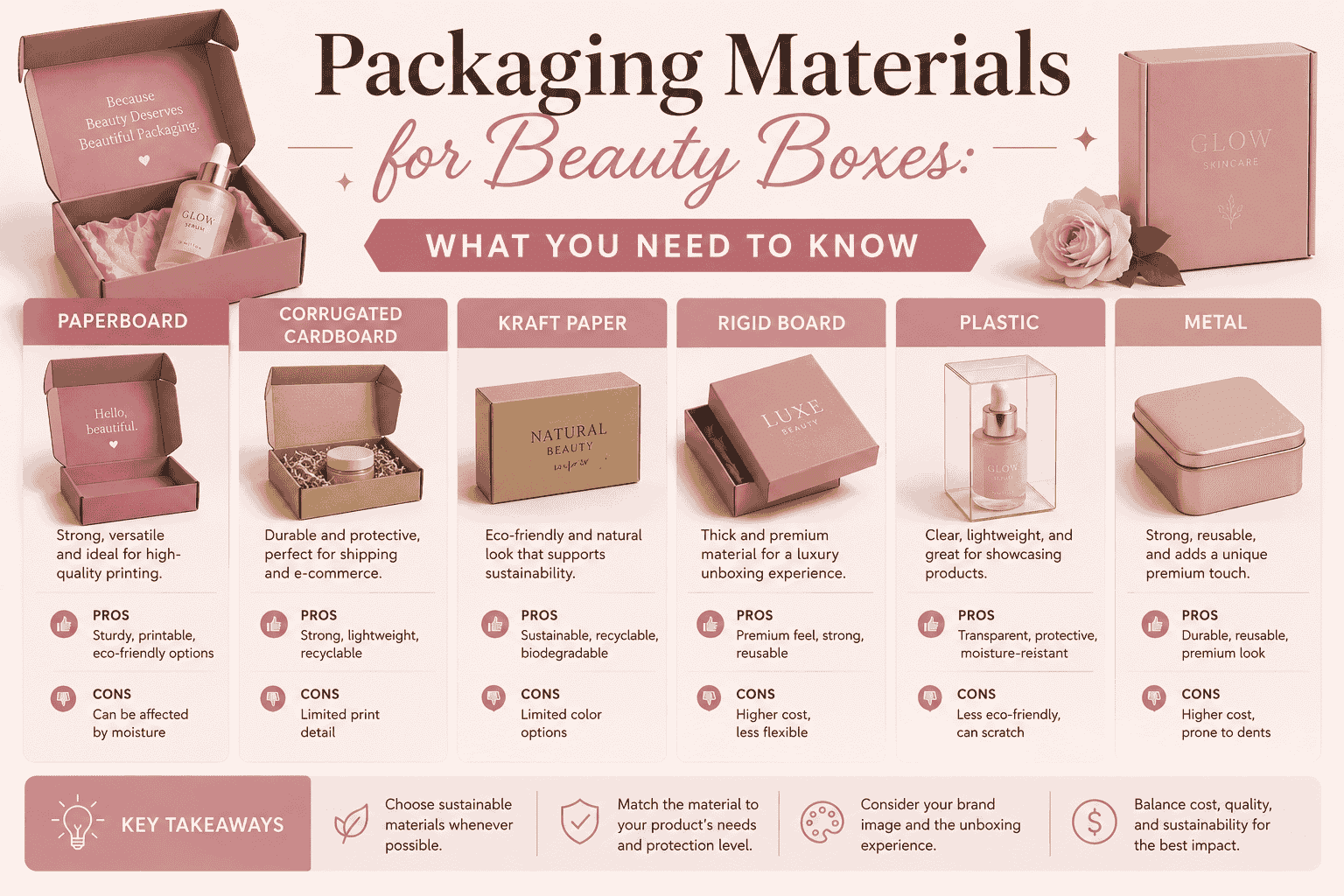
The box style is only half the equation. The material determines how your packaging feels, how well it prints, and how structurally protective it is.
Paperboard (SBS — Solid Bleached Sulfate)
The most common material for folding cartons. Bright white, smooth surface, excellent print quality. Best for: tuck-end boxes, window boxes, most retail beauty packaging.
Kraft Board
Unbleached, brown, natural-looking. Strong eco brand associations. Best for: natural, organic, or sustainable beauty brands. Prints well in earthy tones; bright colors appear slightly muted.
Rigid Chipboard (Greyboard)
Dense, heavy board used in rigid and luxury boxes. Wrapped in a separate outer material (paper, fabric, leatherette). Best for: luxury rigid boxes, magnetic closure boxes, lid-and-base structures.
Corrugated Board
Fluted middle layer between two flat layers — the most protective material. Best for: outer shipping boxes, mailer boxes, subscription kits. Not typically used for retail shelf packaging.
PET / Clear Board
Fully transparent plastic sheet. Best for: clear boxes, window panels.
Sustainable Packaging Choices for Beauty Brands
Consumer expectations around sustainability are now a major factor in beauty packaging decisions. Practical steps:
Choose recyclable materials — SBS paperboard, kraft, and corrugated are all widely recyclable. Avoid laminates that can’t be separated from the paperboard (though many water-based laminates now are recyclable).
Use FSC-certified board — Forest Stewardship Council certification is a recognized signal to eco-conscious consumers that your packaging materials come from responsibly managed forests.
Right-size your packaging — Oversized boxes for small products are a waste signal that now actively damages brand perception among eco-aware consumers. Boxes that fit their products precisely look better and communicate sustainability without saying a word.
Consider molded pulp inserts — Replacing foam or plastic inserts with molded paper pulp maintains protection while being both biodegradable and recyclable.
Soy-based inks — A straightforward switch from petroleum-based inks that appeals to natural beauty brand positioning.