
Introduction
Choosing the right packaging for mailing clothing is one of the most important decisions you’ll make as an online seller, boutique owner, or fulfillment business. Pick the wrong option and you risk damaged goods, unhappy customers, sky-high shipping costs, and a brand that looks careless.
But here’s the good news: once you understand your options, matching the right packaging to the right clothing type becomes straightforward.
In this guide, we break down every major packaging option for shipping clothes — what it is, when to use it, what it costs, and how to customize it for your brand. Whether you’re mailing a single lightweight t-shirt or a set of premium wedding garments, you’ll find the right answer here.
The 6 Best Packaging Options for Mailing Clothing
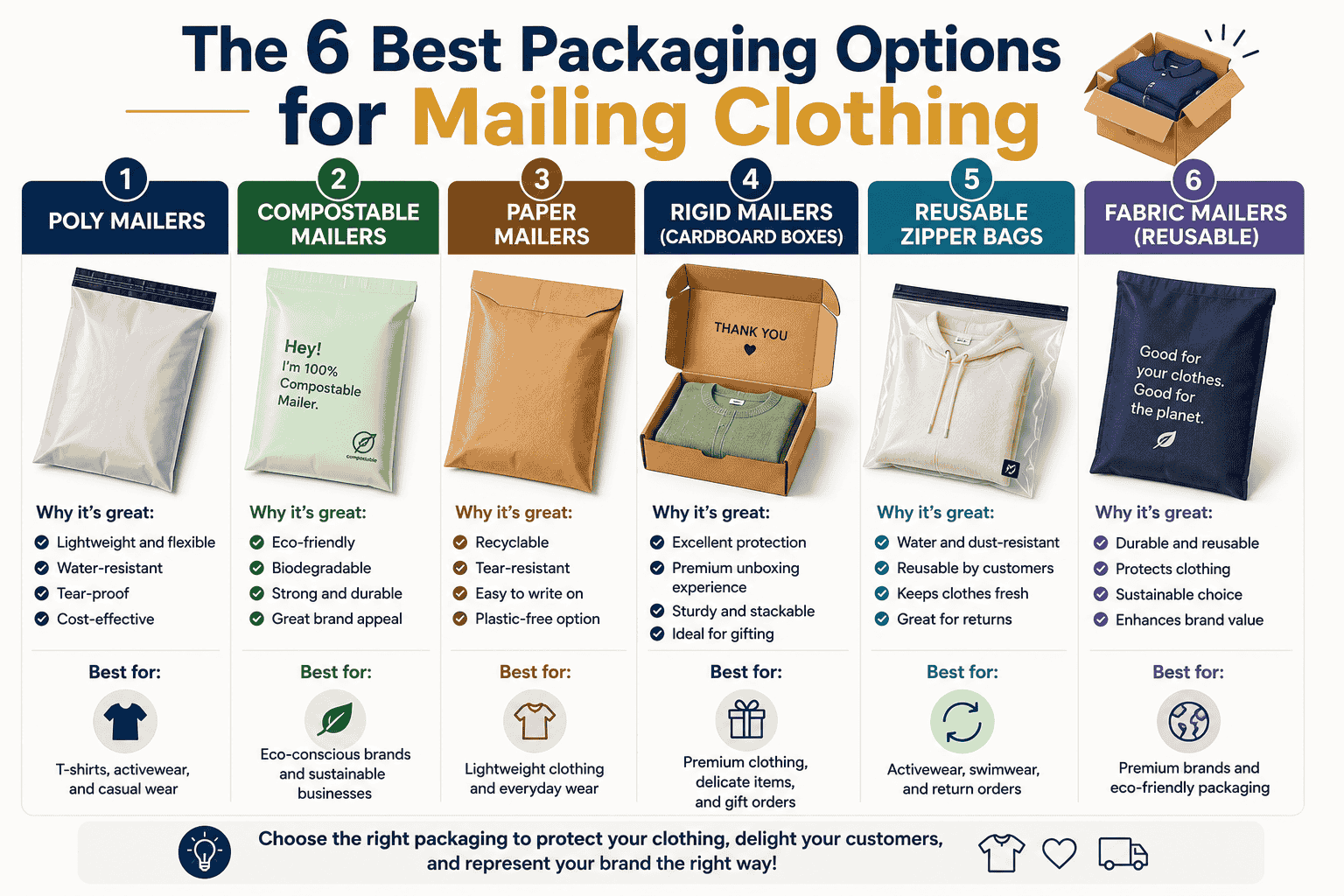
1. Poly Mailers — Best for Lightweight, Everyday Clothing
What they are: Poly mailers are thin, plastic envelopes with a self-sealing adhesive strip. They come in a range of sizes and can be customized with your brand colors and logo.
Best for:
- T-shirts, leggings, socks, underwear, and activewear
- Single-item orders
- Lightweight items under 1–2 lbs
- High-volume ecommerce sellers looking to reduce costs
Why they work:
Poly mailers are lightweight, which directly reduces your shipping cost. They’re water-resistant, tear-resistant, and take up minimal storage space in your warehouse. Because they conform to the shape of the garment, there’s very little wasted space.
What to watch for:
Poly mailers offer no cushioning. They’re not suitable for structured garments, embellished pieces, or anything that could crease badly. They also don’t provide a premium unboxing experience.
- Padded Mailers / Bubble Mailers — Best for Delicate Small Items
What they are: Padded mailers combine a paper or poly exterior with a bubble-wrap interior lining for added cushioning.
Best for:
- Delicate accessories like scarves, belts, or lightweight knitwear
- Gifts being sent to individuals
- Small boutique orders requiring a slightly elevated presentation
- Items that need protection but don’t need a full box
- Cardboard Mailer Boxes — Best for Multiple Items or Mid-Range Orders
Best for:
- Multi-item orders (e.g., 3–5 garments)
- Folded clothing that needs to stay neat
- Brands that want a strong unboxing experience
- Mid-range to premium casual clothing
- Corrugated Boxes — Best for Bulk Shipments or Heavy Clothing
What they are: Corrugated boxes are the sturdy, fluted cardboard boxes most people picture when they think of shipping boxes. They consist of three layers: two flat liners with a ridged middle layer.
Best for:
- Bulk wholesale orders (10+ garments)
- Heavy items like coats, jackets, denim, or suits
- Long-distance or international shipping
- B2B shipments to retailers
Why they work:
Corrugated cardboard offers exceptional strength-to-weight ratio. It absorbs shocks, resists stacking pressure, and handles the rigors of international freight better than other options. For businesses shipping large quantities at once, corrugated boxes are the most economical choice per item.
- Rigid Boxes — Best for Luxury and High-Value Clothing
What they are: Rigid boxes (also called set-up boxes) are made from thick, dense greyboard covered in paper or fabric. Unlike cardboard, they don’t fold flat — they hold their shape permanently.
Best for:
- Luxury apparel: wedding dresses, tailored suits, formal gowns, premium coats
- High-value gifting items
- Brands positioning themselves in the premium segment
- Jewelry or accessories sold alongside clothing
6. Garment Bags / Poly Bags — Best for Individual Garment Protection
What they are: Clear or branded plastic or polythene bags used to individually wrap garments before placing them in a mailer or box.
Best for:
- Protecting individual garments inside a larger shipment
- Formal wear and delicate fabrics
- Wholesale and retail-ready packaging (hanging garment bags)
- Adding an inner layer of moisture protection
Quick Comparison: Clothing Packaging at a Glance
| Packaging Type | Best For | Cost Level | Shipping Weight | Customizable |
| Poly Mailer | Lightweight single items | $ | Very Light | Yes |
| Padded Mailer | Delicate small items | $$ | Light | Limited |
| Cardboard Mailer Box | Multi-item or mid-range orders | $$ | Medium | Yes |
| Corrugated Box | Bulk / heavy clothing | $ | Medium–Heavy | Yes |
| Rigid Box | Luxury apparel | $$$$ | Heavy | Yes |
| Garment Bag | Inner protection / formal wear | $ | Very Light | Yes |
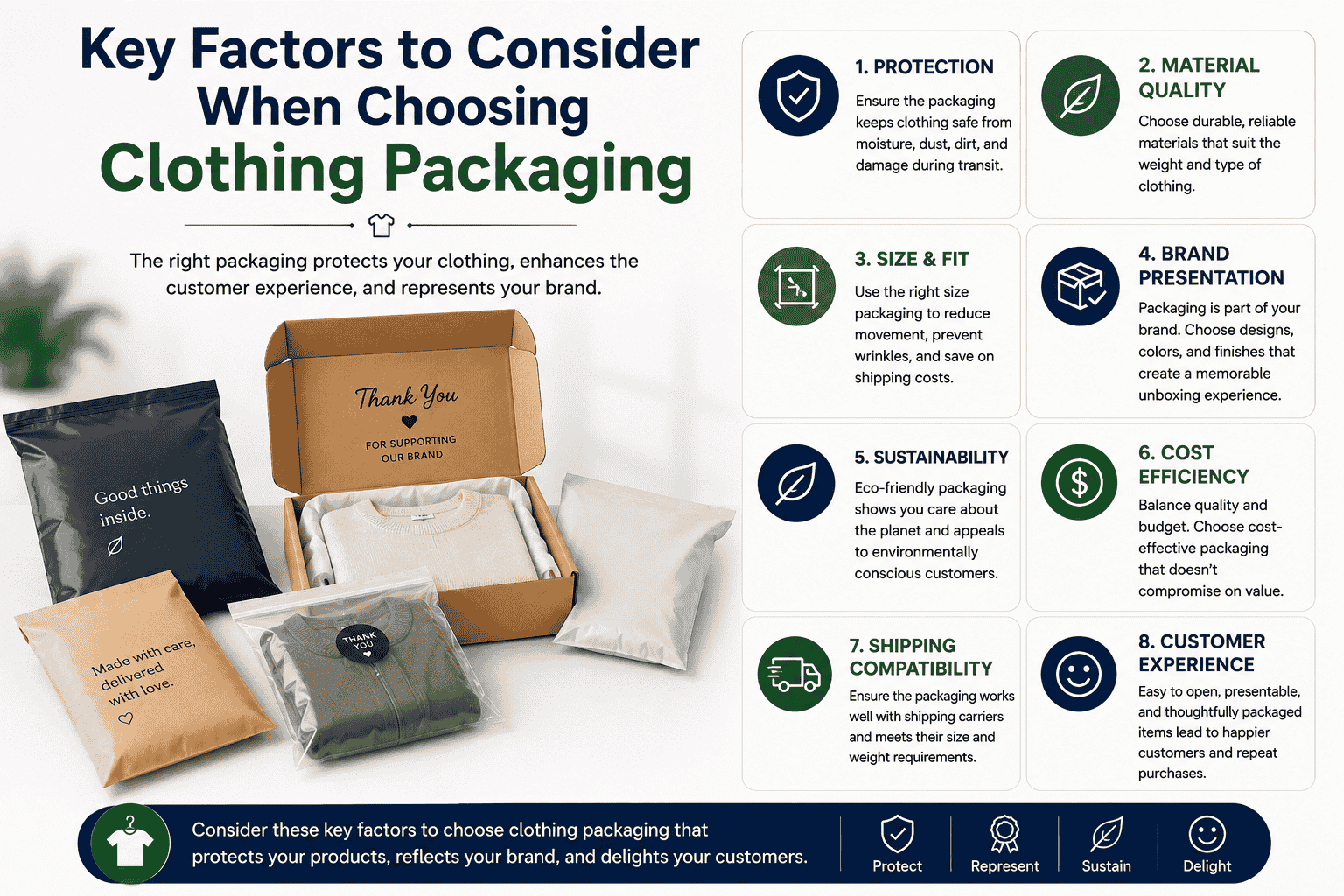
Key Factors to Consider When Choosing Clothing Packaging
1. Weight and Size of the Garment
Lightweight fabrics (t-shirts, activewear) → poly mailer. Heavy fabrics (coats, jeans, denim jackets) → corrugated or rigid box. Structured garments → box with inserts to prevent creasing.
2. Value of the Product
The higher the retail price of the garment, the more you should invest in packaging that protects and presents it properly. A $10 t-shirt doesn’t need a rigid box. A $300 dress does.
3. Quantity Per Shipment
Single item → poly mailer or padded mailer. Multiple items → mailer box or corrugated box. Large wholesale orders → corrugated boxes with garment bags inside.
4. Shipping Distance
Local or domestic short-distance → most packaging types work. International or cross-country → use more durable options; corrugated boxes are the safest bet for long journeys.
5. Your Brand Positioning
If your brand is premium, your packaging needs to reflect that from the outside in. If your brand is affordable and practical, cost-effective packaging with clean custom printing is the right call. Packaging is marketing.
6. Sustainability Goals
Kraft paper, recyclable cardboard, and compostable poly mailers are available options if your brand values eco-friendliness. More customers than ever factor this into their purchasing loyalty.
How to Pack Clothes for Mailing: Step-by-Step
Regardless of which packaging type you choose, follow these steps to ensure garments arrive in perfect condition:
- Fold neatly. Fold clothes tightly along natural seams to minimize creasing.
- Wrap in tissue paper or a garment bag for delicate items or formal wear.
- Place in packaging with minimal empty space. Extra room = garments shifting and wrinkling.
- Seal securely. Self-seal adhesive strips on poly mailers and peel-and-seal tape on boxes should be fully pressed down.
- Label clearly. Address label should be flat and readable. Avoid covering with tape.
- Add protective inserts if needed. Tissue, bubble wrap, or shredded kraft paper fill space and look premium.
How to Save Money on Clothing Packaging Without Sacrificing Quality
- Buy in bulk. Per-unit costs drop significantly when you order packaging in larger quantities.
- Right-size your packaging. Using a box that’s too large increases dimensional weight shipping costs. Measure your folded garments and order accordingly.
- Use poly mailers where appropriate. If your product genuinely doesn’t need a box, don’t use one.
- Consolidate SKUs. Fewer packaging sizes means better bulk pricing and simpler fulfillment.
- Custom print upfront. Ordering blank packaging and adding stickers costs more per unit over time than printing directly on the packaging.
Final Thoughts
There’s no single answer to what kind of packaging is best for mailing clothing — the right choice depends on what you’re shipping, who you’re shipping it to, and what your brand stands for.
Here’s the short version:
- Poly mailers for everyday lightweight clothing on a budget
- Padded mailers for delicate small garments or gifts
- Mailer boxes for multi-item orders or a branded unboxing experience