
5 Places Where You Can Buy Durable Moving Boxes
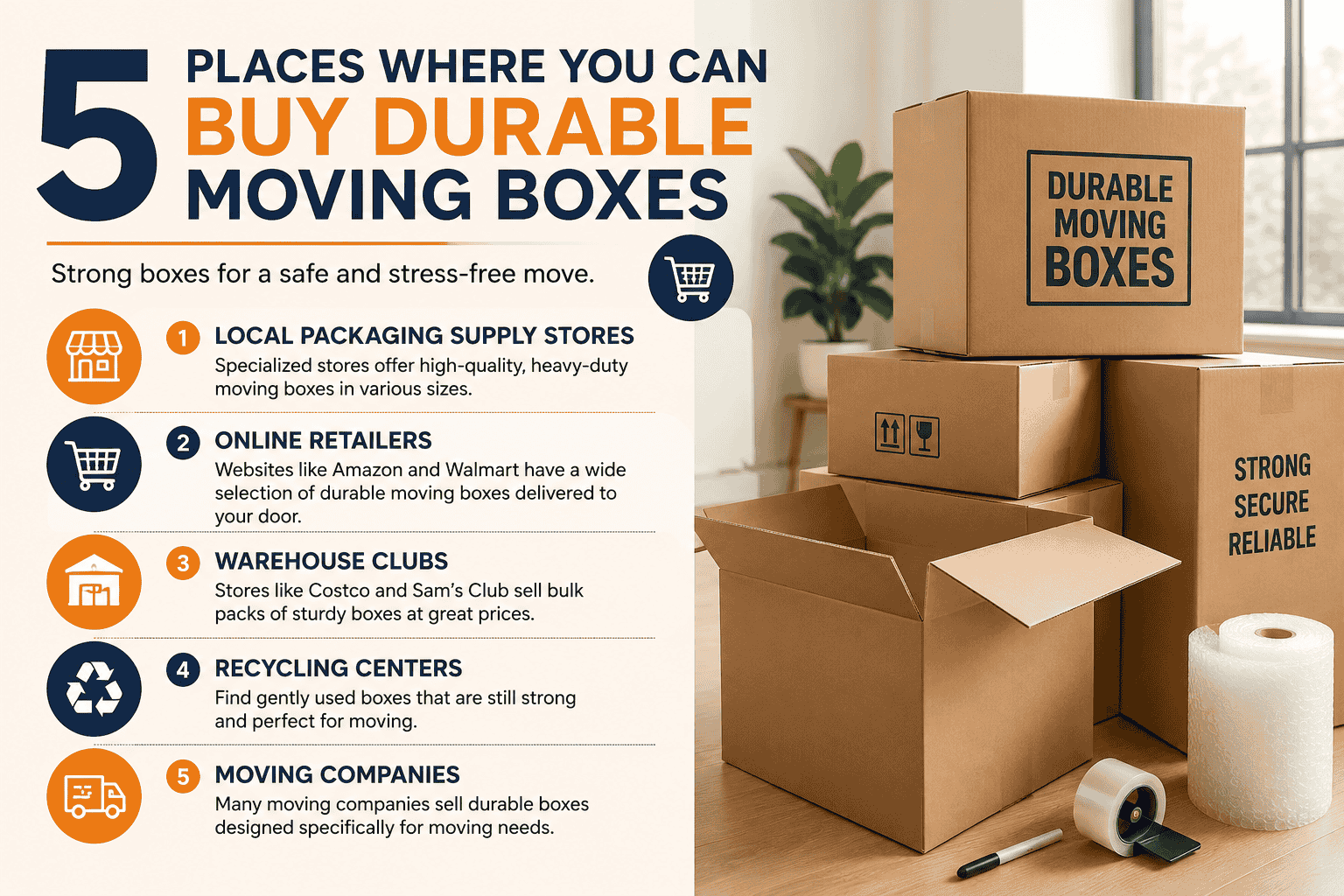
Moving day has a way of exposing weak packaging fast. A box that looked fine in the garage can buckle the second you stack four more on top of it, or the bottom gives out halfway to the truck. If you’ve ever watched a “sturdy” box split open on a staircase, you already know that not all moving boxes are built the same, and where you buy them matters almost as much as the box itself.
This guide walks through the real options for sourcing durable moving boxes, what each one is actually good for, and how to avoid paying for boxes that won’t survive one trip up a flight of stairs.
What Makes a Moving Box Actually Durable
Before comparing sources, it helps to know what you’re looking for, since “heavy duty” on a label doesn’t always mean much.
Look for:
- Double-wall or triple-wall corrugated construction for anything over 30 lbs, especially books, kitchenware, or tools.
- Edge crush test (ECT) rating of 32 or higher — this number tells you how much stacking weight the box can handle before it collapses, and it’s usually printed near the manufacturer’s stamp on the bottom flap.
- Consistent flute size (B-flute or C-flute) rather than mismatched recycled stock, which tends to have inconsistent strength.
- Reinforced bottoms, either through double-thick construction or interlocking flaps, since the bottom seam is where most boxes fail first.
Keep this checklist in mind as you shop, because pricing alone won’t tell you which boxes will actually hold up.
1. Home Improvement Stores (Home Depot, Lowe’s)
These are the most convenient option if you need boxes same-day. Both retailers sell kits with assorted sizes, and their heavy-duty and specialty lines (dish packs, wardrobe boxes) are generally reliable for a single move.
Best for: Last-minute moves, small quantities, specialty box shapes like wardrobe or mirror boxes.
Trade-off: Per-box cost is higher than buying in bulk elsewhere, and in-store stock can run out fast during peak moving season (late spring through Labor Day).
2. Online Packaging Retailers and Wholesalers
Buying directly from a packaging supplier — rather than a general retailer — is usually the better move if you’re relocating a household with a lot of volume, or if you’re a business relocating inventory or equipment. Wholesale suppliers sell in bulk, often at a fraction of the per-unit cost of retail boxes, and many let you choose flute type and wall count instead of guessing from a label.
Best for: Large moves, office relocations, businesses that need repeat orders, anyone who wants boxes matched to actual weight requirements rather than generic sizing.
Trade-off: Bulk orders typically come with a minimum order quantity and a short production or shipping lead time, so this route works better when you can plan a week or two ahead rather than needing boxes the same afternoon.
3. Truck Rental and Moving Container Companies
Companies like U-Haul, PODS, and similar moving-container providers sell their own box lines, often bundled with tape, bubble wrap, and packing paper as a kit. Quality is generally consistent since these companies build boxes specifically for moving stress, not general storage.
Best for: People already renting a truck or container from the same company — bundling often saves a trip.
Trade-off: Kit pricing can be more expensive per box than buying loose, and sizing options are usually limited to their standard set.
4. Grocery, Liquor, and Retail Stores (Free Boxes)
Asking local stores for their leftover boxes is still one of the most common ways people furnish a move on a budget. Liquor store boxes in particular tend to be well-built since they’re designed to hold glass bottles without collapsing.
Best for: Budget moves, short-distance moves, anyone who doesn’t mind boxes with printed branding on the outside.
Trade-off: Quality is inconsistent box to box, sizes won’t be uniform (which makes stacking in a truck harder), and stores often can’t guarantee availability, since it depends on their delivery schedule.
5. Local Buy-Nothing Groups and Online Marketplaces
Facebook Marketplace, Craigslist, and neighborhood Buy Nothing groups are worth checking before buying new. People who just moved often give away boxes in good condition because they don’t want to store or dispose of them.
Best for: Sustainability-minded movers, short moves, filling gaps in an otherwise-purchased supply.
Trade-off: Boxes have already been through at least one move, so structural wear is a real risk — inspect corners and bottoms before relying on them for anything heavy or fragile.
Comparing Your Options at a Glance
| Source | Typical Cost per Box | Durability | Lead Time | Best For |
| Home improvement stores | $$ | Good | Same day | Small or last-minute moves |
| Online packaging wholesalers | $ (in bulk) | Very good–excellent | Few days to 2 weeks | Large or business moves |
| Truck rental/container companies | $$$ | Good | Same day (with rental) | Renting a truck/container anyway |
| Free store boxes | Free | Inconsistent | Depends on stock | Budget, short-distance moves |
| Marketplace/giveaway boxes | Free–low cost | Variable | Depends on availability | Sustainable, short moves |
How Many Boxes You’ll Actually Need
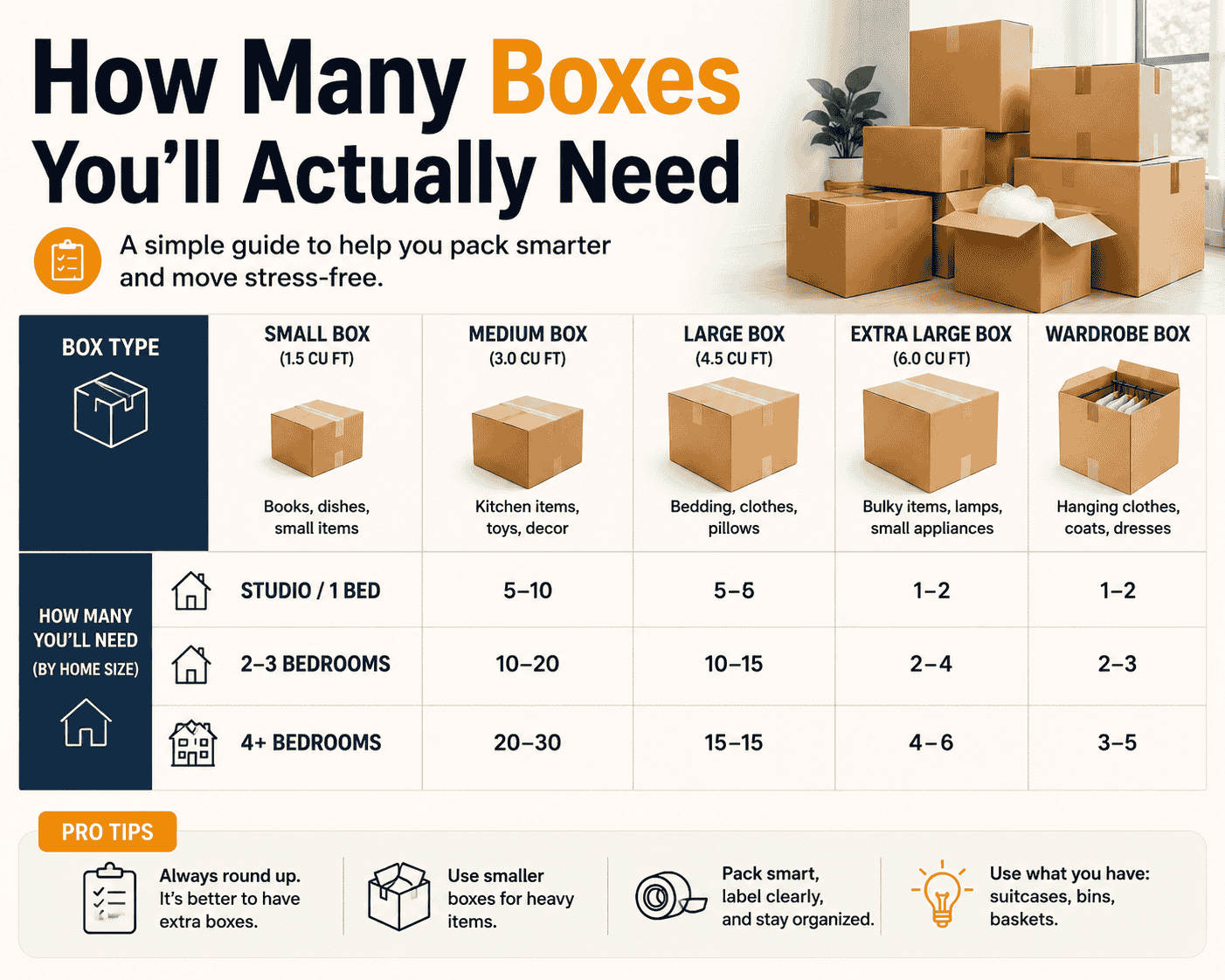
As a rough guide, a one-bedroom apartment typically needs 20–30 boxes, a two-to-three-bedroom house needs 40–60, and a four-plus-bedroom home can run well past 80, depending on how much you’re packing versus donating or selling beforehand. It’s worth ordering roughly 10% more than your estimate — running out mid-pack is more disruptive than having a few extra flattened boxes left over.
A Few Packing Tips Worth Following
- Pack heavier items in smaller boxes and lighter items in larger ones, so no single box becomes too heavy to lift safely.
- Reinforce the bottom seam of every box with tape, even ones that come pre-scored, since factory folds alone often aren’t enough for a full load.
- Label boxes by room and rough weight so movers (or you) know which ones need extra care when stacking.
- Avoid overpacking boxes past their fill line, since a bulging box is far more likely to fail under stacking pressure.