
Nobody gets excited about a cardboard box. I get it. It’s not the fun part of running a brand — the fun part is the product, the photos, the launch. But here’s the thing: the box is the last thing you control before your product lands in someone’s hands, and if it shows up crushed, or looks cheap, or the item inside got banged around, none of the rest matters much. So let’s actually talk about it for once.
Corrugated packaging (which is really just a fancier way of saying “cardboard box”) has been growing steadily as an industry, somewhere around 5% a year by most estimates. Makes sense when you think about it — everything ships now. Groceries, furniture, skincare, phone cases, dog food. Somebody, somewhere, packed almost everything you own into a corrugated box at some point.
So what’s actually going on with this stuff, and why does it keep beating the alternatives?
What Corrugated Cardboard Actually Is
Most of us just call it “cardboard” and move on with our day, but it’s not really one material — it’s three layers pressed together. Flat sheet on the outside, flat sheet on the inside, and squeezed between them, this wavy zig-zag layer that’s doing basically all the actual work. That middle part is why a box of ceramic mugs can survive getting thrown around in the back of a delivery van without shattering.
It’s made from wood pulp, so it’s renewable, and it’ll break down on its own if it ends up somewhere it shouldn’t. Recycling rates on this stuff are genuinely high — north of 90% in the US — and a lot of the board is already recycled fiber before it even reaches you. I was a little skeptical when I first looked into this, expecting the “eco-friendly” angle to be mostly marketing. It’s not. The numbers actually back it up.
Why It Doesn’t Just Fall Apart
There’s more engineering packed into this simple-looking material than you’d guess.
The Liners
These are the flat outer and inner layers — usually kraft paper — and they’re the reason the box doesn’t puncture the second something pokes it from the outside.
- Kraft Liner – mostly virgin wood pulp. Tough stuff, handles moisture decently.
- Test Liner – recycled fiber, usually goes on the inside where it doesn’t need to work as hard.
- White Top Liner – bleached white so your logo prints clean instead of looking muddy on plain brown board.
- Barrier Liners – treated to resist moisture, grease, or oxygen. Handy if you’re shipping food.
The Fluting
Honestly this is the interesting part. It’s the wavy middle layer, and bigger waves mean more cushioning while smaller waves mean a smoother, cleaner surface for printing. You kind of have to pick your tradeoff.
- A-Flute — biggest, best cushioning, not great for fine printing detail.
- C-Flute — the default for most shipping boxes out there. Doesn’t excel at any one thing but does everything decently.
- B-Flute — thinner, handles crushing well, shows up a lot in retail boxes.
- D-Flute — sits in the middle, you’ll see it in things like pizza boxes.
- E-Flute — thin, smooth, popular for nicer retail packaging.
- F-Flute — thinnest of all, mostly for cosmetics or luxury stuff where looks matter more than raw toughness.
The Glue
Never thought about this until I looked into it, but yeah — the adhesive matters too.
- Starch-based — cheap, works well, the industry default.
- Hot melt — sets fast, mostly used to seal the box shut.
- Water-based — a bit more flexible, plays nice with coated boards.
Wall Types
Depending on what you’re shipping, you don’t always need the same amount of layering.
- Single-Face is barely a box — one liner, one fluted layer. More of a wrap, really.
- Single-Wall is what most shipping boxes are, good up to around 10 kg.
- Double-Wall steps it up for heavier or fragile stuff, roughly up to 30 kg.
- Triple-Wall is the heavy-duty version — industrial loads, serious stacking.
Okay, But Why Should Your Brand Care
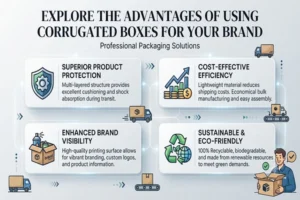
They Actually Protect Your Stuff
That wavy fluting exists to absorb pressure. That’s the whole reason these boxes survive being stacked ten-high in a warehouse, or tossed around in transit without much care. The trapped air even adds a bit of insulation, and you can throw on coatings if moisture’s a concern.
You Can Shape Them However You Want
A corrugated box doesn’t have to be a boring rectangle. It can get cut and folded to basically hug your product’s shape, so you’re not stuffing a bunch of unnecessary filler in there. And when it comes to how it looks — you’ve got real choices. Small batch? Digital printing works fine. Bigger runs with more detail? Flexographic or litho-laminated printing makes more sense. Want it to feel a bit more expensive? Matte finish, gloss, foil stamping, embossing, spot UV — pick one and suddenly it’s not “just a box” anymore, it’s part of the whole unboxing moment.
Light, But Don’t Underestimate It
This part surprised me the most, if I’m honest. The fluted layer gives real structural strength without adding much weight, because it’s mostly trapped air doing the cushioning, not solid material. And that matters, because lighter boxes cost less to ship — not a huge deal for one package, but a very real deal once you’re shipping hundreds a month.
The Eco Angle Holds Up
With recycling rates around 90% and most board already made from recycled fiber, corrugated packaging earns its “eco-friendly” label honestly, no asterisk needed. It breaks down naturally if it doesn’t get recycled, and because it’s lighter than a lot of alternatives, less fuel gets burned moving it from A to B.
And It’s Just… Cheaper
Lighter boxes cut down both actual weight and the “dimensional weight” carriers charge you for, which really adds up on international shipping. Standard, partly-recycled materials keep the raw costs down too, and since the designs are pretty standardized, they go together fast without slowing down a production line.
How It Stacks Up
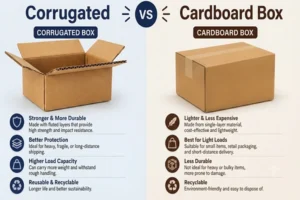
Corrugated vs. Plastic
| Property | Corrugated | Plastic |
| Durability | Short-term | Long-term |
| Moisture Resistance | Low | High |
| Recyclability | High | Low |
| Manufacturing Cost | Low | High |
| Best For | Shipping, e-commerce, short-term storage | Long-term storage, moisture-sensitive goods |
Corrugated vs. Rigid Boxes
| Property | Corrugated | Rigid |
| Durability | High | Very High |
| Cost | Low to Moderate | High |
| Storage | Collapsible | Non-Collapsible |
| Recyclability | Excellent | Moderate |
| Primary Use | Shipping and logistics | Retail and luxury branding |
Neither one wins outright, really — depends what you’re doing with it. A luxury skincare brand might keep rigid boxes on the shelf for that premium feel, then switch to corrugated the moment the product actually has to go somewhere.
Finding Someone to Actually Make These For You
Once you get the basics — flute type, wall strength, liner choice, finishing options — go find a manufacturer willing to build to your specs instead of handing you something generic off a shelf. Ask about minimum order quantities, what flute options they offer, what kind of printing they can actually pull off. If they answer all that without hesitating, they probably know what they’re doing.
Last Thought
A cardboard box isn’t glamorous, and nobody’s lying awake thinking about their packaging strategy. But it’s quietly doing a lot of work — protecting the product, keeping shipping costs sane, backing up whatever sustainability claims the brand is making, and honestly, giving the customer their first real physical moment with the brand before they’ve even opened it. Worth taking seriously, even if it never feels like the exciting part.