
If you’ve ever pulled a pastry out of a bakery bag and noticed the paper was slightly see-through but didn’t leave a single grease mark on your hands, you’ve already met glassine. It’s one of those materials people use constantly without ever learning its name — until they start shopping for packaging themselves and the word starts showing up everywhere.
This guide breaks down what glassine actually is, how it’s made, where it shines, where it falls short, and how to decide whether it’s the right fit for your product.
What Is Glassine, Exactly?
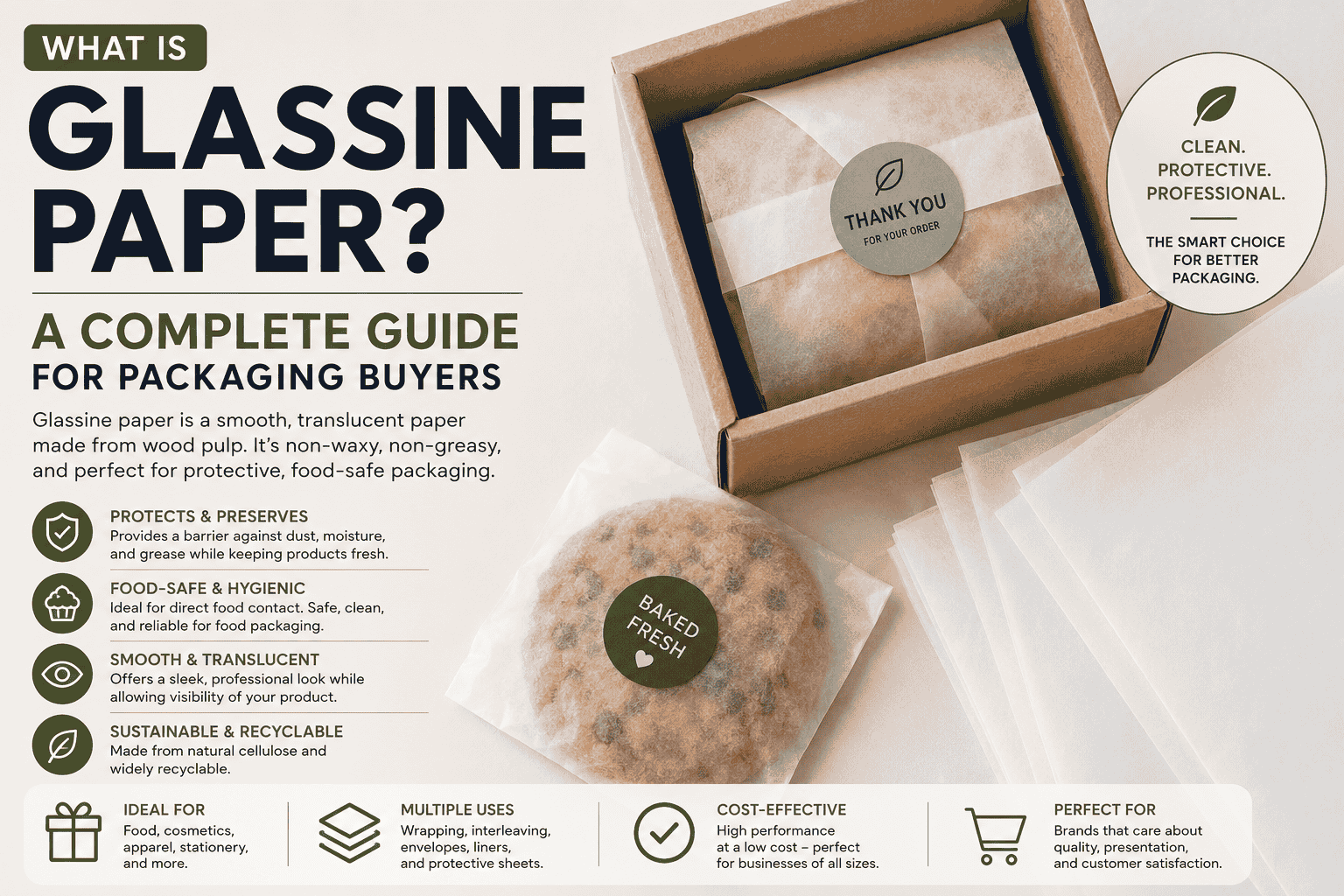
Glassine is a thin, smooth, semi-transparent paper prized for one unusual combination of traits: it resists grease, air, and moisture, yet it’s still 100% paper — no plastic film, no wax coating, no laminate layer added on top.
That resistance doesn’t come from a coating. It comes from how densely the paper fibers are packed together during manufacturing, which is also what gives glassine its glossy, glass-like surface and its name. Most glassine falls in the 50–90 gsm range, light enough to feel delicate but strong enough to hold up in daily handling.
Because it’s uncoated and made almost entirely from wood pulp, glassine is also recyclable and biodegradable — a big part of why it’s had a resurgence as brands move away from plastic.
How Glassine Paper Is Made
Glassine starts out as ordinary paper and becomes something else entirely in the finishing stage. The general process looks like this:
- Pulping – Hardwoods such as birch, aspen, or oak are chipped and cooked to break the wood down into raw pulp.
- Lignin removal – Lignin, the compound that makes wood rigid, is stripped out. Leftover lignin is what makes regular paper yellow and brittle over time, so removing it thoroughly is what allows glassine to stay stable and acid-free for years.
- Sheet forming – The pulp slurry is spread onto a moving screen where water drains away and fibers mat together into a continuous sheet.
- Pressing and drying – Standard papermaking steps that remove remaining moisture.
- Supercalendering – This is the step that makes glassine unique. The dried sheet is run through alternating steel and fiber rollers under heat and pressure, again and again. This compresses the fibers, aligns them in one direction, and collapses the tiny air pockets inside the paper. The result is a dense, low-porosity sheet with a glossy finish and natural resistance to air, water, and grease — no coating required.
That last step is really the whole story. Regular paper is porous; supercalendered paper isn’t. Everything glassine is known for traces back to it.
What Makes Glassine Different From Other Papers
People often lump glassine in with wax paper, parchment paper, or even plastic film, but the materials behave quite differently.
- Vs. wax paper: Wax paper gets its resistance from a wax coating, which can transfer to food or feel sticky in heat. Glassine has no coating at all — the resistance is baked into the fiber structure itself, so there’s nothing to flake, melt, or rub off.
- Vs. parchment paper: Parchment is treated for heat resistance and is meant to go in the oven. Glassine isn’t oven-safe and is built more for moisture and grease resistance at room temperature.
- Vs. plastic film: Plastic is fully non-porous and waterproof, and it doesn’t biodegrade. Glassine trades a bit of that waterproofing for being recyclable, compostable, and paper-based from the start.
If your product needs to go in an oven or handle sustained moisture, glassine isn’t the right call. If you want the look of a premium, semi-sheer wrap with real grease and moisture resistance and a smaller environmental footprint, it’s hard to beat.
Common Uses for Glassine
Glassine shows up across a surprising range of industries:
- Food packaging — bakery bags, sandwich wraps, candy wrappers, and liners for greasy or oily foods
- Retail and gifting — glassine bags and sleeves for candles, soaps, jewelry, and small retail items, where the slight translucency adds a premium, “reveal a little” look
- Archival and collectibles — stamp and coin sleeves, photo negative envelopes, and interleaving paper for books and prints, because it’s acid-free and won’t damage what it touches
- Industrial and lab use — release liners for adhesives and labels, and as a lightweight weighing paper in laboratories
The common thread is protection without bulk: glassine shields a product from grease, dust, and light handling damage while staying light, recyclable, and visually clean.
Pros and Cons of Glassine Packaging
Advantages
- Naturally grease-, air-, and moisture-resistant without added coatings
- Recyclable and biodegradable
- Acid-free and pH-neutral, so it’s safe for long-term storage of sensitive items
- Lightweight, with a premium, semi-transparent look
- Printable, so it works well for branded packaging
Limitations
- Not fully waterproof — it resists moisture, but sustained exposure or submersion will compromise it
- Not heat-resistant like parchment; it’s not intended for oven use
- Manufacturing (supercalendering) is energy-intensive compared to producing standard uncoated paper
- Tears more easily than thicker packaging papers if mishandled
Is Glassine Right for Your Product?
As a rough guide: if you’re packaging something greasy, delicate, or something you want to sell on unboxing appeal — baked goods, candles, jewelry, soap, small retail goods — glassine is usually a strong fit. If your product needs full waterproofing, oven-safe wrapping, or heavy-duty durability, you’re better off with a different material, and it’s worth pairing glassine with a secondary layer if extra protection is needed.