
Making a custom deck of playing cards is kind of like creating a small piece of art that’s going to get shuffled, dropped, shoved into bags, and handled constantly for years. The cards matter most, obviously, but the box is what people actually touch first. It’s the thing standing between a nice deck and one that shows up bent or damp.
Picking the material isn’t really about looks alone. It’s a balance – durability, how it feels in your hand, and whether it actually says something about the brand behind it. So here’s an honest look at the options.
The Material Basically Sets the Tone for Everything
Think about a set of nice, linen-finished cards sitting inside some flimsy paper box. That mismatch is jarring the second you notice it, and it drags the perceived quality down instantly. The box is really the stage the cards perform on. Feel something cheap in your hands and you assume, without even meaning to, that what’s inside is cheap too. A box that feels solid does the opposite – it builds trust before anyone’s even opened it.
C1S and C2S Paperboard – Still the Industry Default
Most solid card boxes use C1S (coated one side) or C2S (coated two sides) paperboard, and there’s good reason it’s stuck around this long.
Why People Keep Coming Back to It
Ink just holds onto it well. Foil work, matte finishes, detailed photography – none of it loses sharpness on this stock.
It folds cleanly too, without cracking, which matters more than people realize since a tuck box lives or dies on clean folds.
Thickness is flexible as well. Boards get measured in points, and for a standard tuck box, somewhere between 10pt and 12pt tends to hit that sweet spot – sturdy enough to feel legit, without turning into a nightmare to assemble.
Rigid Setup Boxes – When You Actually Want Luxury
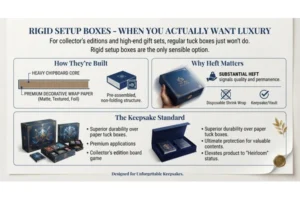
Working on something like a collector’s edition, or a higher-end gift set? A regular tuck box just won’t get you there. Rigid setup boxes – think premium board games, limited tarot decks – are really the only sensible option at that point.
These are built differently altogether. Heavy chipboard wrapped in nice decorative paper, and they don’t fold at all – they show up pre-assembled, closer to a small vault than a box.
Durability’s not even close to a paper tuck box. And the weight alone tells people something before they’ve even opened it – that heft in the hand signals this thing’s meant to be kept around, not thrown out with the shrink wrap. If the cards are supposed to be a keepsake, this is basically the only material that makes real sense.
Kraft Stock – For Brands Leaning Into Sustainability
Kraft board’s been having a moment lately, especially with brands that want their eco-conscious values to actually show up in the packaging, not just get mentioned in a footer somewhere.
It’s got that raw, earthy look going for it – works particularly well with minimalist black-and-white printing, or white ink stamped straight onto the natural brown tone. It’s genuinely recyclable too, often made from post-consumer waste, which matters to a growing number of buyers.
One thing worth knowing though – kraft’s more porous than C1S or C2S, so colors tend to come out a bit more muted and matte on it. Sometimes that’s exactly the look you want. Just something to keep in mind when you’re prepping your print files, so it doesn’t catch you off guard.
Making Sense of “Points” and GSM
Manufacturers throw a lot of numbers around, so here’s the plain version.
10pt to 12pt board is your standard tuck box range – light, flexible, easy enough to slide into a pocket without thinking twice.
14pt and above feels noticeably thicker, more rigid. Good if sturdiness is the goal, though the thicker it gets, the harder it is to fold cleanly without a crack showing up somewhere along the edge.
GSM, or grams per square meter, is just another way of talking about weight. For boxes, staying around 300 to 350 gsm usually gets you that nice, satisfying snap and solid overall structure.
The Finishing Touches That Actually Change the Feel
Once you’ve got the material sorted, the finish is where things really come alive.
Spot UV adds a glossy, slightly raised layer over specific elements – a logo, maybe some art. Put it over a matte background and the contrast makes it pop in a way flat printing never quite manages on its own.
Linen embossing presses a subtle linen-like texture right into the cardstock itself. It ends up matching the feel of the air-cushioned cards inside, which is a small detail, but it elevates the whole experience without making a big deal of itself.
Soft-touch lamination is worth a look too, especially on C1S board. It kills that cheap plastic feel regular lamination sometimes has, swapping it for something velvety that people genuinely enjoy running their fingers over.
Choosing What Actually Fits Your Brand
Don’t just pick based on cost – pick based on what the box is actually supposed to communicate.
Running a high-volume retail operation? Stick with C1S or C2S. It’s the most cost-effective route and gives you the sharpest color reproduction for shelf presence.
Building something more boutique? Kraft board tells that story – artisan roots, intentional values – better than anything glossy ever could.
Launching something meant to feel prestige? Spend the extra money on a rigid setup box. It stops being just a deck at that point and starts being more of a showpiece.
Always, Always Order the White Dummy First
Before committing to a run of thousands of units, ask your supplier for a white dummy – an unprinted version of the box in your chosen material. Open it. Close it. Toss it in a bag. Drop it on your desk a few times. Does it hold together? Does the flap actually stay shut without help?
At the end of the day, the right material is whatever matches your brand’s personality while still surviving how people actually use their cards day to day – shoved in pockets, dropped on tables, carried around for years. Spend the time feeling the material in your hands before locking anything in. It’s a small step, but it saves a lot of regret down the line.