
If you grow, pack, or sell fresh produce, you’ve probably run into this problem: order boxes too big, and your vegetables shift around and bruise in transit. Order too small, and you’re crushing stock or paying for extra shipments you didn’t need. Getting the size right isn’t a small detail — it directly affects spoilage rates, shipping costs, and how your produce looks when it lands on a shelf or a customer’s doorstep.
This guide breaks down real, usable sizing standards for vegetable boxes and bags, what actually drives those numbers, and how to pick the right fit for your specific produce — instead of guessing.
Why Vegetable Packaging Size Actually Matters
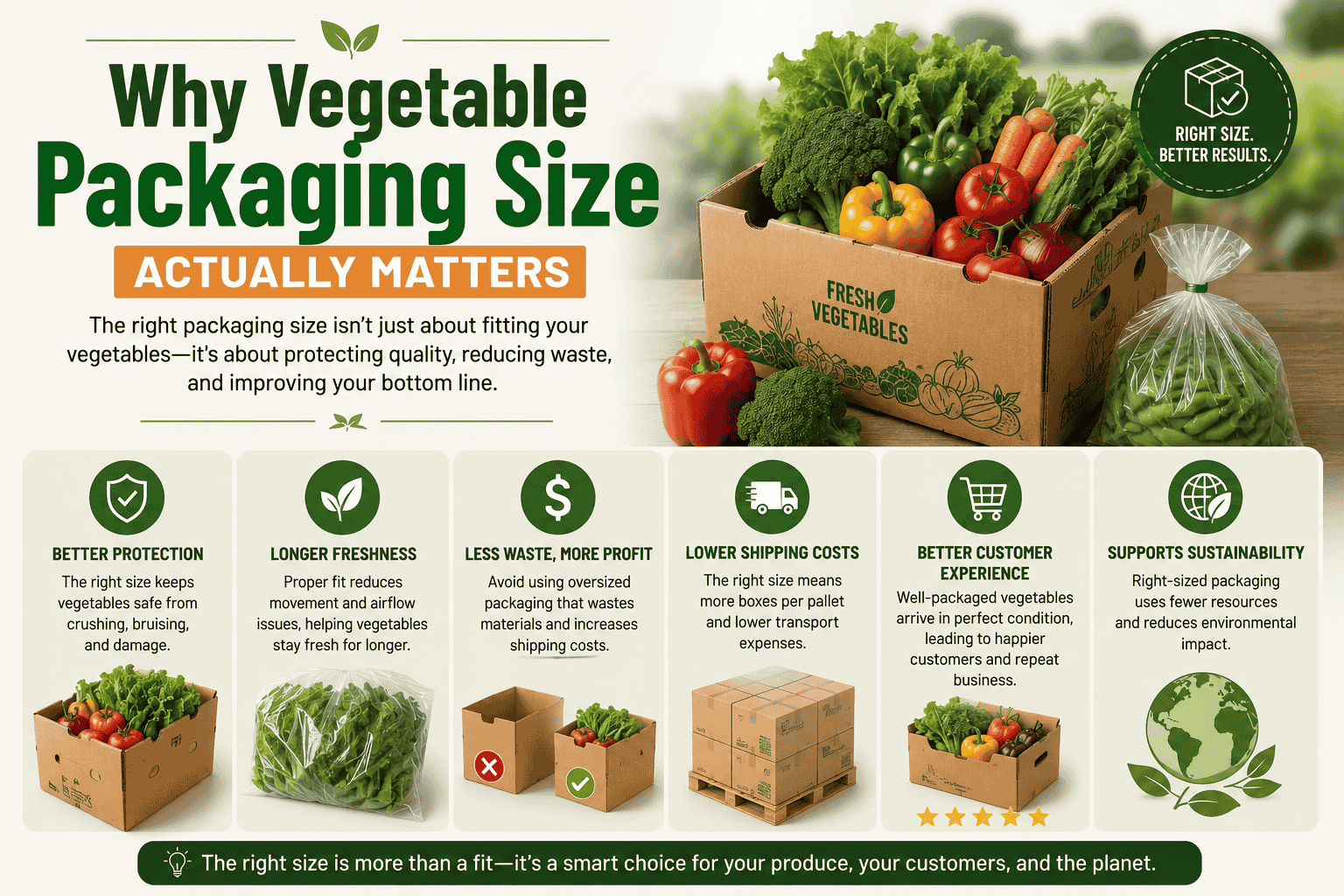
Vegetables aren’t uniform. A crate that works perfectly for potatoes will crush lettuce. A bag sized for cherry tomatoes will suffocate a bunch of kale. Three things are always at play:
- Ventilation — most fresh produce needs airflow to avoid trapped moisture and rot. Packaging that’s too tight cuts off airflow; packaging that’s too loose lets produce jostle and bruise.
- Weight distribution — a box that’s the right dimensions but rated for the wrong weight will buckle or split under the load.
- Shelf and display fit — retailers often have fixed shelf depths or crate slots, so your packaging needs to match what their space can hold.
Get these three right and you’ll see fewer damaged returns, lower spoilage, and better presentation.
Standard Vegetable Box Sizes
Most vegetable shipping boxes fall into a few general size tiers. These aren’t rigid rules, but they’re a solid starting point before you customize for your specific produce:
| Box Size | Typical Dimensions (L x W x H) | Best For |
| Small | 8″ x 6″ x 4″ | Herbs, small root vegetables, mixed retail packs |
| Medium | 12″ x 10″ x 6″ | Standard bulk vegetables — carrots, peppers, cucumbers |
| Large | 16″ x 12″ x 8″ | Wholesale and farm-to-market shipments |
| Extra-Large | 18″ x 14″ x 10″+ | Bulk restaurant or distributor orders |
These figures line up with common USDA produce carton guidance, which recommends cartons in the 100–110 linear inch range (length + girth) for roughly 50-pound loads of produce. That number matters more than it sounds — it’s the point where most freight carriers stop treating a box as “standard” and start charging dimensional weight fees, so staying inside it can genuinely lower your shipping cost per unit.
Sizing by Vegetable Type (Not Just by Box)
This is where most sizing guides stop short — they give you a chart and call it done. But the right packaging size really depends on what you’re packing. Here’s a more practical breakdown:
Leafy greens (lettuce, spinach, kale, chard) These need room to breathe and minimal compression. Perforated bags or vented clamshells in the 8″ x 10″ to 10″ x 12″ range work best. Overpacking leafy greens is one of the most common causes of early wilting — the leaves generate their own moisture and heat, and a tight bag traps both.
Root vegetables (carrots, beets, potatoes, onions) These are dense and can handle more weight, so mesh bags or sturdy cartons in the 10 lb, 25 lb, and 50 lb weight classes are more relevant than exact inch dimensions. Mesh or net bags also help — they let moisture escape, which reduces the sprouting and mold that plague root vegetables in sealed packaging.
Vine vegetables (tomatoes, peppers, cucumbers) These bruise easily, so single-layer or partitioned trays matter more than the outer box size. A tray insert inside a 12″ x 10″ x 6″ carton keeps individual pieces from rolling and pressing against each other.
Small or delicate items (cherry tomatoes, mushrooms, herbs) Small format is the priority here — 4″ x 6″ bags or clamshells, often under 1 lb capacity, with ventilation holes sized to the produce (small enough to hold the item, large enough to let air move).
Bulk/wholesale vegetables For farm-to-distributor or farm-to-restaurant volumes, weight-based cartons (25–50 lb) matter more than exact dimensions, since these are usually stacked on pallets where cube efficiency (how well boxes stack without wasted space) is the real cost driver.
Vegetable Bag Sizes
Bags follow a similar logic to boxes but scale down. General reference points:
- Small bags (4″ x 6″): garlic, shallots, cherry tomatoes, herbs, small radish bunches
- Medium bags (6″ x 9″): individual vegetable portions — a few carrots, a small head of broccoli
- Large bags (10″ x 14″): family-size produce packs, mixed vegetable bundles
- Mesh/net bags: sized by weight (2 lb, 5 lb, 10 lb) rather than dimensions — best for onions, potatoes, citrus-style bulk items
Perforation matters as much as size. A bag with the right dimensions but no ventilation will still trap condensation and speed up spoilage — this is one of the most overlooked factors in vegetable bag selection.
Factors That Should Actually Drive Your Sizing Decision
Instead of picking a size off a chart, work through these questions:
- What’s the shelf life target? Shorter shelf life items (leafy greens, fresh herbs) need more ventilation and less crowding than root vegetables.
- How will it ship? Palletized freight favors cube-efficient, uniform box sizes. Direct-to-consumer shipping favors lighter, protective packaging that survives handling by multiple carriers.
- What’s your damage/return rate telling you? If you’re seeing bruising or crushing complaints, your packaging is likely too large (too much movement) rather than too small.
- Retail or wholesale? Retail packaging needs to look good on a shelf and often has fixed display constraints. Wholesale packaging is judged almost entirely on protection and stacking efficiency.
- Sustainability goals? Right-sized packaging is also the simplest way to cut material waste — oversized boxes use more cardboard or plastic than the product actually needs.
- Getting Packaging Sized Right for Your Product
Standard sizes are a good starting point, but produce, shipping routes, and retail requirements vary enough that most businesses end up needing some level of customization — whether that’s a slightly deeper carton for a taller vegetable or a bag with different perforation for a more delicate one.
If you want help matching packaging size to your specific vegetables and shipping setup, [Your Company Name] can walk through your product mix and recommend sizing that reduces waste and damage without overspending on materials. Reach out at [your phone number] or [your email] for a sizing consultation.