Why Custom Rigid Boxes Define Luxury Packaging
Pick up a rigid box and you already know something before you open it. It has weight. The lid lifts with a soft, controlled resistance instead of flapping open. The corners are sharp, not crushed. That’s not an accident — it’s engineering, and it’s the reason rigid boxes have become the default choice for brands that want their packaging to say “premium” before a customer reads a single word on it.
If you sell jewelry, watches, cosmetics, electronics, or anything where first impressions carry real weight, understanding what makes rigid boxes different — and where they’re worth the extra cost — will save you from an expensive trial-and-error process.
What Actually Makes a Box “Rigid”
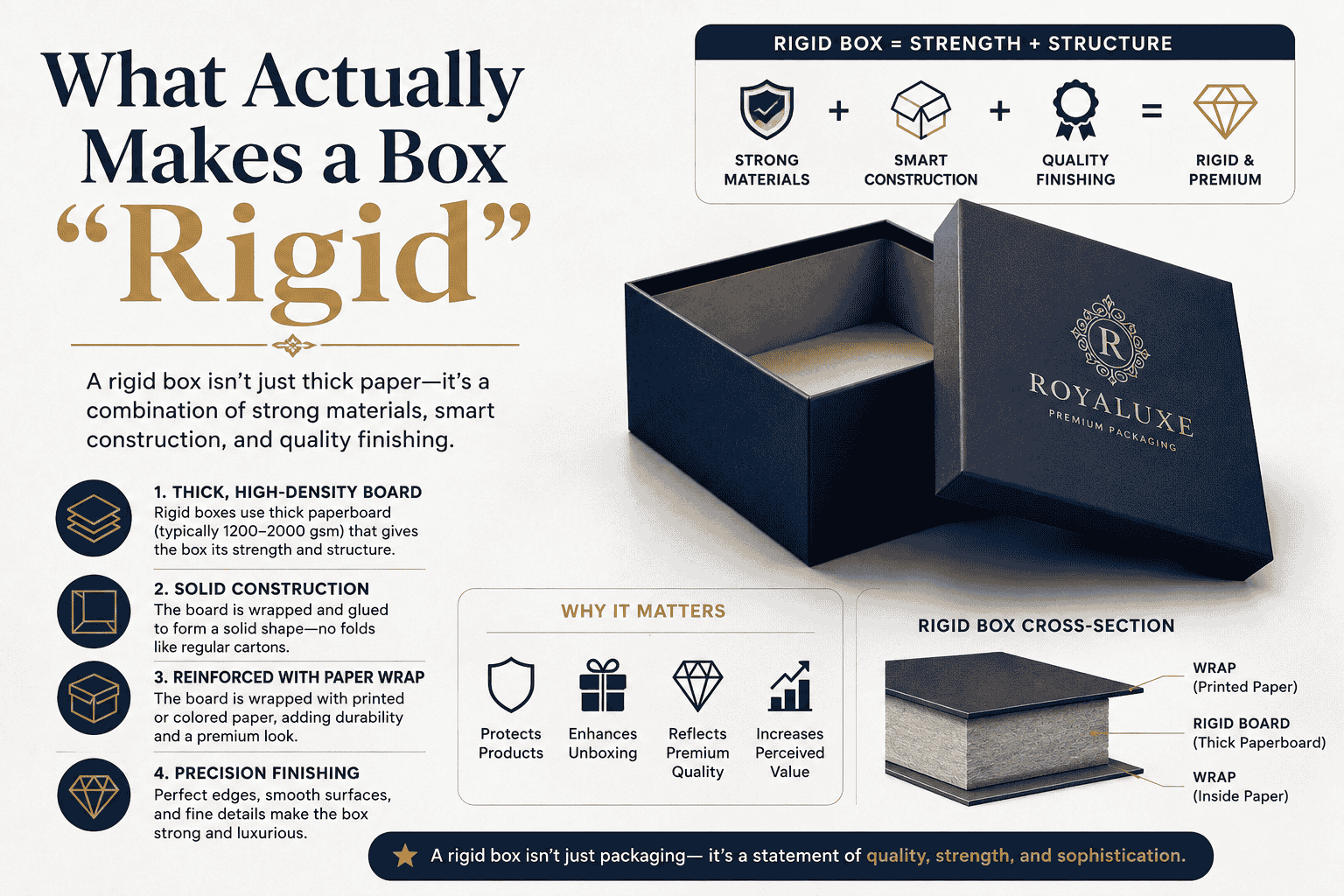
Most shipping boxes are made from corrugated cardboard: a fluted middle layer sandwiched between two liners, designed to flex and absorb shock. Rigid boxes work on the opposite principle. They’re built around a thick, dense paperboard core — usually 1,000 to 3,000 microns — that’s wrapped in a decorative outer layer of printed paper, fabric, or specialty stock.
That core doesn’t bend. It doesn’t collapse under light pressure, and it holds its shape through repeated opening and closing, which matters more than people expect. A rigid jewelry box gets opened dozens of times over its life; a folding carton usually gets opened once.
The result is a box that feels closer to furniture than packaging — solid, deliberate, built to be kept rather than thrown away.
Why “Luxury” and “Rigid” Go Together
Luxury isn’t really a material or a price tag — it’s a set of signals. Weight, texture, precision, and restraint all read as expensive, whether or not the product inside costs a fortune. Rigid boxes hit every one of those signals by default:
- Weight and density communicate quality before the box is even opened.
- Tight tolerances — lids that fit with just the right amount of friction — feel engineered, not mass-produced.
- Surface finishes like soft-touch lamination, foil stamping, or debossing catch light and texture in ways thin cardboard simply can’t hold.
- Structural memory means the box still looks new after being opened, closed, and stored on a shelf.
Compare that to a printed corrugated mailer. It might carry great branding, but it telegraphs “shipping box” the moment it’s touched. Rigid packaging telegraphs “gift.”
The Unboxing Experience Is Now Part of the Product
Unboxing has quietly become part of the customer journey rather than an afterthought. People film it, post it, and remember it. A 2022 Dotcom Distribution study found that a majority of online shoppers say packaging quality influences whether they buy from a brand again — and it shapes perceived product value even when the item itself hasn’t changed.
Rigid boxes are built for that moment specifically. A magnetic-closure rigid box with a slow, resistant lid lift creates a small pause — a beat of anticipation — that flimsier packaging can’t replicate. Brands selling anything from skincare sets to premium electronics have leaned into this because it costs relatively little per unit compared to the lift it gives the overall brand impression.
Where Rigid Boxes Make the Most Sense
Rigid packaging isn’t the right call for every product. It costs more per unit than corrugated or folding cartons, and it takes up more shipping volume. It earns its cost in specific situations:
Fragile or high-value items. Watches, jewelry, fragrances, and glass components benefit from the extra structural protection and the perceived value boost.
Gifting and retail-ready products. If the box itself is part of the gift — think candles, spirits, or cosmetic sets — rigid construction turns packaging into presentation.
Subscription and unboxing-driven brands. Where repeat engagement and social sharing matter, the tactile difference of a rigid box gets noticed and remembered.
Brand relaunches or premium line extensions. Moving a product line upmarket often starts with packaging, since it’s the fastest way to signal a price increase is justified.
If your product ships in bulk, needs to survive rough transit, or competes primarily on price, a well-designed corrugated or folding carton is usually the smarter choice.
Choosing the Right Rigid Box: What to Actually Look At
A lot of buyers get quoted on “rigid box” without realizing how much variation sits inside that term. A few things worth asking about before you order:
Board thickness. Thicker board (2mm+) feels noticeably more premium but adds cost and shipping weight. Match it to the product, not the biggest number available.
Closure style. Magnetic closures feel high-end but cost more per unit. Telescoping lids (two-piece boxes) are the classic choice for a reason — reliable and still elegant when the finish is right.
Interior finishing. Foam inserts, fabric linings, or custom-molded trays protect delicate items and add another layer of perceived value. This is often where the real “luxury” feeling comes from, more than the exterior print.
Print and finish combinations. Matte lamination hides fingerprints and feels soft; gloss and spot UV create contrast and shine. Foil stamping (gold, silver, holographic) adds detail without needing extra ink coverage.
Minimum order quantities and lead times. Rigid boxes typically require die tooling, so MOQs and turnaround times run higher than simpler packaging formats. Plan launches with that lead time in mind.
Sustainability Doesn’t Have to Be a Trade-Off
A common assumption is that rigid boxes are wasteful because they’re sturdier and bulkier than necessary. In practice, most rigid board is made from recyclable paperboard, and many suppliers now offer options using recycled content or FSC-certified stock. Because rigid boxes are designed to be reused and kept — as storage, gifting, or display pieces — they often get a longer functional life than single-use packaging, which offsets some of the environmental cost of the extra material.
If sustainability messaging matters to your customers, it’s worth asking your packaging supplier directly about recycled content percentages and certifications rather than assuming rigid automatically means wasteful.
The Bottom Line
Rigid boxes cost more than standard packaging, and they’re not the right fit for every product. But for brands where the unboxing moment is part of the value proposition — jewelry, cosmetics, spirits, electronics, gifting — that extra cost buys something hard to replicate any other way: a physical object that feels considered, durable, and worth keeping.
Getting it right comes down to matching board thickness, closure style, and finish to the product itself, not defaulting to the most premium-looking option on a catalog page. Done well, the box becomes part of what the customer is actually paying for.