
Custom Rigid Boxes for Jewelry & Watches: The Complete Buying Guide (2026)

Jewelry and watches are small, expensive, and emotionally loaded purchases — nobody wants a $400 watch or a diamond ring arriving in a flimsy box. That’s exactly why rigid packaging has become the default choice for jewelry and watch brands, from independent Etsy sellers to established luxury houses.

This guide breaks down what rigid boxes actually are, which features matter, how to choose between the dozens of styles available, and the mistakes that quietly hurt brands who get packaging wrong.

What Makes a Box “Rigid,” and Why It Matters Here
Jewelry and watches are small, expensive, and emotionally loaded purchases — nobody wants a $400 watch or a diamond ring arriving in a flimsy box. That's exactly why rigid packaging has become the default choice for jewelry and watch brands, from independent Etsy sellers to established luxury houses.
This guide breaks down what rigid boxes actually are, which features matter, how to choose between the dozens of styles available, and the mistakes that quietly hurt brands who get packaging wrong.
What Makes a Box "Rigid," and Why It Matters Here
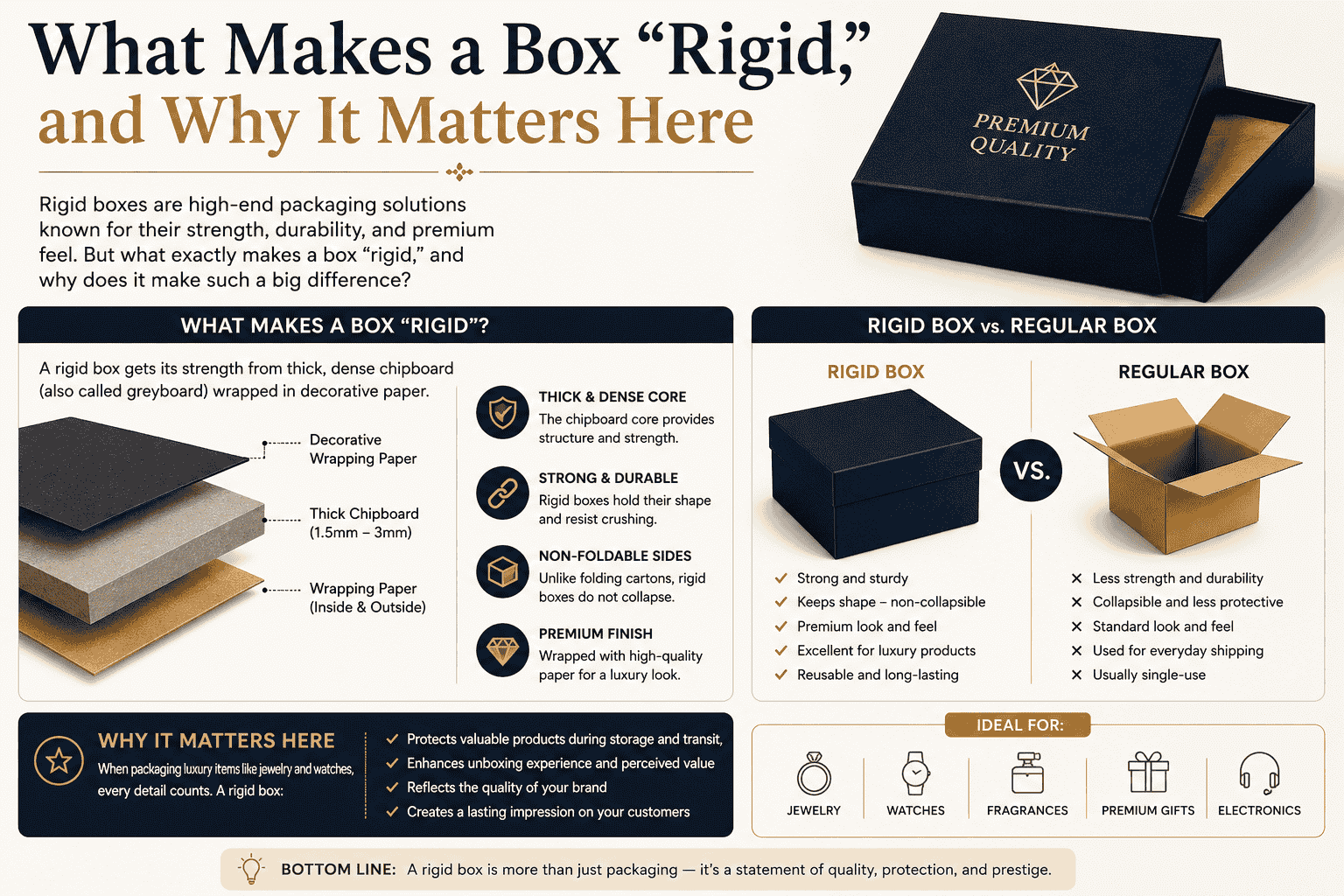
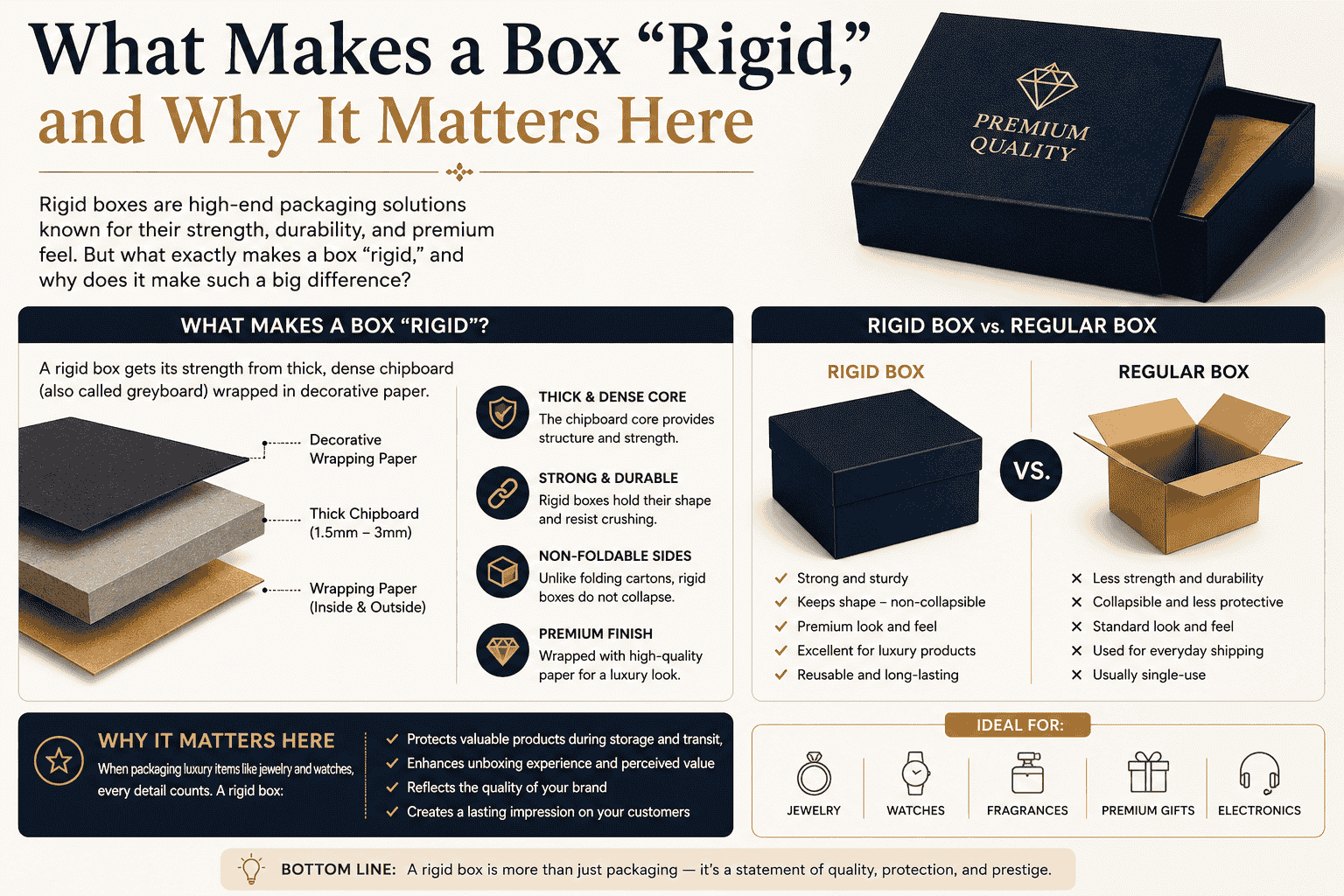
Rigid boxes are built from thick, dense paperboard (usually 1200–2000 GSM) that's wrapped in a decorative paper, leatherette, or fabric outer layer — as opposed to folding cartons, which are thin and collapse flat for shipping. That extra board thickness is what gives rigid boxes their signature weight and "snap" when you open the lid.
For jewelry and watches specifically, this matters for three reasons:
Protection. Rings, chains, and watch movements are small and easy to damage. A rigid structure resists crushing far better than a folding carton.
Perceived value. Buyers subconsciously judge product quality by the packaging it arrives in. A heavy, sturdy box signals "this is worth what I paid" before the product is even visible.
Reusability. Unlike most shipping boxes, rigid jewelry and watch boxes are often kept and reused as storage — which means your branding stays in front of the customer long after checkout.
Rigid Box Styles Worth Considering
Not every rigid box style suits every product. Here's a rundown of the most common structures used for jewelry and watches:
Two-piece (lid-and-base) boxes — the classic style, where a separate lid lifts straight off. Simple, elegant, and inexpensive to produce.
Book-style (magnetic flip) boxes — open like a hardcover book, secured by a hidden magnet. A popular choice for engagement rings and premium watch sets because the reveal feels ceremonial.
Drawer (slide) boxes — an inner tray slides out of an outer sleeve. Good for sets of multiple items (e.g., a necklace-and-earring set) since the drawer can be compartmentalized.
Collapsible rigid boxes — rigid in the hand but fold flat for storage and shipping, cutting freight costs for brands shipping at volume. Slightly more complex construction, but worth it if you're mailing hundreds of units a month.
The Features That Actually Change the Buying Decision
When you're comparing packaging suppliers or specs, these are the details that make the biggest difference in how the final box looks and performs:
Closure type
Magnetic closures feel premium and are the most common choice for mid-to-high-end jewelry and watch brands.
Ribbon pull-tabs add a tactile, gift-like moment but require slightly more manufacturing precision to avoid a loose fit.
Friction-fit lids (no magnet) are the cheapest option and fine for lower price points, but they can feel less substantial.
Interior inserts
Foam inserts cut to the exact shape of a watch or ring are the single best predictor of whether a product survives transit undamaged.
Velvet or suede-flocked inserts look and feel more luxurious than foam but cost more and are typically reserved for higher-end lines.
Slot inserts (for rings) and pillow inserts (for watches, bracelets) each solve different display needs — get this wrong and even a beautiful box will look cheap once opened.
Exterior finish
Matte lamination is the current default for modern, minimalist jewelry brands — it photographs better under studio lighting than gloss.
Soft-touch (velvet) lamination adds a tactile "premium" cue that customers notice immediately.
Foil stamping (gold, silver, rose gold) and embossing/debossing are the most cost-effective ways to make a logo feel high-end without a full custom mold.
Spot UV (a raised glossy coating over specific design elements) is a subtler upgrade often used on top of matte finishes.
Board thickness and construction quality Ask any supplier for the GSM (grams per square meter) of the board they use. Below ~1200 GSM, boxes can feel flimsy regardless of how nice the outer finish looks — this is a common corner suppliers cut to hit a lower price point.
How to Choose the Right Box for Your Brand
A simple framework to work through with your packaging supplier:
Start with the product, not the box. Measure the exact dimensions of your jewelry or watch, including any tags or authenticity cards that need to fit inside.
Match the closure and finish to your price point. A $50 pair of earrings doesn't need a velvet-lined, magnetic book box — but a $2,000 watch probably shouldn't ship in a friction-fit lid.
Decide if the box needs to survive shipping alone, or just retail handoff. E-commerce brands need boxes rated for freight (or a shipper box around the rigid box); in-store retail packaging can prioritize looks over drop-resistance.
Request a physical sample before committing to a production run. Renderings and mockups never fully capture how a finish or hinge feels in hand — and minimum order quantities on rigid boxes are usually high enough that a mistake is expensive to fix.
Confirm turnaround time against your launch date. Custom rigid boxes typically take longer to produce than folding cartons because of the lamination and assembly steps — build in buffer time, especially around holiday seasons.
Mistakes That Quietly Hurt Jewelry & Watch Brands
Sizing the box too loosely. A ring or watch that shifts around inside its box during shipping looks careless, even if nothing gets damaged.
Choosing gloss finish for fine jewelry photography. Gloss laminate reflects studio lights and creates glare in product photos — most jewelry brands are better served by matte or soft-touch.
Skipping the insert. A beautiful outer box with a bare cardboard interior undercuts the whole unboxing moment.
Underestimating minimum order quantities. Custom rigid tooling often has higher MOQs than folding cartons; ordering too small a run can make per-unit cost prohibitive.
Ignoring sustainability signals too long. More buyers now actively look for recyclable or FSC-certified packaging, particularly in the 25–40 age bracket that dominates online jewelry and watch purchases.
Packaging Trends to Watch in 2026
Sustainable materials are moving from "nice to have" to expected, with recycled paperboard and soy-based inks increasingly requested even for premium lines.
Minimalist, monochrome designs continue to dominate over heavily patterned boxes, especially among independent and DTC jewelry brands.
QR codes on packaging are being used more often to link to authenticity certificates, care instructions, or a personalized thank-you message — a low-cost way to extend the unboxing experience digitally.


Rigid boxes are built from thick, dense paperboard (usually 1200–2000 GSM) that’s wrapped in a decorative paper, leatherette, or fabric outer layer — as opposed to folding cartons, which are thin and collapse flat for shipping. That extra board thickness is what gives rigid boxes their signature weight and “snap” when you open the lid.

For jewelry and watches specifically, this matters for three reasons:

  • Protection. Rings, chains, and watch movements are small and easy to damage. A rigid structure resists crushing far better than a folding carton.
  • Perceived value. Buyers subconsciously judge product quality by the packaging it arrives in. A heavy, sturdy box signals “this is worth what I paid” before the product is even visible.
  • Reusability. Unlike most shipping boxes, rigid jewelry and watch boxes are often kept and reused as storage — which means your branding stays in front of the customer long after checkout.

Rigid Box Styles Worth Considering

Not every rigid box style suits every product. Here’s a rundown of the most common structures used for jewelry and watches:

  • Two-piece (lid-and-base) boxes — the classic style, where a separate lid lifts straight off. Simple, elegant, and inexpensive to produce.
  • Book-style (magnetic flip) boxes — open like a hardcover book, secured by a hidden magnet. A popular choice for engagement rings and premium watch sets because the reveal feels ceremonial.
  • Drawer (slide) boxes — an inner tray slides out of an outer sleeve. Good for sets of multiple items (e.g., a necklace-and-earring set) since the drawer can be compartmentalized.
  • Collapsible rigid boxes — rigid in the hand but fold flat for storage and shipping, cutting freight costs for brands shipping at volume. Slightly more complex construction, but worth it if you’re mailing hundreds of units a month.

The Features That Actually Change the Buying Decision

When you’re comparing packaging suppliers or specs, these are the details that make the biggest difference in how the final box looks and performs:

Closure type

  • Magnetic closures feel premium and are the most common choice for mid-to-high-end jewelry and watch brands.
  • Ribbon pull-tabs add a tactile, gift-like moment but require slightly more manufacturing precision to avoid a loose fit.
  • Friction-fit lids (no magnet) are the cheapest option and fine for lower price points, but they can feel less substantial.

Interior inserts

  • Foam inserts cut to the exact shape of a watch or ring are the single best predictor of whether a product survives transit undamaged.
  • Velvet or suede-flocked inserts look and feel more luxurious than foam but cost more and are typically reserved for higher-end lines.
  • Slot inserts (for rings) and pillow inserts (for watches, bracelets) each solve different display needs — get this wrong and even a beautiful box will look cheap once opened.

Exterior finish

  • Matte lamination is the current default for modern, minimalist jewelry brands — it photographs better under studio lighting than gloss.
  • Soft-touch (velvet) lamination adds a tactile “premium” cue that customers notice immediately.
  • Foil stamping (gold, silver, rose gold) and embossing/debossing are the most cost-effective ways to make a logo feel high-end without a full custom mold.
  • Spot UV (a raised glossy coating over specific design elements) is a subtler upgrade often used on top of matte finishes.

Board thickness and construction quality Ask any supplier for the GSM (grams per square meter) of the board they use. Below ~1200 GSM, boxes can feel flimsy regardless of how nice the outer finish looks — this is a common corner suppliers cut to hit a lower price point.

How to Choose the Right Box for Your Brand

How to Choose the Right Box for Your Brand

A simple framework to work through with your packaging supplier:

  • Start with the product, not the box. Measure the exact dimensions of your jewelry or watch, including any tags or authenticity cards that need to fit inside.
  • Match the closure and finish to your price point. A $50 pair of earrings doesn’t need a velvet-lined, magnetic book box — but a $2,000 watch probably shouldn’t ship in a friction-fit lid.
  • Decide if the box needs to survive shipping alone, or just retail handoff. E-commerce brands need boxes rated for freight (or a shipper box around the rigid box); in-store retail packaging can prioritize looks over drop-resistance.
  • Request a physical sample before committing to a production run. Renderings and mockups never fully capture how a finish or hinge feels in hand — and minimum order quantities on rigid boxes are usually high enough that a mistake is expensive to fix.
  • Confirm turnaround time against your launch date. Custom rigid boxes typically take longer to produce than folding cartons because of the lamination and assembly steps — build in buffer time, especially around holiday seasons.

Mistakes That Quietly Hurt Jewelry & Watch Brands

  • Sizing the box too loosely. A ring or watch that shifts around inside its box during shipping looks careless, even if nothing gets damaged.
  • Choosing gloss finish for fine jewelry photography. Gloss laminate reflects studio lights and creates glare in product photos — most jewelry brands are better served by matte or soft-touch.
  • Skipping the insert. A beautiful outer box with a bare cardboard interior undercuts the whole unboxing moment.
  • Underestimating minimum order quantities. Custom rigid tooling often has higher MOQs than folding cartons; ordering too small a run can make per-unit cost prohibitive.
  • Ignoring sustainability signals too long. More buyers now actively look for recyclable or FSC-certified packaging, particularly in the 25–40 age bracket that dominates online jewelry and watch purchases.

Packaging Trends to Watch in 2026

  • Sustainable materials are moving from “nice to have” to expected, with recycled paperboard and soy-based inks increasingly requested even for premium lines.
  • Minimalist, monochrome designs continue to dominate over heavily patterned boxes, especially among independent and DTC jewelry brands.
  • QR codes on packaging are being used more often to link to authenticity certificates, care instructions, or a personalized thank-you message — a low-cost way to extend the unboxing experience digitally.