
You have decided to invest in rigid packaging. Smart move. Rigid boxes communicate quality in a way that folding cartons simply cannot — the weight, the texture, the way they hold their shape. But now you are facing a choice that most packaging guides gloss over too quickly: magnetic closure box or drawer box?
Both are premium. Both are fully customizable. Both can carry your brand beautifully. But they work differently, cost differently, ship differently, and create completely different experiences for the person opening them. Choosing the wrong one does not just affect aesthetics — it can affect your shipping costs, your assembly process, and how customers remember your brand.
This guide breaks down every meaningful difference between the two so you can make the right call before you commit to a production run.
What Is a Magnetic Closure Box?
A magnetic closure box — also called a magnetic flap box or clamshell rigid box — is a two-piece rigid structure with a base and a lid connected by a hinge along the back edge. Concealed magnets embedded inside the front of the lid and the front panel of the base hold the box shut with a satisfying snap when closed.
The structure is almost always built from thick greyboard (typically 1,500–2,000 gsm) wrapped in printed or laminated paper, leatherette, linen, or specialty materials. The lid swings open like a book, revealing the product inside immediately and fully.
What makes this box format distinctive is the closure experience. The magnetic snap is tactile and deliberate — it feels secure and premium in a way that a tuck-end or ribbon-tie closure does not. For brands that want every touchpoint to feel considered, this matters.
Common uses include luxury apparel, corporate gift sets, PR boxes, perfume and cosmetics, high-end electronics, and subscription boxes where the unboxing is part of the brand experience.
What Is a Drawer Box?
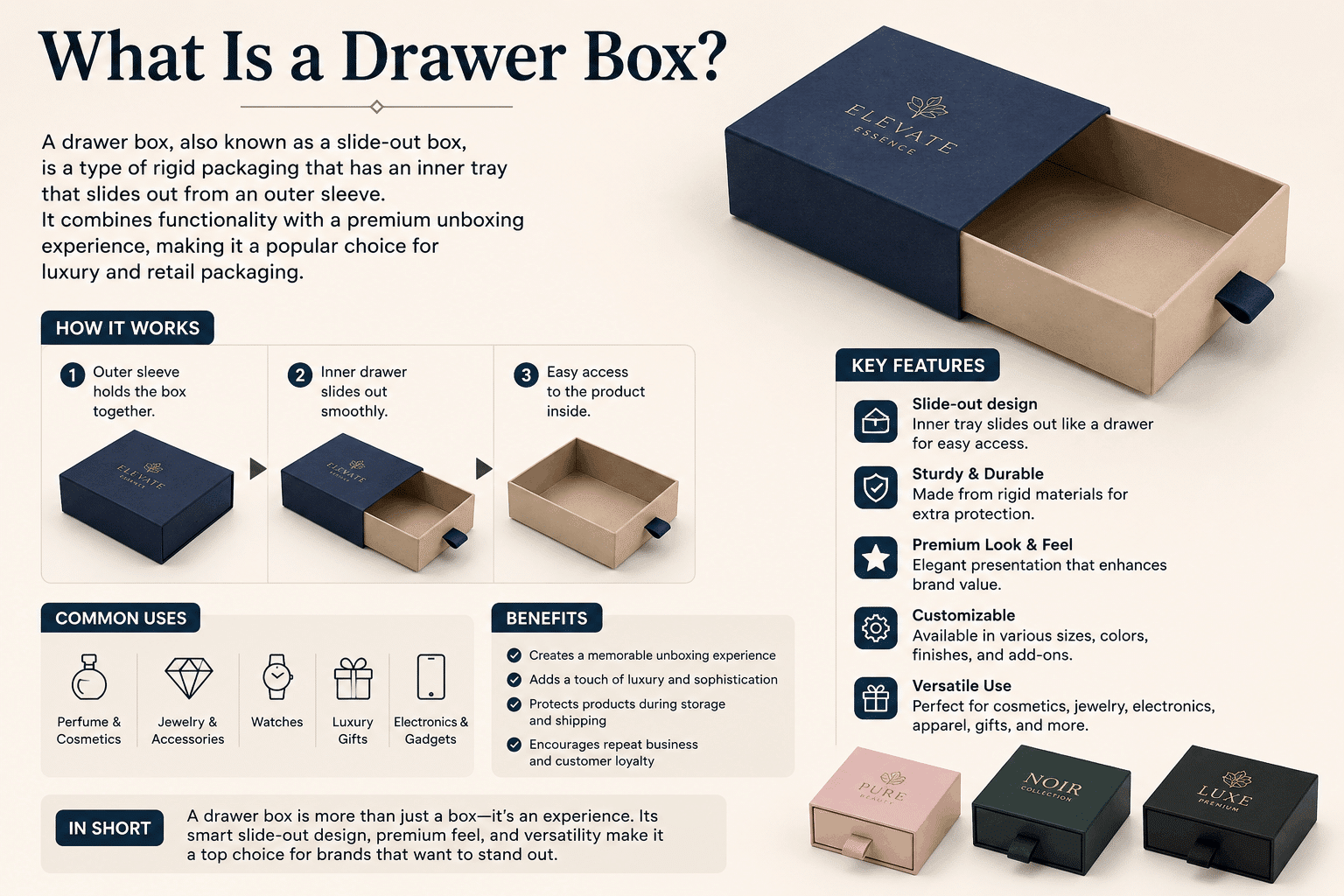
A drawer box — also called a slide box, matchbox-style box, or tray-and-sleeve box — is a two-piece structure made of an outer sleeve and an inner tray that slides in and out. The tray typically includes a ribbon pull, a thumb notch, or an exposed edge to make opening easy.
Like magnetic closure boxes, premium drawer boxes are built from rigid greyboard and wrapped in decorative material. The key difference is the opening motion: instead of flipping a lid open, the customer pulls the tray outward from the sleeve — a slow, deliberate horizontal slide that reveals the product gradually.
This sliding reveal creates a specific kind of anticipation. The product does not appear all at once. It emerges as the tray moves out, which can make even a small item feel ceremonial and considered. Jewellery brands and watch companies have used this to great effect for decades.
Common uses include jewellery, watches, pens, cufflinks, chocolates, small electronics, candles, and any product where a controlled, sequential reveal adds to the experience.
Side-by-Side Comparison
| Factor | Magnetic Closure Box | Drawer Box |
| Opening style | Hinged lid flips open | Inner tray slides out |
| Reveal speed | Immediate — full product visible at once | Gradual — product appears as tray moves |
| Product size range | Small to large | Best for small to medium items |
| Structural strength | Very high (full rigid enclosure) | High (double-walled when assembled) |
| Shipping flat-pack | No — ships assembled | Yes — sleeve and tray ship flat |
| Assembly complexity | Low (arrives ready to use) | Medium (requires tray insertion at fulfilment) |
| Reusability | High (customers keep and reuse) | High (sleeve doubles as storage) |
| Best for | Luxury gifts, PR boxes, apparel, large sets | Jewellery, watches, pens, small premium items |
| Magnet concern | Yes (avoid near electronics/pacemakers) | None |
| Cost per unit | Slightly higher | Slightly lower at volume |
How They Open: The Experience Difference
This is where the two formats diverge most meaningfully — and where most brands should start their decision.
Magnetic closure boxes deliver immediacy. The lid swings open and the customer sees everything at once. The magnet snap on closing is satisfying and repeatable. This format works well when you want the product itself to be the hero the moment the box opens — a pair of sunglasses, a silk tie, a set of cosmetics arranged in a custom insert. The full reveal is theatrical without being slow.
Drawer boxes deliver anticipation. The sliding motion creates a reveal that unfolds over two or three seconds. It feels deliberate and almost ceremonial. This format works particularly well for elongated items — a fountain pen, a watch on a cushion, a bracelet laid flat — where the horizontal slide mirrors the shape of the product and the gradual appearance adds perceived value. Many jewellery brands have built their entire unboxing identity around this motion.
Neither is better in absolute terms. The question is what kind of moment you want the customer to have.
Structural Differences: What Is Inside the Box
Understanding the engineering helps you make a better purchasing decision and brief your supplier more accurately.
Inside a Magnetic Closure Box
The greyboard base and lid are wrapped separately in your chosen material. The hinge is created by a narrow strip of connecting board along the back, usually reinforced during wrapping. The magnets — typically neodymium — are embedded into the board during assembly and covered by the wrap material so they are invisible from the outside.
The board thickness, hinge construction, wrap material, and insert height must all be calibrated together. A lid that is too heavy relative to the magnet strength will not close cleanly. A hinge that is too tight will feel stiff and may crack the wrap over time. A good supplier will prototype these interactions before running production.
One important consideration: neodymium magnets can interfere with electronics and are flagged by airline security. If your product is a device, or if your customers frequently travel with your packaging, discuss magnet strength with your supplier and consider whether drawer boxes are a better fit.
Inside a Drawer Box
The outer sleeve is a rigid tube — open at both ends in most designs, though some versions close at one end. The inner tray is a separate rigid tray that fits inside the sleeve with a controlled tolerance. Too tight and it will not slide. Too loose and it will fall out.
The tolerance engineering is the most critical factor in drawer box quality. After wrapping, printing, and assembly, the tray must slide smoothly but without slop. This is harder to get right than it sounds, and it is one of the main areas where cheap drawer boxes disappoint — the tray either sticks or slides out when the box is tilted.
A ribbon pull or thumb notch on the tray is not decorative — it is a functional necessity. Without it, opening the box is awkward and the customer may damage the wrap trying to get a grip on the tray.
Shipping and Logistics: A Real Cost Difference
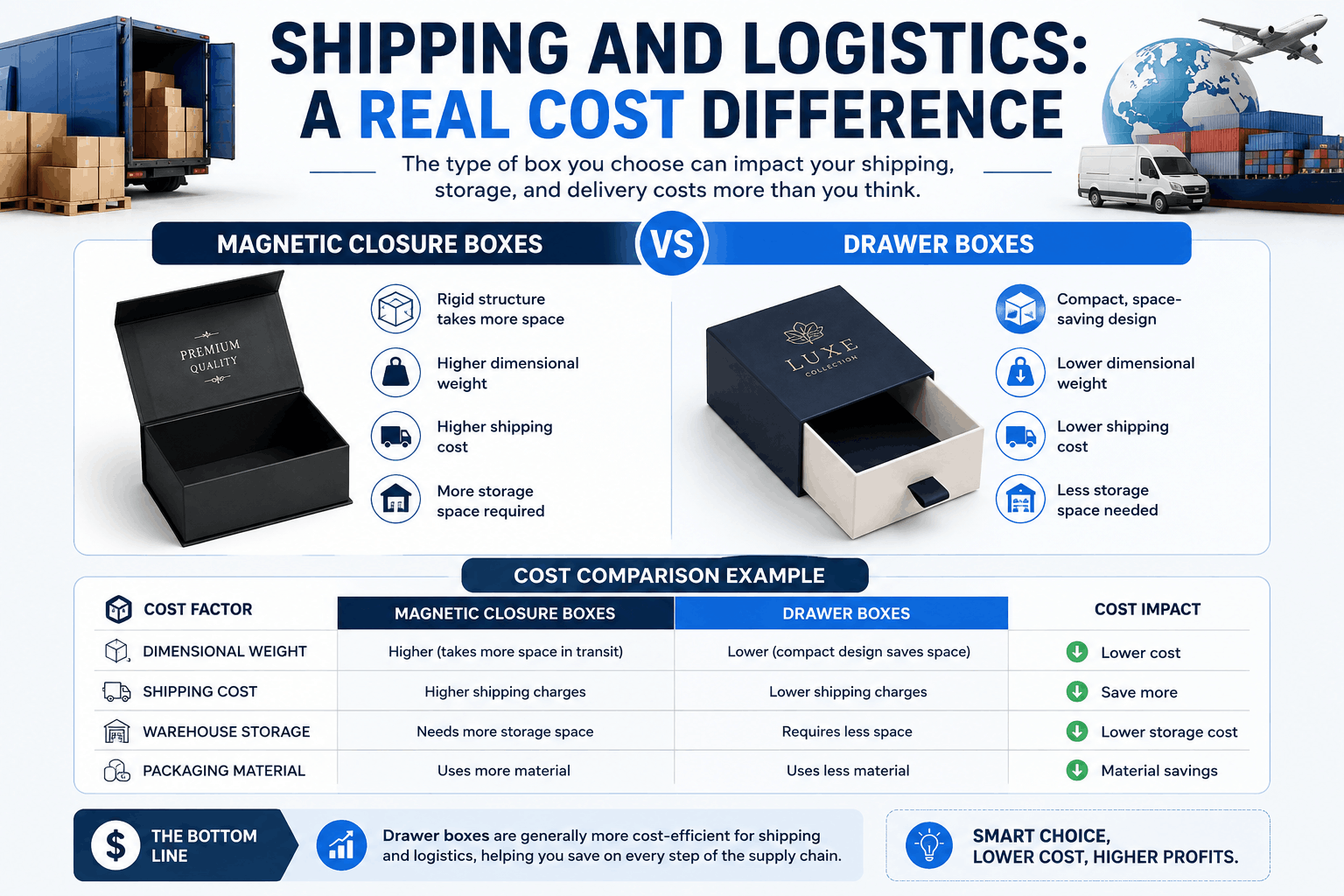
This is a factor that rarely gets enough attention in packaging comparisons, and it can significantly affect your total landed cost per unit.
Magnetic closure boxes ship assembled. The hinged structure cannot be collapsed flat without damaging the hinge. This means you are paying to ship air — the empty space inside every box — across your entire order. For overseas production, this air is expensive. A full container of assembled magnetic closure boxes holds far fewer units than the same container filled with flat-packed drawer box components.
Drawer boxes can ship flat. The sleeve and the tray are separate pieces and can be nested or stacked without assembly. This reduces shipping volume by 50 to 60 percent compared to assembled boxes of equivalent size. For high-volume orders shipped internationally, this difference can amount to thousands of dollars per container.
The trade-off is assembly labour at your end. Flat-packed drawer boxes need to be assembled — tray inserted into sleeve — before packing. For small operations or direct-to-consumer brands doing in-house fulfilment, this is minimal extra work. For high-volume automated fulfilment, it is a real operational consideration.
The rule of thumb: if you are importing large volumes internationally, drawer boxes are almost always cheaper to ship. If you are manufacturing domestically or in smaller runs where shipping cost per unit is low, the assembled convenience of magnetic closure boxes may be worth the small premium.
Customization Options: What You Can Do With Each
Both formats support the full range of rigid box customization. The differences are mostly in which techniques land best on each structure.
Printing and Wrapping
Both box types can be wrapped in:
- Coated or uncoated art paper (for full-colour printing)
- Kraft paper (natural, sustainable aesthetic)
- Leatherette or PU leather (premium tactile finish)
- Linen or fabric wrap (soft, textured, luxury feel)
- Specialty papers (marble, woodgrain, metallic)
Surface Finishes
Both support the same range of finishes on the wrap material:
- Matte lamination — soft, modern, fingerprint-resistant
- Gloss lamination — vibrant, high-contrast, bold
- Soft-touch lamination — velvety feel, extremely premium tactile quality
- Spot UV coating — glossy highlights over a matte base for contrast and depth
- Foil stamping (gold, silver, holographic, coloured) — the strongest premium signal in print finishing
- Embossing / debossing — raises or presses your logo or pattern into the material
Inserts
Both box types accommodate the full range of protective inserts:
- EVA foam cut to product shape
- Velvet or satin-lined trays
- Cardboard dividers
- Moulded pulp inserts
- Ribbon lifts (particularly common in drawer boxes)
The main structural difference is that magnetic closure boxes tend to have more interior depth and therefore more flexibility for multi-item sets and tall products. Drawer boxes work best when the product sits flat or in a shallow profile — a watch face-up, a bracelet coiled, a pen horizontal.
Sustainability Considerations
Neither format is inherently more sustainable than the other — it depends on the specific materials used and the end-of-life behaviour of the box.
Both can be made with FSC-certified board from responsibly managed forests. Both can be wrapped in recyclable paper rather than laminated plastic film. Both can be designed without magnets or metal components that complicate recycling (though this removes the defining feature of magnetic closure boxes).
The strongest sustainability argument for drawer boxes is their flat-ship capability, which reduces the carbon footprint of transport significantly. The strongest argument for magnetic closure boxes is their durability and reusability — a well-made magnetic box survives hundreds of open-and-close cycles and is frequently repurposed by consumers for storage, which extends its useful life considerably.
If recyclability at end of life is the priority, discuss material specifications with your supplier. Avoid PU leather wraps and heavy plastic laminations if you want the box to be kerbside recyclable. Paper-wrapped, non-laminated rigid boxes are the most straightforward to recycle in standard facilities.
Final Word
Magnetic closure boxes and drawer boxes are both strong choices for premium packaging — the decision is not about which is better, but which is right for your specific product, customer, and distribution model.
Choose magnetic closure when you want an immediate, cinematic reveal, need to accommodate large or multi-item products, and want a box that customers will keep on their shelf. Choose drawer boxes when you want a ceremonial sliding reveal, need to control shipping costs at volume, or are packaging small jewellery or accessories where the format is a natural fit.