
If you’ve ever opened a cereal box, a cosmetics package, or a takeout container, you’ve handled a folding carton — even if you didn’t know the name for it. Folding cartons are one of the most widely used packaging formats in the world, prized for being lightweight, affordable, and easy to customize with branding.
But “folding carton” isn’t a single design. It’s a category that covers several distinct box styles, each suited to different products, budgets, and shelf presentations. In this guide, we’ll break down the most common types of folding carton boxes, the materials they’re made from, and how to choose the right one for your product.
What Is a Folding Carton Box?
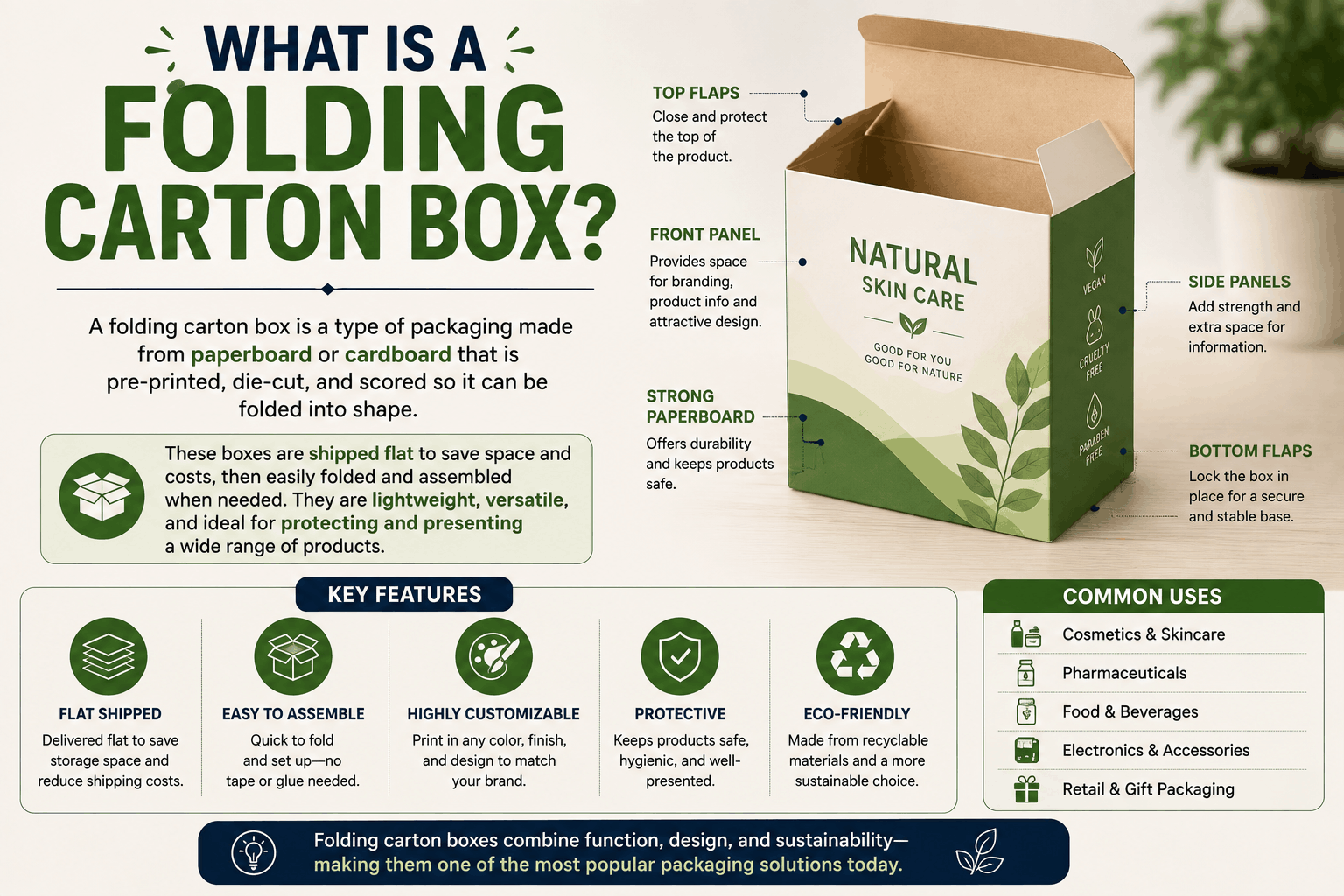
A folding carton is a box made from paperboard that is die-cut and scored flat, then folded and glued (or left unglued for tuck styles) to form a three-dimensional container. Because they ship flat and assemble on demand, folding cartons save significant space in storage and transit compared to pre-formed rigid boxes — one of the main reasons they’re a favorite for retail, food, cosmetics, and pharmaceutical packaging.
Common Materials Used for Folding Cartons
Before looking at box styles, it helps to know what folding cartons are typically made from:
- SBS (Solid Bleached Sulfate) paperboard — a bright white, coated stock often used for cosmetics, pharmaceuticals, and premium retail packaging.
- Kraft paperboard — an uncoated, natural-brown stock valued for its eco-friendly, rustic look.
- CRB (Chipboard/Recycled Board) — a cost-effective option made from recycled fibers, common for lower-cost or interior packaging.
- Corrugated microflute — a thin corrugated board sometimes used when a folding carton needs added rigidity or cushioning.
The material you choose affects cost, print quality, and durability, so it’s worth discussing with your packaging supplier before finalizing a style.
Main Types of Folding Carton Boxes
1. Straight Tuck End (STE) Boxes
In a straight tuck end box, the top and bottom flaps fold in the same direction along the same panel. This makes it one of the simplest and most economical folding carton styles to produce, which is why it’s a go-to for cosmetics, small retail items, and pharmaceuticals.
Best for: Small, lightweight products; budget-conscious runs.
2. Reverse Tuck End (RTE) Boxes
The reverse tuck end is nearly identical to the straight tuck, except the top and bottom flaps tuck in opposite directions. This small change gives the box a larger front and back panel for branding, which is why RTE boxes are so common for food items, supplements, and electronics accessories.
Best for: Products where front-panel branding and shelf visibility matter.
3. Auto-Lock Bottom (Snap-Lock Bottom) Boxes
These boxes have a bottom that locks into place with a simple push — no tape or glue needed at the point of assembly (though the box is glued during manufacturing). The auto-lock bottom distributes weight evenly, making it a strong choice for heavier or bulkier products.
Best for: Retail products, gift boxes, and items with moderate weight that need quick, secure assembly.
4. Seal End (Straight Tuck with Glued Sides) Boxes
A seal end carton looks similar to a straight tuck box but has glued side seams for extra security, often with a small tuck flap at the top or bottom for tamper resistance. These are common in food and pharmaceutical packaging where product security matters.
Best for: Food items, medications, and products needing tamper-evidence.
5. One-Piece Tuck Top (Tuck Top Auto Bottom) Boxes
These combine a self-locking auto bottom with a tuck-style top, giving you fast assembly on the bottom and easy access on the top. It’s a popular middle ground between full auto-lock designs and simple tuck boxes.
Best for: Products packed and unpacked frequently, like retail accessories or subscription boxes.
6. Two-Piece (Tray and Lid) Boxes
A two-piece box separates into a base tray and a separate lid, giving it a more premium, rigid feel even though it’s still made from foldable paperboard. This style is a favorite for jewelry, confectionery, and gift packaging where unboxing experience is part of the brand.
Best for: Luxury and gift items where presentation is a priority.
7. Gable Top Boxes
Recognizable from the milk and juice carton shape, gable boxes have a peaked, tent-like top with a built-in carry handle. They’re increasingly used beyond beverages for bakery items, takeout, and novelty retail packaging.
Best for: Food-to-go items and products that benefit from a built-in handle.
8. Sleeve (Slipcase) Boxes
Rather than a fully enclosed box, a sleeve slides over an inner tray or product to add branding and structure. It’s one of the most affordable ways to add custom print to a plain box.
Best for: Budget-friendly branding on an existing box or tray.
9. Display (Counter) Boxes
Designed to double as both shipping packaging and a point-of-sale display, these boxes often have a front cutout or perforated panel that opens to showcase the product on a store shelf or counter.
Best for: Retail products that need shelf-ready presentation straight out of the shipping carton.
10. Pillow Boxes
Named for their curved, pillow-like shape, these are typically used for small gift items, favors, or soft goods rather than heavier products, since they offer less structural support than other styles.
Best for: Small gifts, favors, and soft or lightweight items.
How to Choose the Right Folding Carton Style
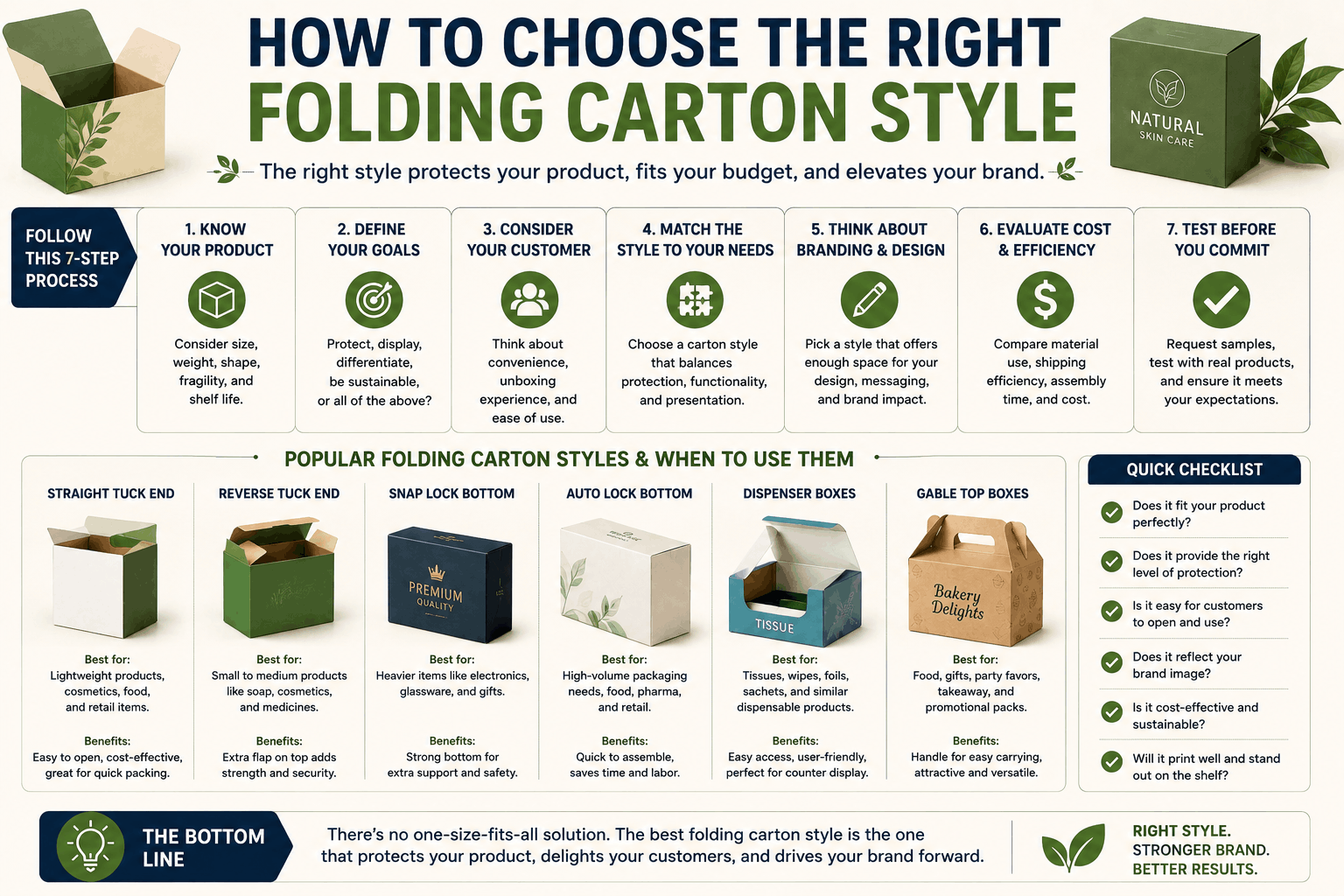
There’s no single “best” folding carton — the right choice depends on a few factors:
- Product weight and shape: Heavier items need auto-lock or two-piece designs; lightweight items can use simpler tuck styles.
- Shelf presence: If retail visibility matters, consider reverse tuck end or display boxes with more branding space.
- Unboxing experience: For gifting or premium positioning, two-piece boxes create a more elevated feel.
- Budget and order volume: Straight tuck and sleeve styles are generally the most cost-effective for large runs.
- Product security: Food, supplements, and pharmaceuticals often need seal-end or tamper-evident features.