Picking a lunch bag size sounds simple until the bag arrives too small for a wrapped sandwich or so oversized it looks half-empty on a shelf. Get the size wrong and you either waste money on paper you didn’t need, or you hand customers a bag that tears, gapes open, or doesn’t show off your branding the way it should.
This guide breaks down real-world brown paper lunch bag dimensions — small, medium, and large — so you can match the bag to what’s actually going inside it, whether that’s a packed lunch, a bakery item, or a retail product.
Quick Answer: Standard Brown Paper Lunch Bag Sizes
| Size | Width | Depth (Gusset) | Height | Best For |
| Small | 5″ | 3″ | 9.5″ | Snacks, single sandwiches, small retail items |
| Medium | 6″ | 3.5″ | 11″ | Full lunches, bakery goods, party favors |
| Large | 8″ | 4.5″ | 15.75″ | Family-size meals, groceries, bulkier products |
These are the most common off-the-shelf measurements. If your product doesn’t fit neatly into one of these, custom sizing is usually more cost-effective than sizing up and padding out a bag that’s too big — more on that below.
How to Read Paper Bag Dimensions (Width x Depth x Height)
Paper bag measurements are almost always listed in the same order: width x depth x height.
- Width — the flat front-to-back measurement when the bag is empty and folded shut.
- Depth (or gusset) — how much the bag expands at the sides and bottom, which determines how “full” it can get.
- Height — the bag’s total height from the bottom seam to the open top.
The depth is the number people overlook most, and it’s usually the reason a bag feels too tight even though the width looked fine on paper. A wide sandwich or a boxed bakery item needs gusset room, not just height.
Small Brown Paper Lunch Bags
Typical dimensions: roughly 5″ W x 3″ D x 9.5″ H
Small bags are built for single-serving items — one sandwich, a handful of snacks, or a small pastry. They’re also a popular pick for retail packaging where the product itself is compact, like jewelry, candles, or soap bars.
Good for:
- Single sandwiches or wraps
- Cookies, muffins, or small bakery items
- Party favors and small retail goods
- Snack portions for kids’ lunches
Medium Brown Paper Lunch Bags
Typical dimensions: roughly 6″ W x 3.5″ D x 11″ H
This is the size most people picture when they hear “paper lunch bag.” It has enough depth to hold a full meal — a sandwich, chips, and a piece of fruit — without the bag bulging or tearing at the seams.
Good for:
- A complete packed lunch
- Bakery boxes or wrapped baked goods
- Takeout portions for one
- Mid-size retail or gift items
Large Brown Paper Lunch Bags
Typical dimensions: roughly 8″ W x 4.5″ D x 15.75″ H
Large bags step outside “lunch” territory and into grocery or bulk-item packaging. They’re a common choice for family meal takeout, farmers market produce, or any product that needs more room to breathe.
Good for:
- Family-size or multi-item meals
- Grocery and produce packaging
- Bulk retail or gift bundles
- Products with irregular shapes that need extra clearance
Choosing the Right Size: 3 Quick Checks
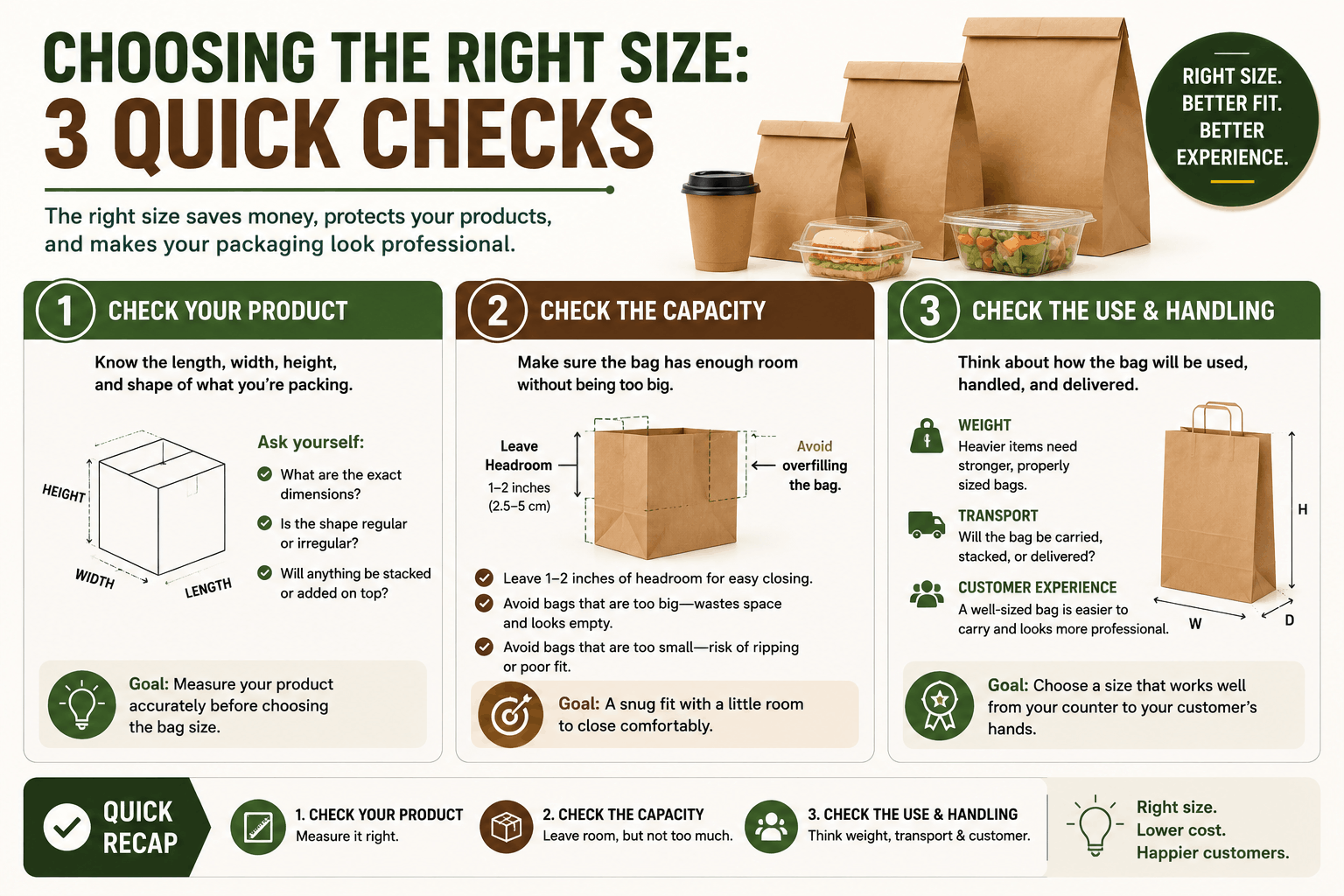
- Measure the actual item, not the “category.” A wrapped sandwich and a boxed sandwich need different depths even though they’re both “one sandwich.”
- Leave a small margin, not a lot of one. A bag that’s slightly larger than the contents folds shut cleanly. A bag that’s much larger leaves the top gaping and looks unfinished — especially on branded packaging.
- Think about what’s printed on it. If you’re printing a logo or design, a bag with more flat surface area (medium or large) gives you more room to make an impression than a small bag will.
Standard Sizes vs. Custom Sizes
Off-the-shelf sizes work well when your product is a common shape — sandwiches, baked goods, typical retail items. But if you’re consistently sizing up to make something fit, a custom dimension is usually the smarter move. It cuts material waste, keeps shipping and storage more predictable, and avoids the “why is this bag half-empty” look on a shelf or in a delivery order.