
Order a jewelry box that’s even a quarter-inch off and you’ll feel it immediately — rings sliding around inside oversized cavities, necklaces that won’t lie flat, lids that won’t close over a bulky bracelet. For a category where presentation is the sale, the wrong size costs you more than material. It costs you the unboxing moment.
This guide breaks down standard jewelry box dimensions by piece type, explains the difference between internal and external measurements (a mix-up that trips up more brands than you’d expect), and walks through how to think about sizing when you’re ready to order custom.
Why Jewelry Box Dimensions Matter More Than You’d Think
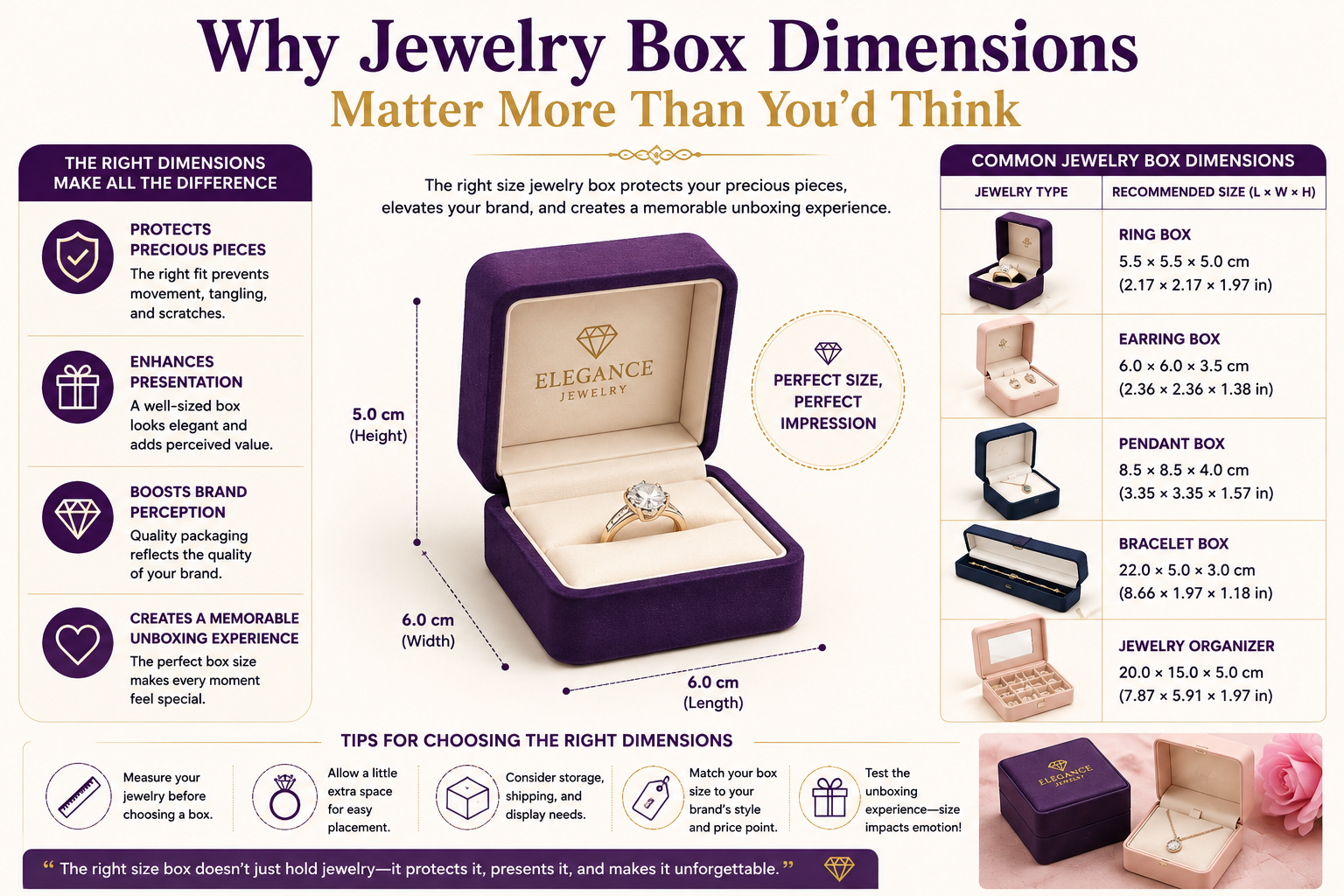
Jewelry is small, valuable, and easy to damage — which makes the box doing three jobs at once: protecting the piece in transit, presenting it well at the moment of opening, and doing both without wasting material or shelf space. A box that’s too tight risks scratching delicate finishes or forcing a clasp to bend. Go too large and you’re paying for extra cardboard, extra void-fill, and a package that looks like it’s swimming around a small item — never a good look for something marketed as premium.
There’s no single industry-wide standard, since jewelry itself varies wildly in shape. But there are well-established size ranges that most manufacturers build around, and knowing them will save you a few rounds of sampling.
Standard Sizes by Jewelry Type
Ring boxes run the smallest, typically 2″ x 2″ x 1.5″ to 2″ x 2″ x 1.75″ internally. Engagement rings with a raised center stone often need the taller end of that range, or a touch more, so the lid clears the setting without pressing on it.
Earring and stud boxes tend to be shallow and square, commonly 2″ x 2″ x 1″ to 2.5″ x 2.5″ x 1″. Drop earrings or hoops need extra depth or a slot insert to stop them from tangling.
Pendant and small charm boxes land around 3.5″ x 3.5″ x 1″, giving enough surface for a foam or velvet insert with a cut slit to hold the chain in place.
Bracelet boxes usually run longer and narrower, roughly 5.5″ x 3.5″ x 1.25″, enough to lay a bracelet flat without folding or coiling it.
Necklace boxes are the largest of the “everyday” sizes, generally 7″ x 5″ x 1″ for shorter chains, scaling up toward 8″ x 6″ x 2″ for statement pieces or layered sets that need more depth.
Large and collector boxes — multi-compartment cases for full collections — typically start around 9″ x 12″ and can extend to 13″–20″ with 6″–8″ of depth, often including trays, drawers, or dividers.
These numbers are internal cavity measurements. Add wall thickness, lining, and insert material on top when you’re calculating the box’s outer footprint.
Internal vs. External: The Mistake That Costs You a Reorder
This is the single most common sizing error: a box listed as “3” x 3″ x 1.5″” almost always refers to the external dimensions unless the supplier says otherwise. If you order based on that number expecting your jewelry to have that much room, you’ll get a box that’s noticeably tighter once you account for wall thickness and insert padding.
The fix is simple — always confirm whether a quoted size is internal or external before you commit, and when in doubt, measure the inside cavity of a sample box yourself:
- Open the box fully.
- Measure the longest horizontal edge (length), the shorter horizontal edge (width), and the vertical depth with the lid closed (height).
- Record everything in the same unit, ideally millimeters if you want precision for tooling.
- Build in roughly 10–15% of extra interior space beyond the jewelry’s own dimensions, so there’s room for a ribbon, tissue, or gift card without forcing the lid.
Stock Sizes vs. Custom Dimensions
Stock sizes are the fastest and cheapest route, and they cover the majority of common pieces — rings, studs, simple pendants. If your product line is fairly standard, stock Kraft or paperboard boxes in the sizes above will usually fit with minimal adjustment.
Custom dimensions make sense once you’re producing at meaningful volume, or your jewelry doesn’t fit neatly into standard categories — oversized statement pieces, layered necklace sets, or a signature box shape that reinforces your brand. The tooling investment for a fully custom dieline typically pays for itself once you’re ordering in the thousands of units per year; below that, stock or semi-custom (standard shape, custom print) is usually the more economical choice.
Whichever route you take, always request a dieline review or a physical sample before committing to a full production run. A flat digital mockup won’t show you how the lid sits, how the insert holds the piece, or whether the proportions actually look right in hand.
A Quick Reference Table
| Piece Type | Typical Internal Dimensions |
| Ring | 2″ x 2″ x 1.5″–1.75″ |
| Earrings/Studs | 2″–2.5″ x 2″–2.5″ x 1″ |
| Pendant/Charm | 3.5″ x 3.5″ x 1″ |
| Bracelet | 5.5″ x 3.5″ x 1.25″ |
| Necklace | 7″ x 5″ x 1″ (up to 8″ x 6″ x 2″ for statement pieces) |
| Collector/Multi-piece | 9″–20″ x 6″–8″ depth |
Getting Your Sizing Right the First Time
Jewelry box dimensions aren’t just a technical spec — they’re part of how customers judge the quality of what’s inside before they’ve even touched it. Get the size right, and the box disappears into the experience; get it wrong, and it’s the first thing people notice.
If you’re planning your next run of jewelry packaging, [Your Business Name] can help you land on the right dimensions from the start — whether that’s a stock size that fits off the shelf or a fully custom dieline built around your product line. Reach out for a free size consultation and 3D mockup before you commit to a production run.