If you’ve ever received a small gift, a candle, or a piece of jewelry in a box shaped like a rounded cushion, you’ve handled a pillow box. They’ve become one of the most popular packaging styles for small retail and gift items over the past few years — and for good reason. They’re inexpensive to produce, easy to customize, and they photograph beautifully, which matters a lot for brands selling through Instagram, TikTok, or their own e-commerce site.
This guide covers what a pillow box actually is, what it’s made of, when it’s the right packaging choice (and when it isn’t), and how to think through customizing one for your own products.
What Is a Pillow Box?
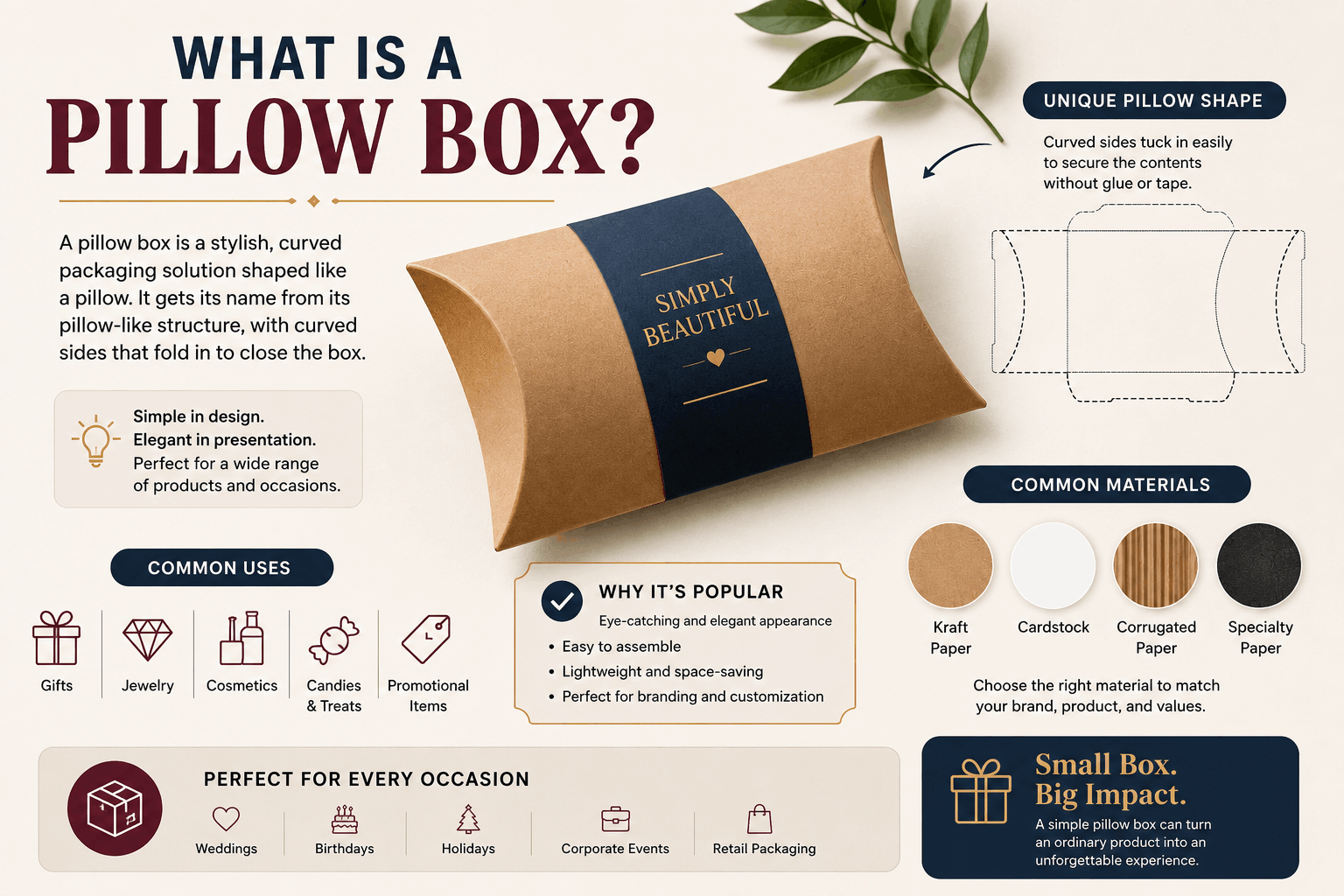
A pillow box is a curved, cushion-shaped box formed from a single piece of die-cut paperboard that folds and locks into a rounded shape without glue or tape. The name comes from its resemblance to a small pillow — flat on the ends, gently arched along the top and bottom.
Structurally, it’s one of the simplest box styles to produce: a single sheet of stock is scored and creased, then folded so the two tucked ends hold the shape closed. That simplicity is part of the appeal — no complex assembly, no separate lid, and (in most designs) no adhesive needed at all.
What Are Pillow Boxes Made Of?
Most pillow boxes are produced from one of three materials, chosen based on the product inside and the look a brand wants:
- Cardstock — the most common choice. Smooth, lightweight, and excellent for high-resolution printing, making it a favorite for retail and gift packaging that leans on strong branding.
- Kraft paper — heavier and more textured, often chosen for a natural or eco-friendly aesthetic. Popular with brands that want to signal sustainability without saying it outright.
- Clear or frosted PVC/plastic — used when a brand wants the product itself to be the focal point, common for candy, soap, or small novelty items.
Thickness typically ranges from lightweight stock for very small, light items up to heavier board for boxes that need to hold a bit more structural weight, like a candle or a stack of stationery.
Why Brands Use Pillow Boxes
They stand out visually. The curved silhouette is instantly different from the rectangular boxes that dominate most shelves and unboxing videos, which makes it easier to catch attention in a crowded product photo or retail display.
They’re inexpensive relative to their impact. Because they’re a single-piece die-cut with no separate lid or extensive assembly, production costs run lower than rigid or multi-piece boxes, while still reading as more considered than a plain poly bag.
They’re naturally suited to gifting. The shape alone feels a little more special than a standard carton, which is why pillow boxes show up so often for favors, small gifts, jewelry, and seasonal retail — the packaging does some of the presentation work for you.
They customize easily. Because the surface area is mostly flat with gentle curves, printing, foil stamping, and embossing all transfer cleanly, without the awkward seams that some box styles have to work around.
They’re quick to assemble. No glue, minimal folds, and a design that locks itself closed — useful for small businesses hand-packing orders without production-line equipment.
Common Uses for Pillow Boxes
Pillow boxes tend to work best for products that are small, lightweight, and don’t need heavy structural protection:
- Jewelry and accessories — rings, earrings, bracelets, and small watches
- Candles and bath products — bath bombs, soap bars, small candle tins
- Confectionery — chocolates, macarons, small candy assortments
- Beauty and skincare minis — lip balms, sample-size products, travel sets
- Gift favors — wedding favors, baby shower favors, small party gifts
- Stationery and small keepsakes — greeting cards, small prints, charms
When a Pillow Box Isn’t the Right Choice
It’s worth being honest about the limits, since the wrong packaging choice costs more in returns and damaged-product complaints than it saves in printing costs upfront.
- Fragile or delicate items (like cake, glassware, or anything easily crushed) generally need a rigid or corrugated box with real structural support — a pillow box’s curved single-layer construction isn’t built to protect against pressure.
- Liquids or anything that could leak should never go directly in a paperboard pillow box without a sealed inner container, since the material isn’t moisture-resistant on its own.
- Heavier products put strain on the tucked-end closure, which can pop open in transit if the box is holding more weight than it’s designed for.
- Shipping-heavy businesses should treat a pillow box as inner packaging, not the sole shipping container — it protects presentation, not impact.
A simple gut check: if the product could survive being gently squeezed in transit, a pillow box is probably fine. If not, it needs a sturdier outer layer.
Customization Options to Consider
Since a pillow box’s whole value proposition is presentation, customization is where most of the design decisions actually matter:
- Printing — full-color CMYK printing works well on cardstock for photography, patterns, or brand illustrations.
- Foil stamping — metallic gold, silver, or rose gold accents on a logo or pattern add a premium feel without a large cost increase.
- Window cutouts — a die-cut window (sometimes with a clear film insert) lets the product itself act as part of the packaging design.
- Embossing/debossing — raised or recessed detailing on a logo, useful when a brand wants texture without adding color.
- Ribbon or string closures — an added ribbon through die-cut slots gives the box a finished, gift-ready look and makes it easier to open without tearing.
As with most packaging, restraint matters — one or two well-executed finishing touches usually read as more premium than combining every option available.
Pillow Box vs. Other Small Packaging Styles
| Style | Assembly | Best For | Structural Strength |
| Pillow box | Single-piece, no glue | Gifts, small retail items | Low-moderate |
| Tuck-end box | Folded, self-locking | General retail, cosmetics | Moderate |
| Rigid box | Multi-piece, glued | Premium/luxury items | High |
| Poly mailer/bag | Sealed | Shipping, apparel | Low (no rigid protection) |
Pillow boxes sit in a specific niche: more visual impact than a tuck-end box, less production cost than a rigid box, and considerably more presentation value than a poly bag. They’re not meant to replace heavier-duty packaging — they’re meant to be the best option for products where presentation matters as much as protection.
Final Thoughts
A pillow box won’t be the right fit for every product, but for small, gift-worthy, or presentation-driven items, it’s one of the most cost-effective ways to make packaging feel considered rather than generic. The shape does a lot of the visual work on its own — the details you add on top (material, finish, printing) are what turn it into something that actually represents your brand.
If you’re weighing pillow boxes against other packaging styles for your product line, [Your Brand Name] can help you figure out the right material, size, and finish for what you’re selling — reach out and we’ll help you land on the right fit.