
Talked to a guy running a small home goods store a while back, and he told me this whole story about ordering the wrong type of corrugated boxes for his first big shipment of retail stock. Boxes he got were built for shipping, tough, plain, nothing pretty about them at all, and he ended up unpacking everything and repackaging half his inventory into nicer boxes just so it’d look decent sitting on store shelves. Cost him a weekend and some money he really hadn’t planned on spending. Simple mix-up honestly, but an expensive one.
If you’re new to ordering corrugated boxes for your business, retail and shipping boxes actually serve pretty different purposes even though they’re made from similar material. Mixing them up happens more than you’d think.
Same Material, Completely Different Jobs Though
Corrugated just refers to the material itself, that wavy layer sandwiched between flat cardboard sheets giving it strength and some cushioning. Both retail and shipping boxes use this same base material, which is honestly why people assume they’re interchangeable when they’re really not.
Real differences come down to purpose. Shipping boxes exist to protect a product getting from point A to point B. Retail boxes exist to sell a product while it’s sitting there on a shelf, which is a totally different job needing different design choices entirely.
What Actually Makes a Shipping Box a Shipping Box
Built almost entirely around durability and cost efficiency, appearance barely factors in here.
Shipping boxes generally use heavier board, sometimes double or triple wall for fragile or heavy stuff, since they need to survive getting tossed around a delivery truck, stacked under other packages, handled by people who aren’t always gentle about any of it. Most stay plain brown too, maybe a basic logo stamp if anything at all, no point spending money on elaborate printing for something getting torn open and tossed in recycling within minutes of arriving anyway.
They usually come in a handful of standard sizes rather than fully custom dimensions as well, keeps costs down since standard sizing’s cheaper to produce in bulk than custom one-off dimensions for every single product you sell.
What Actually Makes a Retail Box a Retail Box
Flips the priority almost entirely, appearance and shelf presence matter as much, sometimes more, than raw durability alone.
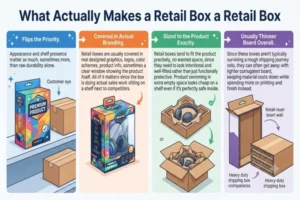
Covered in Actual Branding
Retail boxes are usually covered in real designed graphics, logos, color schemes, product info, sometimes a clear window showing the product itself. All of it matters since the box is doing actual sales work sitting on a shelf next to competitors.
Sized to the Product Exactly
Retail boxes tend to fit the product precisely, no wasted space, since they need to look intentional and well-fitted rather than just functionally protective. Product swimming in extra empty space looks cheap on a shelf even if it’s perfectly safe inside.
Usually Thinner Board Overall
Since these boxes aren’t typically surviving a rough shipping journey solo, they can often get away with lighter corrugated board, keeping material costs down while spending more on printing and finish instead.
Can One Box Actually Do Both Jobs
Sometimes yeah, though it’s more of a middle ground than a perfect combo honestly.
Some businesses use boxes designed to double as both, sturdy enough for shipping but also branded and structured to slide directly onto a retail shelf without needing repackaging once it hits the store. Saves a step for retailers, which makes them more likely to want to stock your product in the first place.
Usually a trade-off though. A box trying to do both jobs at once often ends up a bit pricier than a pure shipping box while still not looking quite as polished as a dedicated retail box would. Fine for some businesses, not ideal if you’re leaning hard into premium shelf presentation.
Which One Do You Actually Need
Depends a lot on how you’re actually selling the product.
Selling purely online, shipping boxes make the most sense since customers never see it on a shelf anyway, just receiving it at their door. Spend design budget on the unboxing experience instead, tissue paper, inserts, a nice printed thank-you card, rather than the outer shipping box itself.
Selling in physical retail stores though, retail boxes are worth the investment since the box itself is part of the actual sales pitch, competing for attention against other products on that same shelf.
Selling both ways is where a lot of businesses end up needing two different box types honestly, plain sturdy shipping box for direct-to-customer orders, separate nicely designed retail box for anything going into physical stores. Costs a bit more managing two SKUs of packaging, but avoids that whole repackaging headache the home goods guy ran into.
Worth Checking Before You Order
Test shipping boxes with an actual full shipment before committing to a big order, sometimes what looks sturdy on paper doesn’t hold up once it’s stacked under other packages during real transit. For retail boxes, actually look at how it sits on a shelf next to similar products before finalizing anything, since what looks good alone on a table can get lost or just blend in once surrounded by competitors in a real store.
Final Thoughts
Retail and shipping corrugated boxes might share the same base material, but they’re solving two pretty different problems really, one protecting a product in transit, the other selling it while it sits there waiting to get picked up. Knowing which one you actually need, or whether you need both, saves the kind of expensive mix-up that guy with the home goods store learned the hard way.