
This question comes up more than almost anything else I deal with. Someone’s launching a frozen meal line, or moving out of a small local freezer section into real retail shelves, and the packaging question ends up being harder than they expected. Frozen food isn’t like packing a candle or a t-shirt. The material has to survive temperatures that crack most standard packaging, hold up through freeze-thaw cycles during shipping, and still look good enough to sell once it’s under store lighting.
A lot of people just assume any plastic bag will work. It won’t. I’ve watched products fail in testing because someone picked a material that looked fine sitting in a warehouse and then cracked apart the second it hit negative twenty degrees. So here’s what actually holds up, what doesn’t, and why this decision matters almost as much as the recipe itself.
Why Frozen Packaging Is a Different Game Entirely
Regular food packaging only has to deal with room temperature, maybe a fridge at worst. Frozen packaging deals with extreme cold, constant moisture buildup, and getting stacked and thrown around during shipping before it ever reaches a customer’s freezer. A material that’s totally fine on a bag of chips can go brittle and snap at freezer temperatures. That’s not theoretical — it happens all the time with businesses that skip proper cold-chain testing.
Then there’s moisture. Ice crystals form inside packaging whenever temperature fluctuates, and if the material can’t handle that, you end up with freezer burn, soggy packaging, or worse — contamination if the product thaws slightly in transit and gets refrozen.
Three Things a Frozen Packaging Material Has to Get Right
Cold resistance is the obvious one, but it’s really just step one. The material also needs a real moisture barrier, since frozen food quality drops fast once water vapor starts moving in or out. And it needs enough physical strength to survive being tossed around a distribution center, because nobody handles frozen shipments gently.
Plastic Films: Still the Industry Workhorse.
Plastic films dominate this industry, and honestly, for good reason. They’re flexible, cheap to produce at scale, and they seal tight enough to keep moisture out.
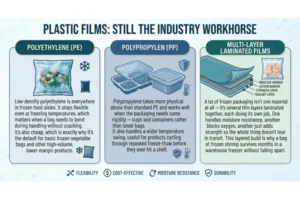
Polyethylene (PE)
Low-density polyethylene is everywhere in frozen food aisles. It stays flexible even at freezing temperatures, which matters when a bag needs to bend during handling without cracking. It’s also cheap, which is exactly why it’s the default for basic frozen vegetable bags and other high-volume, lower-margin products.
Polypropylene (PP)
Polypropylene takes more physical abuse than standard PE and works well when the packaging needs some rigidity — trays and containers rather than loose bags. It also handles a wider temperature swing, useful for products cycling through repeated freeze-thaw before they ever hit a shelf.
Multi-Layer Laminated Films
A lot of frozen packaging isn’t one material at all — it’s several thin layers laminated together, each doing its own job. One handles moisture resistance, another blocks oxygen, another just adds strength so the whole thing doesn’t tear in transit. This layered build is why a bag of frozen shrimp survives months in a warehouse freezer without falling apart.
Paperboard: The Structural Layer Behind Most Boxed Frozen Foods
Walk down any frozen food aisle and most of what’s in front of you isn’t plastic on the outside at all — it’s coated paperboard. Frozen pizza boxes, ice cream cartons, TV dinner trays, they almost all use treated paperboard as the outer shell.
Why It Needs a Coating
Plain paperboard falls apart the second it gets wet, and frozen food generates condensation constantly as it moves between temperature zones. That’s why frozen paperboard packaging usually gets a wax coating or a polyethylene lining on the inside. The coating keeps moisture out of the fibers while the paperboard itself handles printing, branding, and holding its shape.
Where It Actually Makes Sense
It works best as an outer shell, not as direct food-contact packaging. A frozen pizza box wrapped around a plastic film liner is the classic example — the paperboard gives it shelf presence and stacking strength, while the inner film does the actual job of protecting the food.
Aluminum: Old-School but Still Relevant
Aluminum trays and foil aren’t as trendy as they once were, but they haven’t gone anywhere, and there’s a reason. Aluminum conducts heat and cold extremely well, so food packaged in it freezes faster and reheats more evenly than food in plastic. That’s a genuine advantage for TV dinners and other oven-ready meals.
The Trade-Offs
Aluminum isn’t microwave-safe, and as microwave use overtook oven use for quick meals, that pushed a lot of manufacturers toward plastic or hybrid trays instead. It’s also heavier and more expensive per unit than plastic film, so it tends to end up in premium or oven-specific product lines rather than budget frozen meals.
Rigid Plastic Containers
For anything with sauce, liquid, or a shape that needs to hold together — frozen soups, casseroles, ice cream — rigid containers matter more than flexible film.
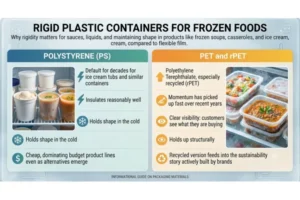
Polystyrene (PS)
Polystyrene has been the default for ice cream tubs and similar containers for decades. It insulates reasonably well, holds its shape in the cold, and it’s cheap enough that it still dominates budget product lines even as more companies shift toward alternatives.
PET and rPET
Polyethylene terephthalate, especially the recycled version, has picked up momentum fast over the past several years. It’s clear, which matters when customers want to see what they’re buying, and it holds up structurally. The recycled version also feeds into the sustainability story a lot of frozen food brands are actively building right now.
Sustainable Materials Are Reshaping This Industry
This whole conversation basically didn’t exist ten years ago, and now it comes up in almost every packaging meeting I sit in on. Compostable films made from plant-based polymers are starting to show up in frozen food, though they’re still catching up to traditional plastic when it comes to cold-temperature performance. Recycled paperboard paired with plant-based coatings instead of standard polyethylene linings is also gaining ground, mostly with brands trying to build a cleaner environmental story around what they sell.
None of these alternatives are quite there yet. Compostable films especially still struggle with moisture barrier performance at extreme cold, which is a real problem given that keeping moisture out is the entire point of frozen packaging. But the materials are improving fast enough that I’d expect this gap to close within a few years.
Matching the Material to the Product
There isn’t one right answer, and that’s usually where new brands trip up. A bag of frozen peas doesn’t need the same packaging as a single-serve frozen lasagna, and treating them the same way means overpaying on one product and under-protecting the other.
Loose items like vegetables and fruit generally do fine with simple PE or PP film, since the product itself isn’t fragile and doesn’t need rigid structure around it. Ready meals with sauce or layered components usually need rigid trays — plastic or aluminum — paired with a film lid to keep everything sealed. Premium or oven-ready products tend to lean toward aluminum or heavier laminated trays, since they need to survive both the freezer and, later, direct heat.
Final Thoughts
Choosing the right material for frozen food packaging shouldn’t be a decision left until the end of product development — it needs to be part of the conversation from day one. Get it wrong and you’re dealing with freezer burn, cracked bags, soggy boxes, or a product that just doesn’t survive the trip from warehouse to freezer aisle looking the way it should. Get it right and packaging becomes something customers never even think about, which is honestly the whole point. Nobody remembers a bag that worked perfectly. They only remember the one that didn’t.