
Pick up any deck of cards and shuffle through it, and you’ll run into the same three faces over and over — King, Queen, Jack. Most of us learned to recognize them before we even understood how to play a proper game. But ask someone why the Jack ranks below the Queen, or why the King of Hearts looks like he’s stabbing himself in the head, and you’ll probably get a blank stare. I’ve been playing cards since I was a kid, and it wasn’t until years later, digging through old card history for fun, that I actually learned where all this came from. So here’s the rundown — the stuff casual players skip past without ever really noticing.
What Counts as a Face Card
A standard deck has 52 cards, four suits, thirteen cards apiece. Out of those thirteen, three break the pattern — instead of pips (those little suit symbols scattered across the card), you get an actual illustrated person. That’s your King, Queen, and Jack. Everything else, from Ace through 10, is a number or “pip” card.
Do the math across all four suits and you land on:
- 4 Kings
- 4 Queens
- 4 Jacks
Twelve face cards total, out of 52. Not a huge chunk of the deck, but they punch above their weight in almost every card game you can name.
The “Court Card” Thing
You’ll hear people — especially in the UK — call these “court cards” instead of face cards. Same idea, different name. It comes from the fact that a King, Queen, and Jack are basically a mini royal court sitting in your hand. The Jack used to be called a “knave,” which meant something closer to a servant or a young attendant to nobility, which is honestly why he sits at the bottom of the face-card pecking order.
Where Face Cards Actually Came From
Cards weren’t always drawn this way. Most historians point back to 9th-century China as the rough origin point, though what we’d recognize today took shape much later, after the concept moved through the Islamic world and eventually landed in Europe sometime around the 1300s.
Before Kings and Queens, There Were Viceroys
Early Mamluk decks — which a lot of scholars think heavily influenced what came next in Europe — didn’t even have kings and queens the way we picture them. Their court cards were more like a king, a deputy, and a second deputy. When these designs made their way into Italy, Spain, and France, local artists redrew everything to match their own royal structures. And it’s France, more than anywhere else, that really locked in the look we still use today.
Why French Decks Became the Standard
Somewhere around the 15th and 16th centuries, French card makers settled on a design that spread and stuck — the one most English-speaking countries still use. They also had this habit of tying each face card to a real or legendary historical figure. You’ll often see:
- King of Hearts linked to Charlemagne
- King of Spades tied to King David
- King of Diamonds representing Julius Caesar
- King of Clubs associated with Alexander the Great
None of this is set in stone, by the way — different sources give different figures, and there’s no single “correct” version. But it’s a neat detail that turns an ordinary deck into something with actual history behind it.
The Three Face Cards, One at a Time
King
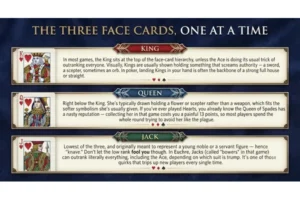
In most games, the King sits at the top of the face-card hierarchy, unless the Ace is doing its usual trick of outranking everyone. Visually, Kings are usually shown holding something that screams authority — a sword, a scepter, sometimes an orb. In poker, landing Kings in your hand is often the backbone of a strong full house or straight.
Queen
Right below the King. She’s typically drawn holding a flower or scepter rather than a weapon, which fits the softer symbolism she’s usually given. If you’ve ever played Hearts, you already know the Queen of Spades has a nasty reputation — collecting her in that game costs you a painful 13 points, so most players spend the whole round trying to avoid her like the plague.
Jack
Lowest of the three, and originally meant to represent a young noble or a servant figure — hence “knave.” Don’t let the low rank fool you though. In Euchre, Jacks (called “bowers” in that game) can outrank literally everything, including the Ace, depending on which suit is trump. It’s one of those quirks that trips up new players every single time.
Why Face Cards Actually Matter When You’re Playing
Blackjack and Point Values
Every face card is worth exactly 10 in blackjack — doesn’t matter if it’s a King, Queen, or Jack, they’re all the same. Pair one with an Ace and you’ve got yourself a blackjack right off the deal. Simple rule, but it’s the reason face cards get so much attention at the table.
Rummy Games
In most rummy variants, face cards carry more point value than your average number card. Which sounds fine until you’re the one still holding a Queen and a Jack in your hand when someone else goes out — that’s a rough way to lose a round.
Poker Rankings
Face cards outrank number cards, with King sitting just under the Ace. Having them in your starting hand generally bumps your odds of walking away with a decent pair, trips, or at least a strong high card at showdown.
Games Where They Do Something Weird
Not every game treats face cards the same way. Euchre’s bower system is the obvious one, but plenty of Uno-style adaptations built around a standard deck use Jacks as skip or reverse cards. It’s a small twist, but it changes how you think about holding onto them.
A Few Things Most People Never Notice
One-Eyed Royals
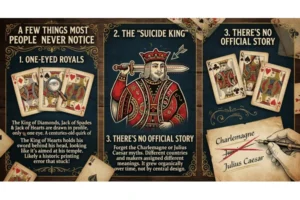
Look closely next time you’ve got a deck in your hands. The King of Diamonds and both the Jack of Spades and Jack of Hearts are drawn in profile — meaning you only ever see one eye. Card players nicknamed them the “one-eyed royals” for exactly that reason. There’s no deep meaning behind it, just how the illustration ended up being drawn centuries ago and never got changed.
The “Suicide King”
The King of Hearts holds his sword in a way that makes it look like it’s pointed straight at his own head — which is how he earned the nickname “suicide king.” Most card historians chalk it up to a printing or engraving slip from way back that just never got corrected as decks were mass-produced.
There’s No Official Story
As fun as the Charlemagne-and-Julius-Caesar angle is, don’t treat it as gospel. Different countries and different manufacturers assigned different meanings over the centuries, and there was never one central authority deciding “this is what the King of Clubs represents.” It grew organically, which honestly makes it more interesting, not less.
Wrapping It Up
Twelve cards out of fifty-two doesn’t sound like much, but face cards carry more weight — historically and strategically — than almost anything else in the deck. From murky origins in Mamluk playing cards to the French designs that eventually became the standard, and all the way to how they function in poker, blackjack, and Euchre today, the King, Queen, and Jack have earned their spot as the most recognizable cards in the pack. Next time you’re shuffling a deck before a game night, take a second look at them — there’s more going on than most people ever bother to notice.