
Every few weeks, I get a client who’s convinced flute selection doesn’t really matter — “it’s just cardboard, right?” — and every few weeks, I have to gently explain why that assumption has cost more businesses money than almost any other packaging decision I’ve watched go wrong. Flute type isn’t a small technical footnote buried in a spec sheet somewhere. It’s the actual backbone of how your box performs, and getting it wrong shows up fast — crushed corners, bulging sides, or a shipping bill that’s higher than it needed to be.
If you’ve never had a reason to think about flutes before, that’s completely normal. Most people haven’t. So let’s break this down properly, the way I’d walk a client through it the first time this question comes up.
What a Flute Actually Is
Before comparing types, it helps to know what “flute” even refers to, since the word alone confuses people who’ve never worked with corrugated packaging.
The Wave Hiding Inside Your Box
Corrugated cardboard isn’t a flat sheet — it’s built from a wavy, fluted layer of paper sandwiched between flat liner sheets. That wave shape is where the strength actually comes from, since a wavy structure resists crushing far better than a flat piece of the same material ever could alone. The size of that wave is what “flute” refers to.
Why Flute Size Changes Everything..
The basic trade-off looks like this:
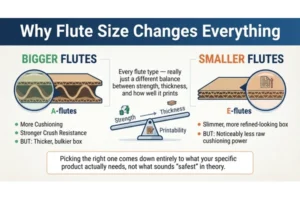
- Bigger flutes — more cushioning, stronger crush resistance, but a thicker, bulkier box
- Smaller flutes — slimmer, more refined-looking box, but noticeably less raw cushioning power
- Every flute type — really just a different balance between strength, thickness, and how well it prints
Picking the right one comes down entirely to what your specific product actually needs, not what sounds “safest” in theory.
The Main Flute Types You’ll Actually Run Into
There are more flute variations out there than most people realize, but a handful of them cover the vast majority of real-world packaging needs.
A Flute: Thick, Strong, Old-School Reliable
A flute is the original corrugated flute — thick, strong, excellent at cushioning and stacking. It’s what most people picture when they imagine a traditional shipping box: sturdy, a little bulky, built to survive rough handling without much drama.
Where it works best:
- Heavier, fragile items that need serious cushioning during transit
- Products facing a lot of rough handling between warehouse and doorstep
Where it falls short:
- Takes up more shipping space and material, which adds cost
- Not great for fine, detailed printing, since the thick wave underneath can distort finer graphics

B Flute: Thinner, Sturdier for Its Size
B flute is noticeably thinner than A flute but still holds up well against crushing, especially when boxes are stacked flat. It’s a common pick for canned goods, smaller retail boxes, and point-of-purchase displays that need to hold their shape without adding much bulk.
Its biggest strength is printability — the flatter surface takes detailed graphics much better than A flute does, which matters a lot when the box itself is doing some of the marketing work on a shelf.
C Flute: The Everyday Workhorse
C flute sits right between A and B, and it’s probably the flute you’ve handled the most without ever noticing. It’s the default choice for standard shipping cartons across a huge range of industries, since it balances decent cushioning, reasonable strength, and manageable thickness better than almost anything else out there.
If you’re genuinely unsure which flute your product needs, and nothing about it screams “unusual requirements,” C flute is a safe, sensible starting point — which is exactly why it became the industry default for general shipping in the first place.
E Flute: Thin, Precise, Retail-Friendly
E flute is considerably thinner than A, B, or C, built for situations where a slim profile and clean printing matter more than raw crush strength. Think:
- Retail packaging for smaller items
- Cosmetics boxes
- Anything meant to sit directly on a store shelf rather than survive rough freight handling
The trade-off is obvious — less cushioning, less crush resistance. It’s not the flute you reach for when shipping something heavy or fragile long distance. It’s the flute you reach for when the box itself needs to look sharp and hold detailed print work cleanly.
F Flute and Beyond: The Ultra-Thin Specialists
F flute, and the even thinner micro-flutes beyond it, exist mainly for small, lightweight retail packaging that needs to feel almost as refined as rigid board, without the cost of actually using rigid board. Common in:
- Cosmetics
- Small electronics
- Premium retail packaging where presentation matters more than shipping durability
How to Actually Choose the Right One
Flute selection isn’t really about finding the “best” flute in some abstract sense — there isn’t one. It’s about matching flute characteristics to what your specific product actually needs.
Start With Weight and Fragility
- Heavier, more fragile products → thicker flutes like A or C, for genuine cushioning during transit
- Lighter, sturdier products → thinner flutes like E or F, without much real risk, and with material cost savings
Think About Where the Box Will Actually Live
- Mostly moving through a distribution network → prioritize strength, C flute or thicker usually makes sense
- Sitting on a retail shelf facing customers directly → prioritize printability and clean appearance, B or E flute usually fits better
Factor In Your Printing and Branding Needs
If your design leans on sharp, detailed graphics — fine text, gradients, photographic printing — thinner flutes like B or E handle that far better than thick A flute, since the flatter surface doesn’t distort the print the way a heavier wave underneath tends to.
Don’t Ignore the Shipping Cost Angle
Thicker flutes take up more space, which can quietly inflate shipping costs, especially with carriers charging based on dimensional weight rather than actual weight. A slightly thinner flute that still meets your protection needs can save real money at scale, even when the per-unit material cost looks roughly similar on paper.
A Mistake I See Constantly
Businesses often default to the thickest, sturdiest flute available, assuming more protection is always the safer bet. In practice, that usually just means paying for cushioning strength a lightweight product never needed — while also losing the crisp printing a thinner flute would’ve handled better. Match the flute to the actual product, not to a vague sense of caution.
Test Before You Commit to a Full Production Run
Whatever flute looks right on paper, test it with a real sample before ordering in bulk:
- Pack the actual product
- Run it through a rough shipping simulation — a few drops, some stacked weight, a day under pressure
- Check for bowing, crushing, or any weak points afterward
It’s a lot cheaper to catch a flute mismatch on ten test boxes than to discover it after five thousand units are already sitting in a warehouse.
Bottom Line
Flute selection isn’t a minor technical detail buried in a spec sheet — it’s one of the decisions that quietly determines whether your packaging actually does its job. Match flute type to your product’s weight, fragility, printing needs, and where it’s actually traveling, and you’ll end up with a box that protects what’s inside without paying for strength you never needed in the first place.