
I’ve reviewed enough packaging quotes over the years to notice a pattern almost every time — the client is surprised by the number, not because the supplier overcharged them, but because nobody ever explained what actually drives that cost in the first place. Once you understand what’s really going into the price, it stops feeling random, and more importantly, you start spotting the places where you can actually save money without gutting the quality of your packaging.
So let’s get into it properly — what actually determines what you pay for packaging, and where the real opportunities to cut costs are hiding.
What Actually Drives Packaging Costs
Before talking about savings, it helps to understand where the money is actually going. Packaging pricing isn’t one single number — it’s a stack of individual cost factors layered on top of each other.
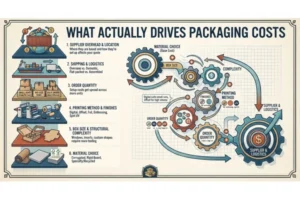
Material Choice
This is usually the biggest single factor, and it’s the one people underestimate the most.
Corrugated cardboard is generally the cheapest option and works for most shipping needs
Rigid board costs significantly more due to density and structural weight
Specialty materials like recycled kraft, textured stocks, or eco-certified boards often carry a premium over standard options
The type of board, the flute thickness, and even the paper’s certification (FSC-certified stock, for instance) all shift the base cost before printing or finishing even enters the picture.
Box Size and Structural Complexity
Bigger boxes use more material, obviously, but structural complexity matters just as much.
Simple tuck-top boxes are cheap and fast to produce
Boxes with windows, inserts, dividers, or unusual fold patterns require more tooling and production steps
Custom shapes often need a new die built specifically for that design, which adds a one-time cost that gets spread across the order
Printing Method and Finishes
Printing is where costs can swing wildly depending on choices that seem minor on the surface.
Digital printing suits smaller runs but costs more per unit at scale
Offset printing gets cheaper per unit at higher volumes but needs upfront plate-making costs
Finishes like foil stamping, embossing, and spot UV each add a separate production step, and each one adds cost
Order Quantity
Packaging pricing almost always drops per unit as order volume increases, since setup costs — plates, dies, machine calibration — get spread across more units.
Small runs (under a few hundred units) tend to carry a steep per-unit cost
Mid-size runs start seeing meaningful price drops
Bulk orders in the thousands often hit the most efficient per-unit pricing a supplier can offer
Shipping and Logistics
This one gets overlooked constantly, but it can be a bigger factor than people expect.
Flat-packed boxes ship far more efficiently than pre-assembled ones
Overseas manufacturing often costs less per unit but adds freight and import costs that can offset the savings
Domestic suppliers may charge more per unit but save significantly on shipping time and cost
Supplier Overhead and Location
Where your supplier is based, and how they’re set up, quietly affects your quote too.
Suppliers with in-house printing, die-cutting, and finishing tend to charge less than ones outsourcing steps to third parties
Labor costs vary significantly by region and factor directly into the final price
Rush production almost always carries a premium, sometimes a substantial one
How to Actually Reduce Packaging Costs
Now for the part most businesses actually care about — where the real savings are hiding, without sacrificing the packaging quality your brand depends on.
Simplify the Structural Design
Elaborate structures look impressive, but they come at a real cost.
Stick to standard box styles where possible, since custom dies add one-time tooling costs
Reduce the number of separate pieces (inserts, dividers) if the product doesn’t strictly need them
Standard sizes across your product line reduce tooling and setup costs significantly compared to unique dimensions for every SKU
Choose Material Wisely, Not Just Cheaply
Cheapest isn’t always the smartest move here.
Match material strength to actual product needs instead of defaulting to the thickest, sturdiest option out of caution
Consider single wall instead of double wall where the product doesn’t genuinely need extra protection
Recycled stock is sometimes cheaper than virgin material, depending on your supplier and region, so it’s worth actually comparing rather than assuming
Order Strategically, Not Reactively
Timing and quantity decisions have a bigger impact on cost than most businesses realize.
Larger, less frequent orders usually beat smaller, frequent ones on a per-unit basis
Forecasting demand accurately avoids both overstock waste and expensive rush reorders
Consolidating orders across multiple products with the same supplier can sometimes unlock better overall pricing
Rethink Printing and Finishing Choices
This is often where businesses find the easiest savings without customers noticing much difference at all.
Limit the number of ink colors, since each additional color adds cost in offset printing specifically
Reserve premium finishes like foil stamping for flagship products rather than the entire product line
Digital printing makes more sense for smaller or frequently changing designs, avoiding wasted plate costs
Negotiate and Compare Suppliers Regularly
This sounds obvious, but a surprising number of businesses just stick with the same supplier out of habit, even as pricing shifts in the market.
Get quotes from at least two or three suppliers before committing to a large order
Ask directly about volume discounts and whether combining orders unlocks better tiers
Long-term supplier relationships can sometimes unlock better pricing than businesses realize, simply by asking
Optimize for Shipping Efficiency
Packaging cost doesn’t stop at production — shipping cost is part of the real total.
Flat-pack wherever the box style allows it, since assembled boxes waste shipping space
Right-size your boxes to the product, since oversized packaging increases both material and dimensional shipping costs
Consolidate shipments where possible instead of scattering smaller, more frequent deliveries
A Mistake Worth Avoiding
A lot of businesses try to cut costs by chasing the cheapest quote available, without considering defect rates, reliability, or communication quality. A slightly higher-priced supplier who delivers consistent quality on time often ends up cheaper overall than a rock-bottom quote that leads to reorders, delays, or damaged shipments. Cost reduction should target waste, not quality.
Bottom Line
Packaging costs aren’t random, even when a quote feels that way at first glance. Material, structure, printing, order size, and logistics all stack together to create that final number, and each one of those factors has a specific, actionable way to bring costs down without cutting corners on what actually matters. Know where your money’s going, and cutting the right corners becomes a lot easier than guessing at which ones are safe to cut.