I still remember the first time a client showed up with a beautiful design file and asked why it wouldn’t just “print like it does on paper.” Cardboard isn’t paper, and printing on it comes with its own set of rules, limitations, and tricks that most people never think about until they’re staring at a proof that looks nothing like what they imagined. If you’re getting ready to print on cardboard boxes for your product, here’s everything I’ve learned over the years about actually getting it right.
Why Printing on Cardboard Is Different From Printing on Paper
Before jumping into methods, it helps to understand why cardboard behaves so differently under a printer in the first place.
The Surface Isn’t as Smooth as It Looks
Cardboard, especially corrugated board, has a slightly textured, uneven surface compared to smooth paper stock. That texture comes from the fluted layer underneath, and it affects how ink sits on the surface, how sharp fine details come out, and how vibrant colors actually appear once printed. Fine text or delicate gradients that look crisp on paper can come out slightly softer or less precise on cardboard, simply because the surface isn’t perfectly flat.
Absorbency Changes Everything About Color
Uncoated cardboard tends to absorb ink more than coated paper does, which can dull colors slightly compared to what you see on a screen. This is exactly why proofing matters so much with cardboard printing — what looks vibrant in a digital mockup can come out a bit muted once it hits the actual material, and it’s much better to catch that on a sample than on five thousand finished boxes.
The Main Printing Methods for Cardboard Boxes
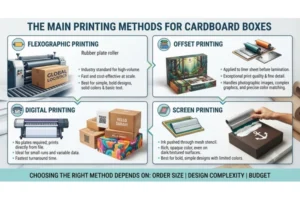
There isn’t just one way to print on cardboard, and picking the right method depends heavily on your order size, your design complexity, and your budget.
Flexographic Printing
Flexo printing uses flexible rubber or polymer plates to transfer ink directly onto the cardboard surface, and it’s the industry standard for large-volume corrugated box printing. It’s fast, cost-effective at scale, and handles simple, bold designs particularly well — solid colors, basic logos, straightforward text.
Where it struggles is fine detail. Flexo isn’t the best choice for photographic images or intricate gradients, since the process doesn’t reproduce that level of nuance as cleanly as other methods can. For high-volume shipping cartons with a simple logo and some basic branding, though, it’s usually the most economical option available.
Offset Printing
Offset printing typically gets applied to a liner sheet before it’s laminated onto the corrugated board, which allows for much higher print quality and finer detail than direct flexo printing on the corrugated surface itself. This method handles photographic images, detailed graphics, and precise color matching noticeably better.
The trade-off is cost and setup time. Offset requires plate-making, which adds an upfront expense that only makes sense once you’re ordering in real volume. For smaller runs, that setup cost per unit becomes hard to justify.
Digital Printing
Digital printing skips plates entirely, printing directly from a design file onto the cardboard surface. This makes it the go-to choice for smaller runs, frequently changing designs, or situations where you need variable data printed on each box, like unique QR codes or personalized messaging.
It costs more per unit than flexo or offset at high volumes, but for short runs, it’s often actually cheaper overall once you factor in the plate costs those other methods require. It’s also the fastest method to turn around, which matters if you’re working on a tighter timeline.
Screen Printing
Screen printing pushes ink through a mesh stencil directly onto the cardboard, and it’s particularly good for bold, simple designs with limited colors, especially on rigid or specialty boxes rather than standard corrugated shipping cartons. It produces rich, opaque color, even on darker or textured surfaces where other methods might struggle to show up clearly.
It’s slower than flexo or digital printing and less suited to intricate, multi-color designs, since each color typically requires its own separate screen and pass.
Choosing the Right Method for Your Actual Needs
Picking a printing method isn’t about finding the objectively “best” one — it’s about matching the method to your specific design, volume, and budget.
Consider Your Order Volume First
Large volume orders, especially with simple designs, generally favor flexo or offset for cost efficiency. Small or variable runs almost always favor digital printing, since the lack of plate costs keeps things economical at lower quantities.
Think About Design Complexity
Simple logos and bold branding work fine across almost any method. Photographic images, fine gradients, or highly detailed artwork need offset or high-quality digital printing to actually look the way they do on your screen, since flexo and screen printing both struggle with that level of nuance.
Factor In Your Timeline
Digital printing turns around fastest, since there’s no plate-making delay involved. Offset and flexo both need setup time before the actual printing run even begins, which matters if you’re working against a launch date or a seasonal deadline.
Practical Tips for Better Print Results
A few things I’ve picked up over the years that genuinely make a difference in how your final boxes turn out.
Always Request a Physical Proof
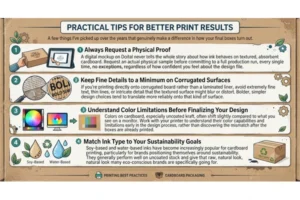
A digital mockup on a screen never tells the whole story about how ink behaves on textured, absorbent cardboard. Request an actual physical sample before committing to a full production run, every single time, no exceptions, regardless of how confident you feel about the design file.
Keep Fine Details to a Minimum on Corrugated Surfaces
If you’re printing directly onto corrugated board rather than a laminated liner, avoid extremely fine text, thin lines, or intricate detail that the textured surface might blur or distort. Bolder, simpler design choices tend to translate more reliably onto that kind of surface.
Understand Color Limitations Before Finalizing Your Design
Colors on cardboard, especially uncoated kraft, often shift slightly compared to what you see on a monitor. Work with your printer to understand their color capabilities and limitations early in the design process, rather than discovering the mismatch after the boxes are already printed.
Match Ink Type to Your Sustainability Goals
Soy-based and water-based inks have become increasingly popular for cardboard printing, particularly for brands positioning themselves around sustainability. They generally perform well on uncoated stock and give that raw, natural look many eco-conscious brands are specifically going for.
A Mistake I See Constantly
Businesses often choose a printing method based purely on cost, without considering whether that method can actually deliver the design they’ve already committed to. Picking flexo for a design full of fine gradients, for instance, sets everyone up for disappointment once the boxes actually arrive. Match your method to your design first, then optimize for cost within whichever methods are still capable of delivering what you actually need.
Bottom Line
Printing on cardboard isn’t the same game as printing on paper, and understanding that early saves a lot of frustration, wasted budget, and disappointing proofs down the line. Flexo for volume and simplicity, offset for volume with fine detail, digital for smaller and variable runs, screen printing for bold simple designs on specialty boxes. Match the method to your actual design and order size, and the final print will look the way you actually pictured it in the first place.