Every small business owner I’ve talked to has the same fear when custom packaging comes up — that “custom” automatically means expensive. It doesn’t, not necessarily. I’ve watched plenty of tiny operations put together packaging that looks like it cost far more than it actually did, just by being smart about where the money goes and where it doesn’t need to. Here’s what I’ve picked up over the years about doing custom packaging right without draining the budget.
Why “Custom” Doesn’t Have to Mean “Expensive”
There’s a common misconception worth clearing up before getting into specifics.
The Real Cost Driver Isn’t Customization Itself
Most of packaging cost comes from complexity, not from the fact that it’s branded or personalized. A simple box with your logo printed in one color costs a lot less than people assume, especially compared to elaborate structures with windows, foil stamping, or multiple print colors. Custom doesn’t have to mean elaborate. It just means yours.
Small Brands Actually Have an Advantage Here
Big companies often overbuild packaging because they can absorb the cost across massive order volumes. Small businesses don’t have that luxury, which forces smarter, more intentional choices — and intentional almost always looks better than expensive-for-its-own-sake anyway.
Practical Ways to Keep Custom Packaging Affordable
Here’s where the actual savings hide, based on what’s worked consistently for the smaller brands I’ve worked with.
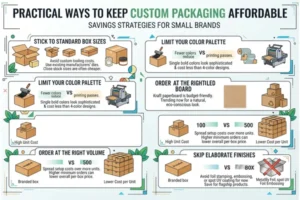
Stick to Standard Box Sizes
Custom dimensions require custom tooling, and that tooling cost gets baked into your price whether you’re ordering fifty units or five thousand. Standard sizes, on the other hand, use existing tooling most manufacturers already have on hand, which cuts a real chunk of upfront cost immediately.
Choosing a stock size close to your product’s dimensions, rather than commissioning something perfectly bespoke, often saves more money than any other single decision in this whole process.
Limit Your Color Palette
Every additional print color adds cost, particularly with offset printing where each color needs its own separate pass. A single bold color on plain kraft or white board can look more sophisticated than a busy four-color design anyway, and it costs a fraction as much to produce.
Choose Kraft or Recycled Board Over Specialty Stock
Kraft paperboard is genuinely one of the cheapest materials available, and it happens to be trending hard right now for its natural, eco-conscious look. That’s a rare situation where the budget-friendly choice and the currently fashionable choice are the exact same thing.
Order at the Right Volume, Not Just the Lowest Volume
It sounds backwards, but ordering slightly more than the bare minimum often lowers your actual cost per unit significantly, since setup costs get spread across more units. Ordering five hundred instead of one hundred, if you can genuinely move that inventory, often costs less per box overall, not more.
Skip Elaborate Finishes for Now
Foil stamping, embossing, spot UV coating — these all look fantastic, and they all add real cost, sometimes substantially. Save these for a flagship product or a limited seasonal run rather than applying them across your entire product line from day one.
Smart Branding Moves That Cost Almost Nothing
Some of the best branding touches genuinely cost pennies, if that.
A Single Stamped Logo
A rubber stamp with your logo, used on plain kraft boxes, gives a handmade, intentional feel at a tiny fraction of full custom printing cost. It works especially well for smaller order volumes where hand-stamping is still manageable.
Branded Tissue Paper Instead of a Fully Printed Box
Wrapping the product in a single sheet of custom-printed tissue paper inside a plain box costs far less than printing the entire box itself, while still delivering a genuine branded moment the second someone opens the lid.
Simple Stickers Over Full Box Printing
A well-designed sticker sealing the box shut can carry your entire brand identity at a fraction of what printing directly onto the box would cost. This is one of the most common budget-friendly moves I see actually working well for early-stage brands.
Where to Actually Source Affordable Custom Packaging
Sourcing choices matter just as much as design choices when you’re working with a tight budget.
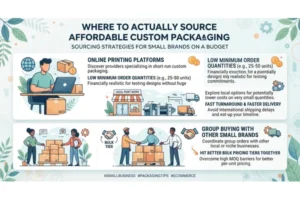
Online Printing Platforms
Several online packaging printers now offer custom boxes with genuinely low minimum order quantities, sometimes as few as twenty-five or fifty units, which makes testing designs financially realistic for a small operation without a huge upfront commitment.
Local Print Shops for Small Runs
Local shops sometimes beat larger online suppliers on price for very small runs, particularly for simpler designs, and they offer the added benefit of faster turnaround without international shipping delays eating into your timeline.
Group Buying With Other Small Brands
Some small business communities coordinate group orders to hit better bulk pricing tiers together. Worth exploring in local business groups or niche-specific online communities if minimum order quantities are the main thing standing between you and better per-unit pricing.
A Mistake I See Small Businesses Make Constantly
Owners often try to do everything at once — custom box, custom tissue, custom stickers, foil stamping, the whole package — right out of the gate, before they’ve even confirmed their product sells consistently. Start smaller. Pick one or two genuinely impactful details, execute those really well, and expand the packaging investment as sales actually justify it. Trying to look like a massive brand before you’re actually one usually just burns cash that would’ve been better spent elsewhere.
Testing Before Committing to a Full Order
Whatever budget-friendly approach you land on, order a small sample batch before committing to your full run. A cheap material choice that looks great in a digital mockup doesn’t always hold up once it’s physically in your hands. It’s a lot less painful to catch that with twenty test units than with two thousand production units already sitting in your garage.
Bottom Line
Custom packaging on a small business budget isn’t about cutting corners everywhere — it’s about being genuinely smart about where the money actually goes. Standard sizes, limited colors, kraft board, and a few well-chosen branded touches can add up to packaging that looks considered and intentional, without draining a budget that should mostly be going toward the product itself. The brands that get remembered aren’t the ones that spent the most. They’re the ones that spent thoughtfully, on the handful of details that actually get noticed.