
I get this question constantly from businesses trying to pin down shipping costs before they’ve even placed a packaging order, and honestly, it’s a smarter question than most people give it credit for. Box weight sounds like a footnote, something nobody really needs to think about. But it quietly affects your shipping rates, your dimensional weight calculations, and sometimes even which carrier ends up being cheaper for your particular product. Let’s actually get into what determines a cardboard box’s weight, and how to estimate it accurately instead of just guessing.
Why Box Weight Actually Matters
Before throwing numbers around, worth understanding why this deserves your attention at all.
Carriers Charge Based on Total Weight
Every carrier calculates cost using the combined weight of your product plus its packaging, not just the product on its own. A heavier box adds directly to your shipping bill, and that matters more than people expect once you’re shipping at real volume — even small differences compound fast across thousands of packages going out the door.
Dimensional Weight Makes This Trickier
Most carriers now charge based on whichever number’s higher — actual weight, or dimensional weight calculated from the box’s size. A bulky, heavier box can push a genuinely lightweight product into a higher dimensional weight bracket, which means your box choice affects cost even when the product barely weighs anything at all.
What Actually Determines How Much a Box Weighs
A handful of factors combine here, and none of them work alone.
Flute Type Plays a Big Role
Single wall boxes, with one fluted layer, weigh noticeably less than double wall boxes stacking two flutes together. Rough estimate: a standard single wall corrugated box usually lands somewhere between half a pound and a full pound for smaller sizes, while double wall versions of similar dimensions often run 30 to 50 percent heavier, just from that extra layer of material.
Box Size Changes Everything, Proportionally
Bigger boxes obviously use more cardboard, so weight scales up right alongside the dimensions. A small box around 10x10x10 inches might weigh close to half a pound. A large moving-sized box, something like 24x18x18, can weigh two to three pounds or more — simply because of how much material it takes to cover that much surface area.
Board Grade and Paper Weight Matter Too
Corrugated board comes in different grades, measured by the weight of paper used per unit area — often expressed in the industry as pounds per thousand square feet. Heavier paper grades produce stronger boxes. They also produce noticeably heavier ones, compared to lighter grades built for less demanding shipping jobs.
Printing and Coatings Add Just a Little
Printed graphics, laminate coatings, protective finishes — these add a bit of extra weight, though it’s usually minor compared to the base cardboard weight itself. Worth knowing about, sure, but rarely enough to actually change a shipping decision on its own.
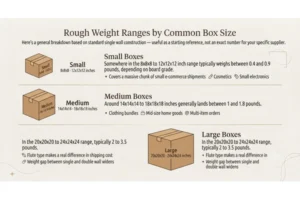
Rough Weight Ranges by Common Box Size
Here’s a general breakdown based on standard single wall construction — useful as a starting reference, not an exact number for your specific supplier.
Small Boxes
Somewhere in the 8x8x8 to 12x12x12 inch range typically weighs between 0.4 and 0.9 pounds, depending on board grade. This size range covers a massive chunk of small e-commerce shipments — cosmetics, small electronics, that sort of thing.
Medium Boxes
Around 14x14x14 to 18x18x18 inches generally lands between 1 and 1.8 pounds. Covers common shipments like clothing bundles, mid-size home goods, or multi-item orders.
Large Boxes
In the 20x20x20 to 24x24x24 range, typically 2 to 3.5 pounds. This is where flute type actually starts making a real difference in shipping cost, since the weight gap between single and double wall widens quite a bit at these larger sizes.
Double Wall, Roughly Speaking
Add somewhere around 30 to 50 percent to any of those figures if you’re working with double wall instead of single wall. That extra fluted layer and liner sheet add real, measurable weight across the whole structure.
Getting an Accurate Number for Your Actual Box
General ranges are fine for planning. Your real number depends on your specific supplier and design.
Ask Your Supplier for the Real Spec Sheet
Most manufacturers can give you a precise per-unit weight for your exact dimensions, board grade, and flute type before you place a single order. That number matters way more than any general estimate once you’re calculating real shipping costs at actual volume.
Weigh a Physical Sample Yourself
Got a sample box sitting around already? A basic kitchen or postal scale gives you an accurate, real number in about ten seconds, accounting for your specific material choice, printing, whatever coatings got applied.
Don’t Forget Packing Materials
The box is only part of your total shipping weight. Bubble wrap, air pillows, tissue paper, whatever cushioning you’re using — all of it adds to the number that actually determines cost. Don’t calculate based on box weight alone if you want your real total.
How This Should Actually Shape Your Shipping Strategy
Knowing these numbers isn’t just trivia. It should genuinely influence real decisions.
Lighter Boxes Save Real Money at Scale
If your product doesn’t need the extra strength of heavier board or double wall construction, going lighter can meaningfully cut shipping costs across thousands of shipments — even if the per-unit savings looks small sitting there on its own.
Right-Sizing Matters Just as Much as Weight
An oversized box doesn’t just weigh more by itself — it also bumps up your dimensional weight calculation, hitting cost from two directions at once. A box that actually fits your product tightly solves both problems at the same time.
Weigh This Against Actual Protection Needs
Cutting weight by grabbing the thinnest flute or lightest board grade available only makes sense if your product genuinely doesn’t need the extra protection heavier construction gives. Saving a few cents on shipping isn’t worth it if it means more damage claims and replacement costs piling up later.
A Mistake Worth Avoiding
Businesses often default to the heaviest, sturdiest box out of pure caution, without ever running the numbers on what that actually costs across a full year of shipping. A small weight difference, multiplied across thousands of packages, adds up to real money — money a slightly lighter, still perfectly adequate box could’ve saved, with no real jump in damage risk.
Bottom Line
Cardboard box weight comes down to flute type, size, and board grade, with rough figures usually landing somewhere between half a pound for small single wall boxes and three-plus pounds for large double wall ones. Get an accurate number for your specific box — supplier spec sheet, or just a physical scale — and you’ve got the real data needed to make smarter packaging and shipping decisions, instead of guessing and hoping the numbers work out in your favor.