
If you’ve ever pulled an old shoebox of cards out of a closet and tried to fit them next to your modern rookies, you already know the truth: not all baseball cards are the same size. The card you buy in a pack today is a specific, standardized product — but that standard only settled into place after decades of trial and error by tobacco companies, gum makers, and card manufacturers.
This guide breaks down the exact modern standard, how it came to be, every major historical size variation, and what the numbers mean for sleeves, boxes, and grading.
The Standard Baseball Card Size Today
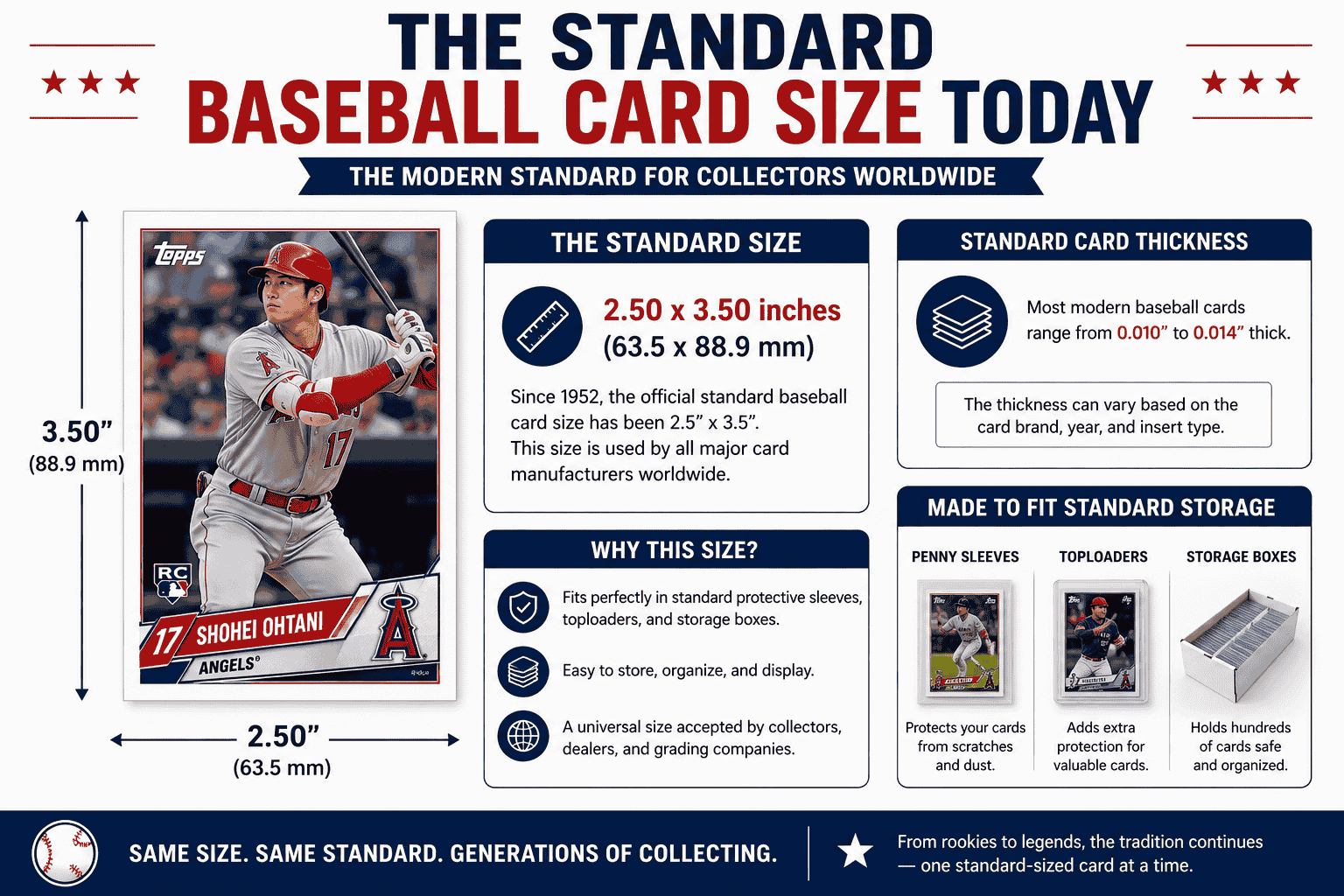
Every baseball card produced by a major manufacturer since the 1950s follows the same footprint:
- 2.5 inches × 3.5 inches
- 6.35 cm × 8.89 cm
- 63.5 mm × 88.9 mm
This is often called the “poker card” or “trading card” size because it’s shared across the entire modern trading card industry — basketball, football, hockey, Pokémon, Magic: The Gathering, and standard playing cards all use it too. That’s not a coincidence. It’s the size that fits existing die-cutting equipment, printing presses, penny sleeves, top loaders, nine-pocket binder pages, and card boxes that were already mass-produced for the playing card industry.
Card thickness varies more than most people expect. A standard modern card runs roughly 20pt to 35pt (thousandths of an inch), while inserts, jersey cards, and autograph cards can run much thicker — sometimes 80pt to 130pt or more, which is why “thick card” top loaders and magnetic holders exist as a separate category.
How the 2.5″ x 3.5″ Standard Came to Be
Baseball cards didn’t start out this size — the industry backed into it.
Tobacco era (1880s–1911). The earliest baseball cards were inserted into cigarette and tobacco packs as stiffeners and advertising, so their size was dictated by the pack, not the player. The famous T206 set (1909–1911) measured about 1 7/16″ × 2 5/8″ — noticeably smaller and narrower than today’s cards. Other tobacco-era issues were smaller still.
Caramel and strip-card era (1910s–1930s). Cards packaged with candy and gum experimented with a wide range of sizes. E90-1 caramel cards ran about 1.5″ × 3″, and Goudey’s 1933 set — one of the most famous vintage issues — measured roughly 2 3/8″ × 2 7/8″, closer to square than today’s rectangle.
Bowman and the “tall boy” experiments (1940s–1950s). Bowman’s late-1940s cards were compact, around 2 1/16″ × 2 1/2″. Topps then swung the other direction with its oversized 1952–1956 issues, sometimes called “tall boys,” at roughly 2 5/8″ × 3 3/4″ to 2 5/8″ × 3.5″.
Standardization (1957–onward). Starting with its 1957 set, Topps settled on 2.5″ × 3.5″ — a size that matched standard playing cards, worked efficiently on existing printing sheets, and fit neatly into wallets, cigar boxes, and eventually the protective sleeves and binder pages that would define the modern hobby. Every major manufacturer that followed — Fleer, Donruss, Score, Upper Deck, Panini — adopted the same footprint, and it has not changed since.
Baseball Card Size Chart by Era
| Card / Era | Approx. Dimensions (in) | Approx. Dimensions (mm) |
| T206 Tobacco (1909–1911) | 1 7/16″ × 2 5/8″ | 36.5 × 66.7 |
| E90-1 Caramel (1910s) | 1.5″ × 3″ | 38 × 76 |
| Goudey (1933) | 2 3/8″ × 2 7/8″ | 60 × 73 |
| Bowman (late 1940s) | 2 1/16″ × 2.5″ | 52 × 63.5 |
| Topps “Tall Boy” (1952–1956) | 2 5/8″ × 3.75″ | 67 × 95 |
| Modern Standard (1957–present) | 2.5″ × 3.5″ | 63.5 × 88.9 |
| 1975 Topps Mini | 2.25″ × 3.125″ | 57 × 79 |
| 1991 Stadium Club Dome | 3″ × 4″ | 76 × 102 |
Vintage cards are also notoriously inconsistent even within the same set, since pre-1950s cutting equipment wasn’t precise by modern standards. That’s one reason grading companies build in tolerance for older cards (more on that below).
Metric, Digital, and Grading Specs
Metric conversion. For anyone working outside the U.S., the standard card is 6.35 cm × 8.89 cm, or 63.5 mm × 88.9 mm. This is the figure to use when specifying packaging or die lines to an overseas printer.
Digital / scanning resolution. There’s no single “official” pixel size, but the hobby has converged on a couple of common working resolutions that preserve the correct 5:7 aspect ratio: 750 × 1050 px for general use and web listings, or 1500 × 2100 px (300 DPI) for high-resolution scans intended for print or close-up authentication.
Grading slab dimensions. Once a card is professionally graded, its size changes entirely — the card itself is sealed inside a rigid plastic holder. A standard PSA slab measures roughly 3.75″ × 5.625″ × 0.3″, and other graders (Beckett/BGS, SGC) use similar footprints. If you’re buying storage boxes for a graded collection, you need slab-sized boxes, not raw-card boxes — a common mix-up for newer collectors.
Grading tolerances. PSA generally allows about ±0.015″ of variance from the 2.5″ × 3.5″ standard before a card is flagged as trimmed or off-spec. SGC is known for being more forgiving with pre-1980s vintage cards, since original manufacturing tolerances were looser.
Why the Standard Size Matters for Storage and Selling
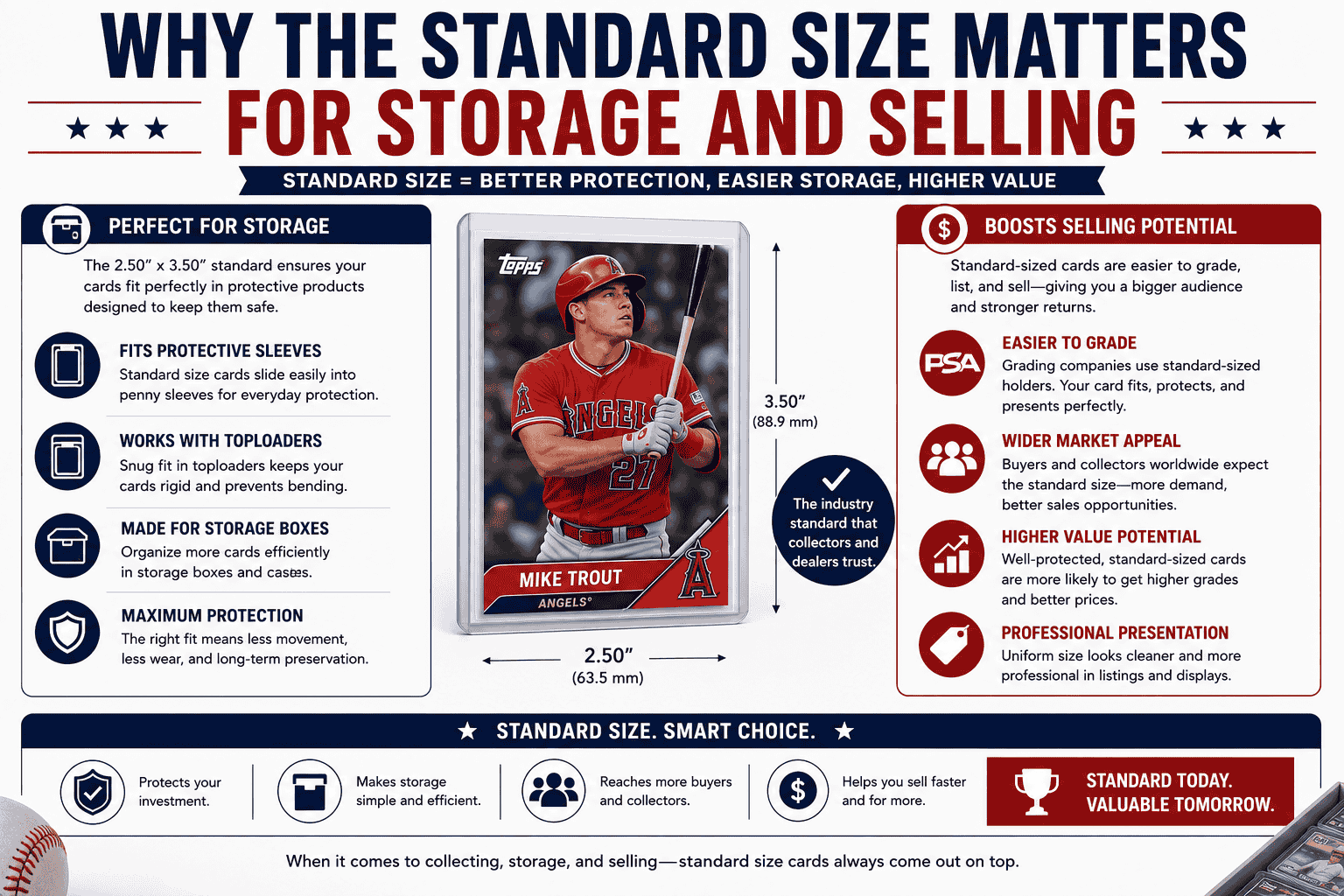
A few practical reasons the 2.5″ × 3.5″ standard is worth knowing, beyond trivia:
- Sleeves and top loaders are built to this exact spec, with a small amount of clearance. A card that’s even slightly oversized (an old tall boy, or a warped/water-damaged modern card) won’t seat correctly and risks bending at the edges.
- Nine-pocket binder pages assume the standard size; vintage or oversized cards typically need single-pocket pages or magnetic holders instead.
- Shipping and bulk storage boxes are almost always sized around the standard card footprint (or the graded-slab footprint), so knowing which category your collection falls into determines which boxes you actually need.
- Authentication — an unusually sized “vintage” card is one of the first things a knowledgeable buyer or grader checks, since trimming down an oversized or damaged card to fit standard sleeves is a known form of alteration.