Introduction
You may have a great product but if it’s not getting the attention of your customer before they open it, then you have just lost the sale.
Packaging is not a garnish in the cosmetic world. It’s your initial handshake, your brand’s tone and voice, and sometimes it’s the one that makes or breaks the sale on the shelf. The brands that are gaining market share are the ones that are investing their packaging, not just adding it on. With $500 billion spent globally on beauty products every year, packaging is essential.
From launching a new cosmetic line to refreshing an existing one, this guide details all the types of makeup packaging you can use, including box styles, materials, finishes, sustainable options, and what you need to know about the makeup packaging trends for 2025.
Why Makeup Packaging Matters More Than You Think
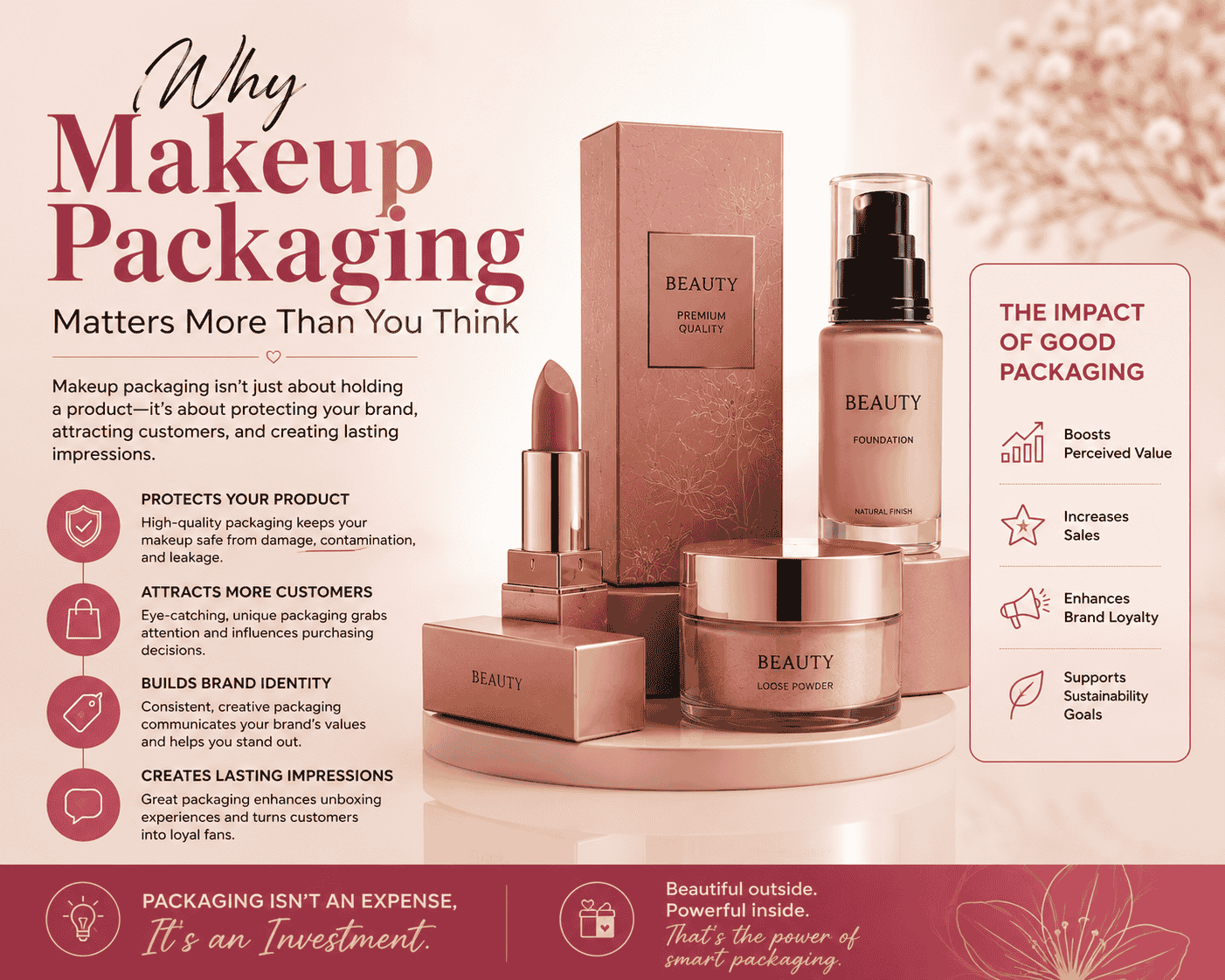
Before we get into the options, it’s worth understanding what packaging actually does for a beauty brand:
- Protection first. Makeup products such as foundation, eyeshadow, lipstick are heat, moisture, UV, and physically sensitive. The right packaging ensures the integrity of the formula and helps to prolong the shelf life.
- shelf presence and purchase decisions. Every time, people make decisions to buy within seconds of viewing a product. Colors, texture, and structure of packaging evoke emotions before the product is even in the consumer’s hands.
- Brand identity. Packaging conveys a message about your brand: Luxury/Accessible, Playful/Clinical, Sustainable/Traditional. Disjointed packaging disorients customers, and unified packaging fosters loyalty.
- Unboxing experience. The unboxing moment is the marketing moment in today’s social media age. An unforgettable unboxing is shared, photographed, and remembered.
- Compliance and function. Cosmetic packaging needs to comply with labelling, prevent contamination, and provide a safe delivery — airless pumps, accurate applicators and good closures are all relevant.
Types of Makeup Packaging: The Complete Overview
1. Folding Carton Boxes (Most Versatile Option)
Folding cartons are the workhorse of cosmetic packaging — used for lipsticks, foundations, eyeshadow palettes, serums, and almost everything else as secondary packaging.
Materials commonly used: SBS (solid bleached sulfate) board, coated duplex, Kraft paperboard
Best for: secondary packaging, gift sets, retail shelf display
Customization: nearly unlimited — any print, finish, window, or structural design is possible
The key advantage of folding cartons is their flexibility. They can be die-cut into unique shapes, printed with high-resolution graphics, and finished with embossing, foiling, or spot UV to create premium appeal at various price points.
Box styles within this category:
- Tuck-end boxes — the most common, most cost-effective. One or both ends fold in (auto-bottom tuck is ideal for heavier items). Used widely for lipstick, mascara, and compact products.
- Reverse tuck — end flaps tuck in opposite directions; useful for automatic filling lines.
- Sleeve and tray boxes — a rigid inner tray slides into an outer sleeve. Excellent for gift sets and high-end makeup kits; creates a premium unboxing moment.
- Two-piece rigid boxes — a separate lid and base. Used for luxury palettes, gift sets, and premium skincare-makeup hybrids. Heavy and high-cost, but they communicate luxury immediately.
- Shoulder neck boxes — three-piece construction (shoulder, neck, lid) that creates a visible inner layer even when closed. Distinct and editorial; popular for high-end perfumes and luxury compacts.
- Magnetic closure boxes — rigid box with embedded magnets that snap the lid shut. High perceived value; common in prestige brands and limited editions.
- Pillow boxes — curved, pillow-shaped structure with ribbon handle. Used for lighter products and gift packaging; less protective but visually charming.
2. Rigid Boxes
Rigid boxes (also called setup boxes) are manufactured pre-assembled, unlike folding cartons that are shipped flat and erected at packaging. They use thick greyboard (typically 1.5mm–3mm) wrapped in printed or textured paper.
Best for: luxury makeup, premium gift sets, limited edition collections
Typical products: eyeshadow palettes, skincare-makeup bundles, high-end lipstick sets
Price point: higher; minimum quantities are generally higher than folding carton
3. Tubes and Squeeze Packaging
Cosmetic tubes are used for foundations, BB creams, lip glosses, tinted moisturizers, and concealer.
Materials: aluminum (premium, 100% recyclable), plastic (LDPE, HDPE, PP — flexible and low cost), laminate tubes (multi-layer for barrier protection)
Closures: flip-top, screw cap, pump-top, nozzle
Aluminum tubes are seeing a strong comeback in 2025 as brands move away from plastic. They’re squeezable, lightweight, highly recyclable, and communicate a premium, editorial feel. Many artisan and clean-beauty brands have shifted to aluminum as their default tube material.
4. Compacts and Palettes
Compacts and palettes are among the most design-intensive packaging formats in makeup. They house pressed powders, blushes, bronzers, eyeshadows, and contour products.
Compact types:
- Single-pan compacts — simple, classic round or square. Low cost.
- Multi-pan palettes — 4, 8, 12+ pan configurations. Popular for eyeshadow collections.
- Hinged compacts with mirror — standard for pressed powder and bronzer; the mirror is functional and expected.
- Refillable compacts — growing rapidly in 2025 due to sustainability demand. Kjaer Weis pioneered the metal refillable compact; many brands now follow this model.
5. Bottles and Jars
Bottles and jars are primary packaging — direct contact with the cosmetic formula — and material selection is critical for both safety and shelf appeal.
Glass: Premium, chemically inert, infinitely recyclable. Creates a tactile weight and luxury perception. Best for serums, foundations, facial oils, and toners. Amber glass adds UV protection.
Acrylic: Looks like glass, much lighter, and more shatter-resistant. Very popular for prestige skincare-makeup hybrids. Can be crystal-clear or frosted.
HDPE (High-Density Polyethylene): Moisture-proof, chemical-resistant, strong. The standard for cosmetic jars containing creams, balms, and thick formulas.
PP (Polypropylene): Slightly more flexible than HDPE; used for pots, compacts, and hinged lids.
PET (Polyethylene Terephthalate): Common for foundations, toners, and liquid products. Recyclable. Can be produced in recycled (rPET) form.
Tin (aluminum with tin plating): Shiny, recyclable, used for lip balms, solid perfumes, highlighter balms, and multipurpose salves. Gives a heritage, artisan quality.
6. Lipstick Cases and Lip Product Packaging
Lipstick cases are engineering meets aesthetics — a small form factor with high branding impact.
Standard bullet lipstick: Twist-up mechanism in round or square barrel. Material choices: plastic, aluminum, zinc alloy.
Slanted bullet: The famous Charlotte Tilbury-style bullet with an angled cut for precise application.
Doe-foot applicator tubes: For lip glosses and liquid lipsticks.
Cushion lip applicators: Growing trend from K-beauty; sponge tip in a jar-style compact.
7. Mascara Tubes and Wands
Mascara packaging is one of the more technically complex formats in makeup. The wand (brush) and tube (reservoir) must work together to deliver the right formula volume and application experience.
Tube materials: Plastic (PP, ABS), aluminum
Wand types: Classic round brush, spiked rubber wand, hourglass, curved, volumizing bristle
8. Eyeliner Packaging
Pencil eyeliners: Wood-cased pencil, or plastic twist-up barrel. Wood pencils require sharpening; twist-up is more convenient.
Liquid liner bottles: Marker-style pen tip (felt tip, brush tip, hard tip). Usually flat-cap design.
Pot liners: Small glass or plastic pots with separate angled brush.
Kajal/kohl sticks: Thick, smoky formula in round barrel.
How to Choose the Right Makeup Packaging for Your Brand
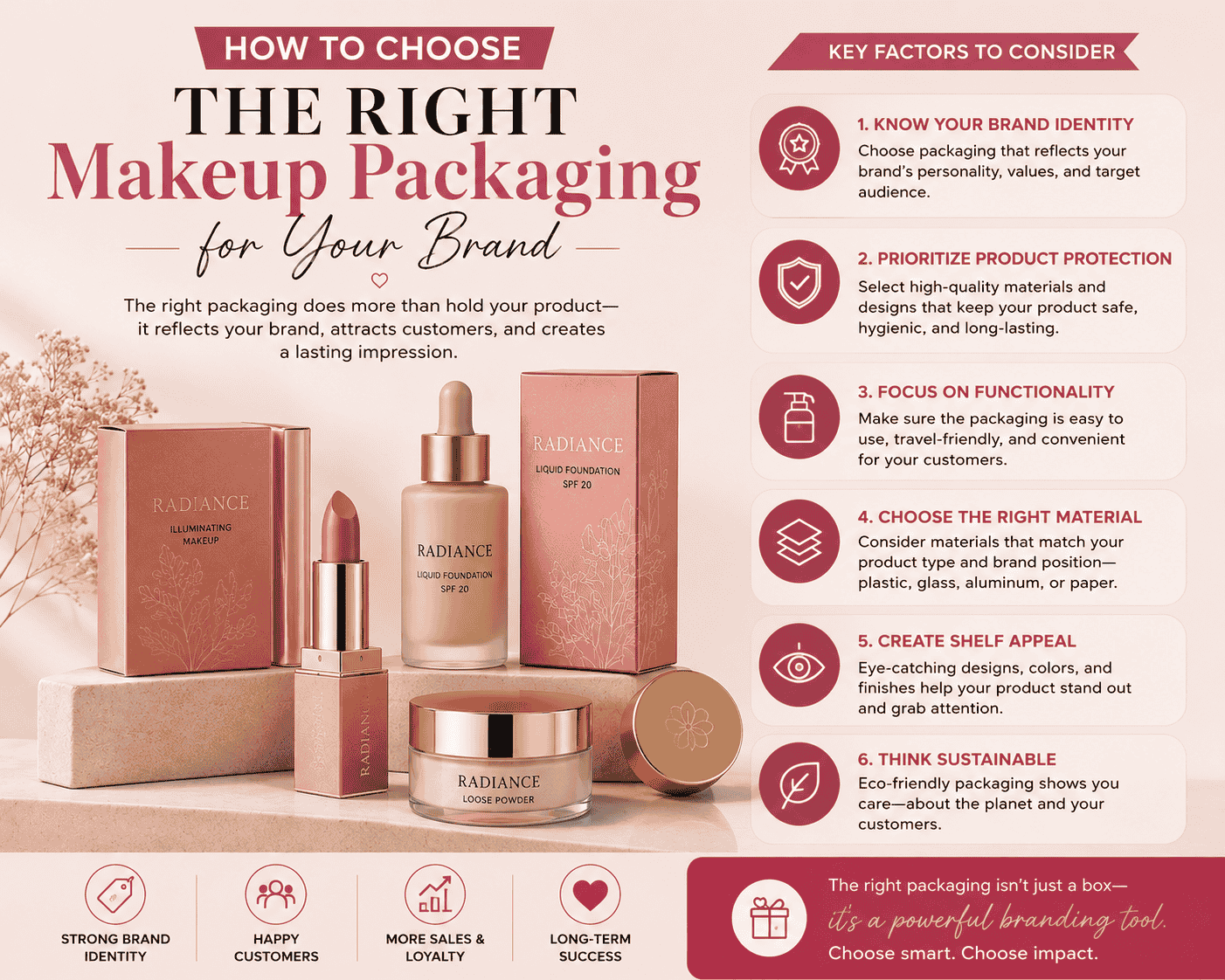
Use this decision framework:
Step 1 — Define your product type and formula requirements.
Liquid, powder, cream, pencil, and gel formulas all have different packaging requirements. Start here before thinking about aesthetics.
Step 2 — Know your price positioning.
Mass-market products need to be cost-efficient. Premium products need packaging that justifies the price. Prestige products require the most investment in materials and finish. Don’t over-package a $10 product or under-package a $60 one.
Step 3 — Know your customer.
A 20-year-old Gen Z customer responds differently to packaging than a 45-year-old luxury skincare buyer. Your packaging must speak your customer’s visual language.
Step 4 — Choose materials for protection first.
Form follows function in cosmetics. The packaging must protect the formula from heat, moisture, light, and air — before it needs to look beautiful.
Step 5 — Align with your brand identity.
Every packaging decision — structure, material, color, finish, typography — should reinforce a consistent brand identity. Inconsistency undermines trust.
Step 6 — Plan for sustainability.
If you’re launching now, build an eco-friendly angle into your packaging from the start. Whether that’s recyclable materials, refillable systems, or reduced plastic — it’s easier and cheaper to start right than to retrofit later.
Step 7 — Work with an experienced custom packaging supplier.
A good packaging partner will guide you through structural design, material selection, printing, and sampling. Get physical samples before approving production. Colors and finishes vary between screen and print.
Final Thoughts
The makeup packaging that works best for your brand is the one that safeguards your product, speaks to your customer, and is reflective of your brand without sacrificing any of the three.
The hard luxury palette box or kraft tube, the matte lamination or soft velvet—all these options are brand choices. Do it correctly, and your packaging will be your best salesperson.
Looking to try out custom makeup packaging solutions for your brand? Call us for a complimentary consultation and quote!