Most people think of packaging as the box a product ships in. Most people think of branding as a logo. Neither is right, and the gap between those two ideas is where a lot of businesses lose money.
Branding is the promise your business makes. Packaging is the first place that a promise gets tested. A customer doesn’t read your mission statement before they buy — they see a box, a bag, or a jar, and they decide in seconds whether your brand feels trustworthy, cheap, premium, or forgettable. That snap judgment happens before they’ve even used the product.
This guide breaks down what branding and packaging actually mean, how they connect, and what you can do this month to make sure your packaging is pulling its weight for your brand instead of working against it.
What Is Branding, Exactly?
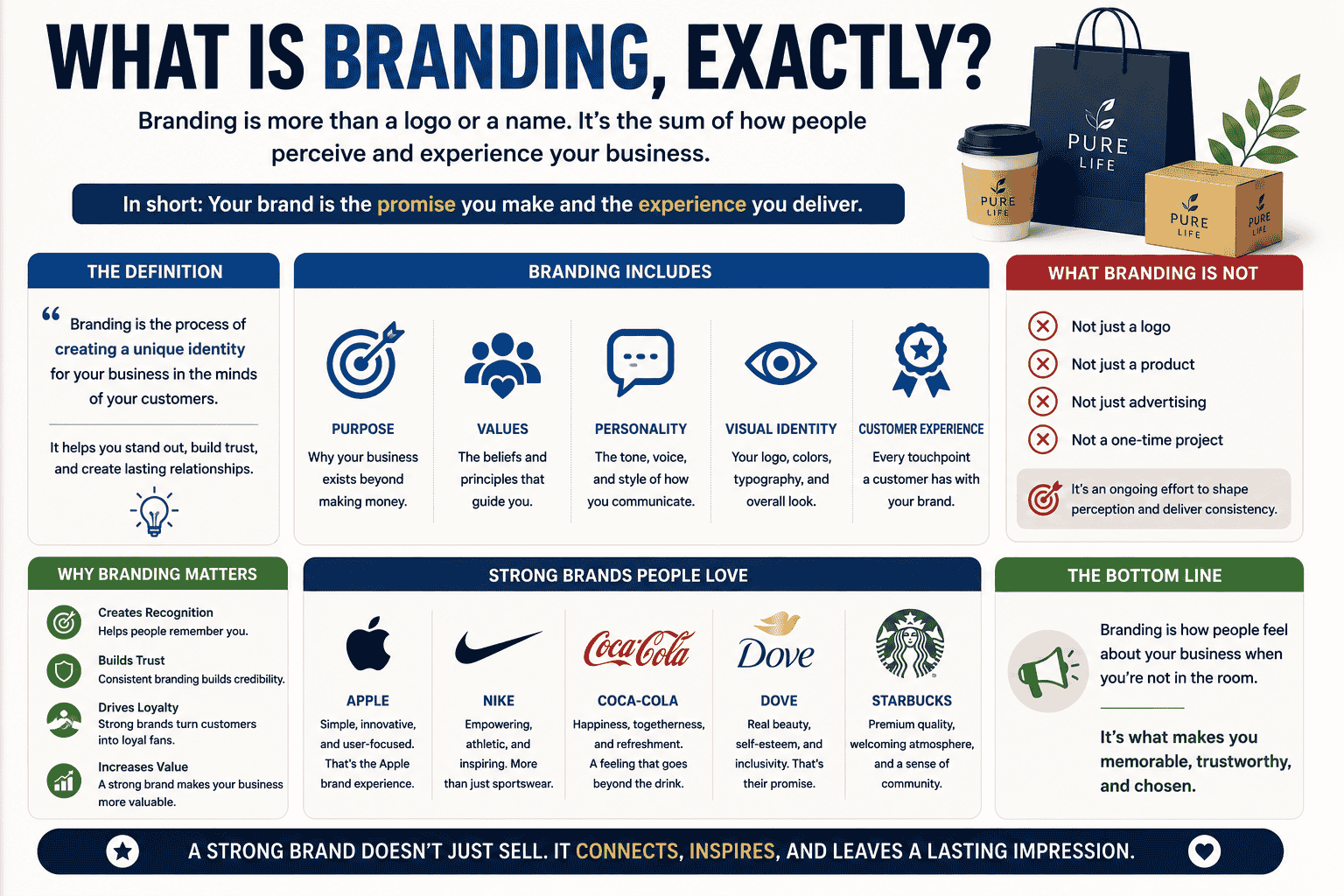
Branding is the full set of decisions that make your business recognizable and trusted: your name, logo, color palette, tone of voice, values, and the experience customers have every time they interact with you. It’s not one asset — it’s a system that has to stay consistent across your website, your ads, your emails, and yes, your packaging.
Good branding answers three questions for a customer, usually without them consciously asking:
- What does this business stand for?
- Why should I trust it over the alternative?
- Will this feel the same way next time I buy?
What Is Packaging, Exactly?
Packaging is the physical container your product ships or sells in — boxes, mailers, pouches, labels, inserts, tissue paper, tape. Its original job was purely functional: protect the product, survive shipping, fit on a shelf. That job hasn’t gone away, but it’s no longer the whole job.
Packaging now does double duty as a marketing surface. It’s often the only physical touchpoint an online customer has with your brand, which means it has to carry visual identity, communicate quality, and in a lot of cases, get photographed and shared.
How Branding and Packaging Actually Connect
Branding and packaging aren’t two separate departments — packaging is one of the places branding shows up in physical form. When they’re aligned, a customer can recognize your product on a shelf or in a photo without reading the label. When they’re not aligned, customers get confused about who they’re buying from, and confusion is expensive: it slows down trust and makes repeat purchases less likely.
Here’s the practical version of that relationship:
- Recognition. Consistent colors, logo placement, and typography across every product mean customers spot you faster, both online and off.
- Perceived value. Packaging materials and finishes signal price point before a customer reads anything. A flimsy box undercuts a premium product; a heavy, well-printed box can justify a higher price on an average one.
- Trust. Clean, professional packaging tells a first-time buyer that the business behind it is legitimate and organized. That matters more for e-commerce, where there’s no store employee to vouch for you.
- Retention. Packaging that people want to keep, reuse, or photograph extends your brand’s reach past the initial sale, often for free.
Why This Matters More Than It Used To
This isn’t just a design opinion — the numbers back it up. Multiple industry surveys have found that roughly seven in ten consumers say packaging design plays a real role in what they decide to buy, and that number climbs even higher when the purchase is a gift. Research on packaging psychology also shows people form an opinion about a product within the first few seconds of seeing it, well before they read a single word on the label. Quality perception follows the same pattern: a large share of shoppers associate sturdier, better-finished packaging directly with a higher-quality product, regardless of what’s actually inside.
For small and mid-sized brands competing against bigger players, this is genuinely good news. Packaging is one of the few brand touchpoints where a smaller company can outperform a larger one on a modest budget, because it doesn’t require a national ad campaign — it requires design discipline.
Branded Packaging vs. Generic Packaging
| Factor | Generic Packaging | Branded Packaging |
| Recognition | The customer has to check the label every time | Instantly identifiable by color, shape, or logo |
| Perceived value | Feels interchangeable with competitors | Justifies premium pricing |
| Unboxing experience | Purely functional | Creates shareable, memorable moments |
| Customer trust | Neutral or forgettable | Builds credibility before first use |
| Marketing cost | None built in | Free repeat exposure with every use or reuse |
| Long-term brand recall | Low | High |
How to Align Your Packaging With Your Brand
- Start with your brand fundamentals, not the box. Before choosing materials or colors, be clear on your logo, color palette, typography, and tone. Packaging should be an output of those decisions, not a separate creative exercise.
- Choose materials that match your brand positioning. Rigid boxes and foil finishes read as luxury. Kraft and matte finishes read as natural or sustainable. Bright colors and bold graphics read as youthful or energetic. Pick materials that reinforce the story you’re already telling, not ones that fight it.
- Keep every SKU visually consistent. If a customer can’t tell two products are from the same brand without checking the label, your packaging system needs work. Consistent layout templates across your product line solve this.
- Design for the unboxing, not just the shelf. For e-commerce especially, the moment a customer opens the box is a marketing opportunity. Inserts, thank-you cards, and thoughtful tissue paper cost very little and noticeably increase the chance someone posts about your product.
- Don’t let sustainability claims outrun your actual materials. Consumers are paying closer attention to greenwashing. If you make an eco-friendly claim on your packaging, make sure the materials back it up — mismatched claims damage trust faster than having no claim at all.
- Test before you commit to a full print run. Order samples, check how the packaging photographs, and get a small group of real customers to react to it before locking in a large production order.
Common Mistakes That Break the Branding-Packaging Connection
- Redesigning the logo or website without updating packaging to match, leaving the brand looking split in two
- Choosing packaging based only on cost per unit, without factoring in what it signals about product quality
- Using different design agencies or printers for different product lines with no shared style guide
- Treating packaging as an afterthought that gets finalized after everything else is already decided
Frequently Asked Questions
Does packaging design really affect sales? Yes. Independent consumer research consistently shows a majority of shoppers say packaging design influences what they buy, and the effect is even stronger for gift purchases and first-time buyers who have no prior experience with the brand to rely on.
What’s the difference between packaging and branding? Branding is the overall identity and promise of a business — its name, values, and visual system. Packaging is one physical expression of that identity: the actual container the product ships or sells in. Packaging supports branding; it isn’t a replacement for it.
How much should a small business spend on branded packaging? There’s no fixed number, but the packaging cost should scale with your product’s price point and target customer. A $15 product doesn’t need luxury rigid boxes, but it does need clean, consistent design. Custom mailer boxes and printed tape are often the most cost-effective starting point for small brands.
Can packaging alone fix weak branding? No. Packaging can only amplify a brand identity that already exists. If your logo, messaging, and customer experience aren’t clear, better packaging will just make an unclear brand look more expensive.
What packaging elements matter most for brand recognition? Color and logo placement are typically recognized fastest, followed by consistent typography and a distinct box or bag shape. Getting color consistent across every touchpoint is usually the highest-impact, lowest-cost fix.
The Bottom Line
Branding tells customers who you are. Packaging shows them. When those two are built together instead of separately, every box you ship becomes free marketing — building recognition, trust, and repeat business without any extra ad spend. When they’re built apart, you end up paying twice: once for the branding, and again to fix the confusion your packaging created.
If you’re ready to design packaging that actually matches your brand, [CTA: Get a Free Custom Packaging Quote] or [CTA: Talk to Our Packaging Design Team] to get started.