
The Question Everyone Gets Wrong at the Post Office
You’ve packed your item. The bubble mailer is sealed. You slap on a Forever stamp and drop it in the mailbox — only to have it returned two weeks later with a red “POSTAGE DUE” sticker on the front.
Sound familiar? It happens more than you would think, and it almost always comes down to one misunderstanding: bubble mailers are not envelopes. Even though they look like envelopes and feel like envelopes, the postal service treats them very differently — and the difference shows up directly in what you pay.
This guide breaks down exactly how USPS classifies bubble mailers, how many stamps you actually need based on weight and size, where to place postage, and how to avoid the most common mailing mistakes that cause packages to be delayed, returned, or delivered with postage due to your customer.
Can You Put Stamps on a Bubble Mailer?
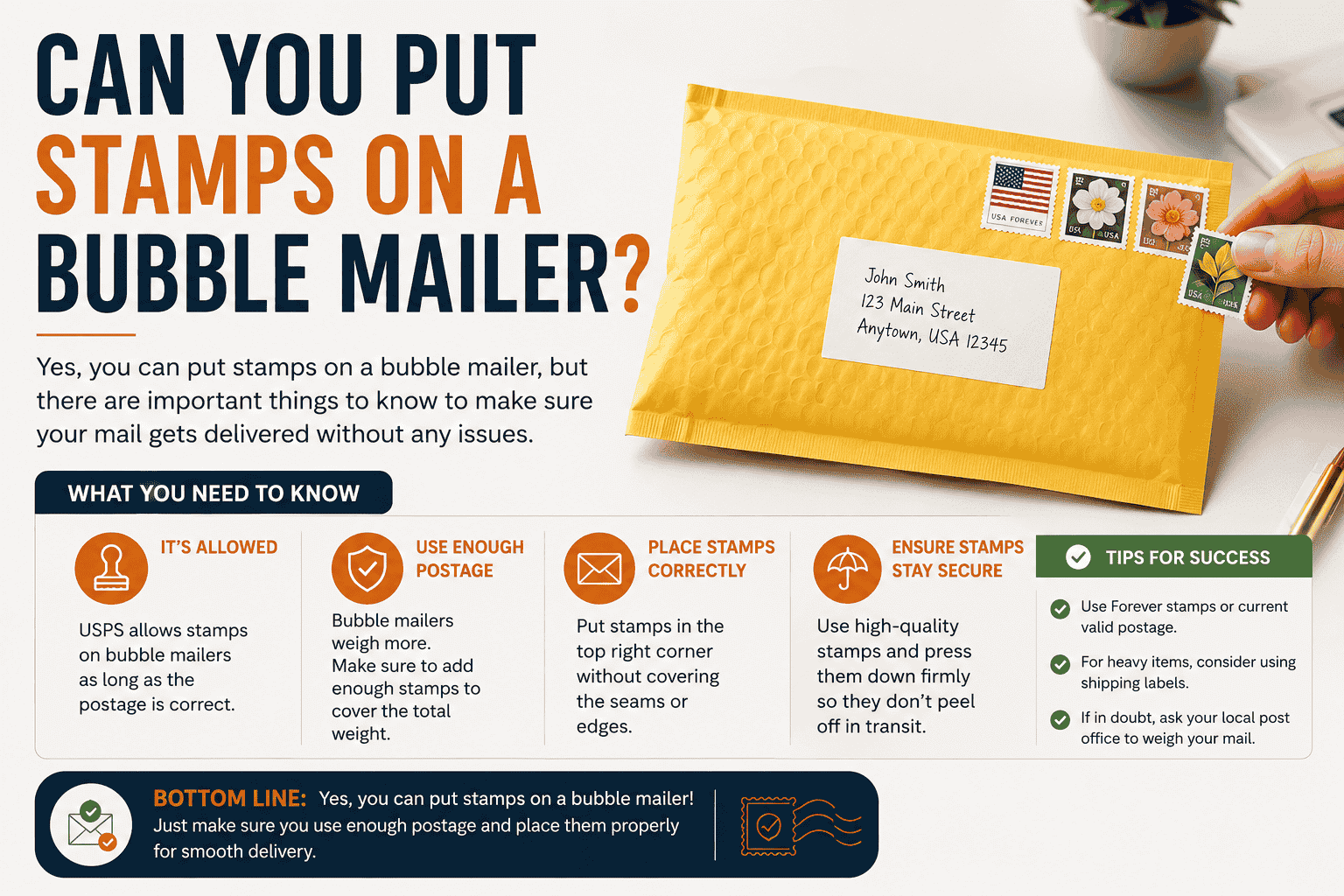
Yes, absolutely. You can use stamps on a bubble mailer — stamps are just a form of prepaid postage, and as long as the total value of the stamps you apply equals or exceeds the required postage, USPS will accept the package.
The problem is that most people underestimate how much postage a bubble mailer actually requires. Because the mailer looks similar to a large envelope, the instinct is to put on one or two stamps and be done with it. In reality, most bubble mailers with anything inside them are classified as parcels — not letters — and parcel rates are significantly higher than letter rates.
How Does USPS Classify a Bubble Mailer?
This is the part that trips everyone up.
USPS does not have a dedicated category called “bubble mailer.” Instead, every piece of mail is evaluated at the time of processing and assigned to one of three categories: letter, flat (large envelope), or package/parcel. The category determines the postage rate.
Here is how those classifications work for bubble mailers:
Letter Rate
To qualify as a letter, a mailpiece must be under 1/4 inch thick, rectangular, and within letter dimensions. A bubble mailer — even a flat, empty one — almost never meets the thickness requirement once it has anything inside it. The bubble wrap lining alone adds thickness and creates an uneven surface. In practice, bubble mailers are almost never mailed at letter rates.
Flat / Large Envelope Rate
To qualify as a flat, the mailpiece must be flexible, no thicker than 3/4 inch, and no heavier than 13 ounces. The dimensions must be no larger than 12 inches high by 15 inches long.
A very lightweight bubble mailer — say, one containing a greeting card or a thin sticker sheet — could potentially qualify here if it stays under that 3/4 inch threshold. But here is the catch: USPS also requires the item to be flexible, and the bubble wrap padding inside creates rigidity that automated sorting machines flag. In practice, the vast majority of post offices treat all bubble mailers as parcels, regardless of whether they technically qualify as flats.
Package / Parcel Rate
Once a bubble mailer exceeds 3/4 inch in thickness, or once postal workers judge it to be rigid or non-uniform, it is automatically classified as a package. This is where most bubble mailers land — and parcel rates are noticeably higher than flat or letter rates.
The practical takeaway: unless your bubble mailer is extremely thin and lightweight, plan on paying parcel rates. Do not assume you can slip it through as an envelope.
How Many Stamps Does a Bubble Mailer Need?
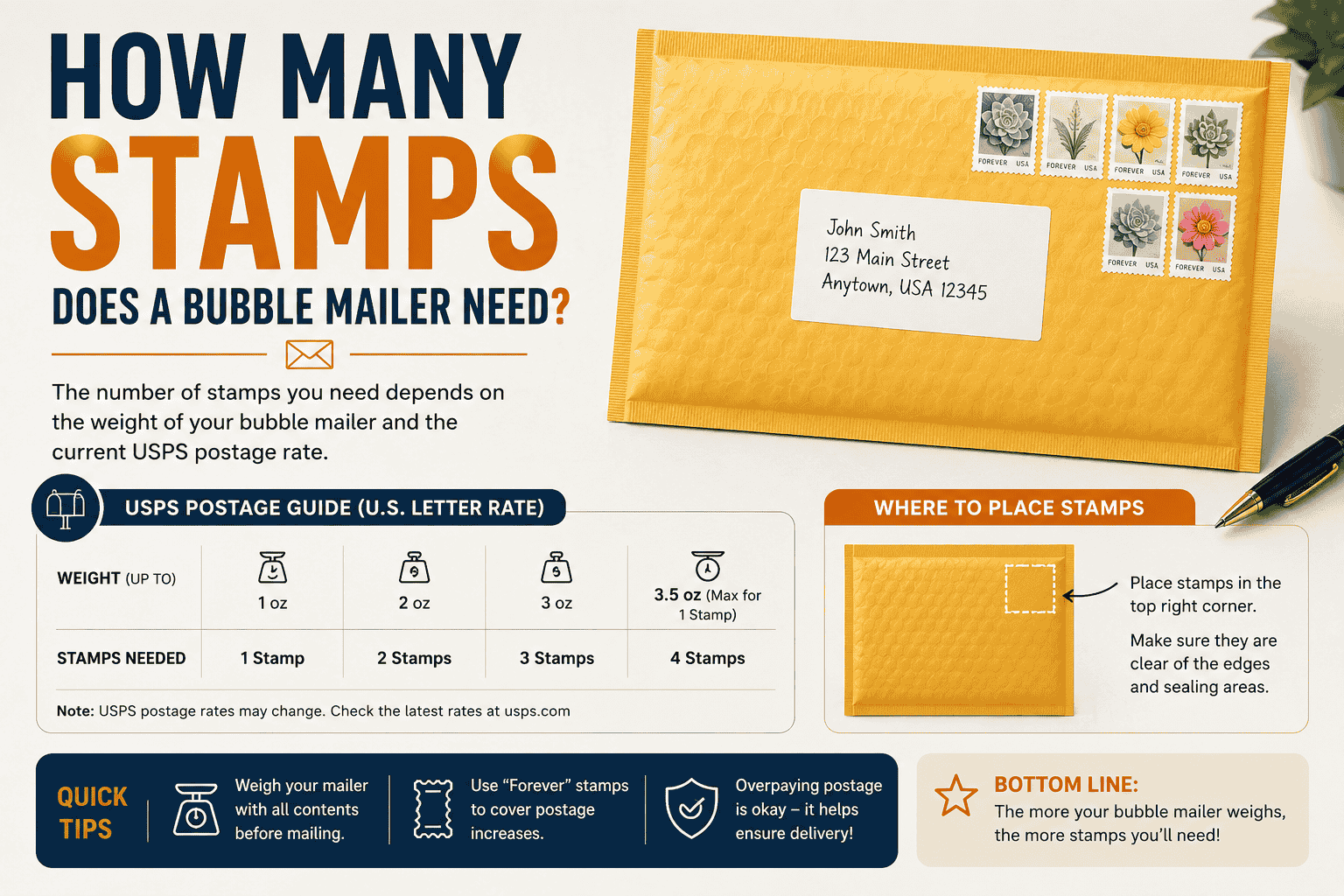
The honest answer is: it depends on the weight. There is no single number that applies to all bubble mailers.
Here is how the math works using current USPS rates:
As of July 2025, a First-Class Forever stamp is valued at $0.78. Forever stamps never expire — their value adjusts automatically with any future rate increases, so they are always worth the current first-class rate regardless of when you bought them.
If Your Bubble Mailer Qualifies as a Flat (Large Envelope)
This is uncommon but possible for very thin, flexible mailers under 3/4 inch thick:
| Weight | Approximate Stamps Needed |
| Up to 1 oz | 1 Forever stamp ($0.78) |
| 2 oz | 1 Forever stamp + additional ounce stamp |
| 3 oz | 1 Forever stamp + 2 additional ounce stamps |
| Up to 3.5 oz | 4 stamps maximum before parcel rates kick in |
If Your Bubble Mailer Is Classified as a Package
This is where the majority of bubble mailers end up. First-Class Package Service starts at around $4.09 for packages up to 4 ounces. USPS Ground Advantage starts at similar rates.
To cover $4.09 in postage using only Forever stamps at $0.78 each, you would need approximately 6 stamps. For a 6-ounce package, you might need 11 or more stamps.
As you can see, stacking that many physical stamps on a bubble mailer becomes impractical quickly. That is why, for anything classified as a parcel, purchasing a printed shipping label online — through USPS Click-N-Ship, Stamps.com, or a similar service — is both easier and often cheaper than using individual stamps.
When to Skip Stamps Entirely
For most small businesses and online sellers, buying a printed postage label is a better approach than using physical stamps on bubble mailers — for three reasons.
Cost: Buying postage online through USPS Click-N-Ship or a third-party platform typically gives you a discount compared to retail counter rates. For parcel rates, even small savings add up quickly across dozens or hundreds of shipments.
Convenience: A printed label includes your return address, the delivery address, and a tracking barcode all in one. Your customer gets tracking updates automatically. You get proof of postage and a delivery confirmation. None of that comes with stamps.
Accuracy: When you buy a label online, you enter the exact weight and dimensions of your package, and the system calculates the correct postage automatically. There is no guessing, no underpaying, and no envelope returned to your doorstep a week after you sent it.
The only real scenario where stamps make practical sense on a bubble mailer is when the mailer is very light and thin — genuinely close to envelope territory — and you are sending it occasionally rather than in volume.
International Shipping with Bubble Mailers
Sending a bubble mailer outside the United States adds another layer of considerations. USPS offers international shipping through First-Class Package International, Priority Mail International, and Priority Mail Express International.
For international shipments, stamps still technically work as postage — but USPS offers Global Forever Stamps specifically priced for international mail. The price of international postage varies by destination country and package weight, so calculating it precisely at the post office or through the USPS online calculator is strongly recommended before sticking anything in the mail.
Bear in mind that customs declarations are required for international packages. You will need to fill out a customs form (or have it generated as part of your printed label) that declares the contents and estimated value of the package. This is in addition to postage — do not skip it, as packages without customs forms are held at customs or returned.
Common Bubble Mailer Stamp Mistakes (and How to Avoid Them)
Treating it like a regular envelope. A bubble mailer with contents inside is almost always a parcel, not a letter. The envelope-rate assumption is the single most common cause of returned or postage-due packages.
Guessing the weight. Eyeballing whether something weighs 2 ounces or 6 ounces is not reliable. Weigh it. A postal scale costs less than $15 and pays for itself the first time it saves you a returned package.
Putting stamps over the seal. Stamps belong in the upper right corner — not across the flap or on the back. Stamps placed over the seal get damaged when the package is processed, and damaged stamps may not be read as valid postage.
Using old stamp values and not accounting for rate increases. Stamps that predate the most recent rate increase may be worth less than the current per-stamp value. Stack them to make up the full postage amount, or top up with additional ounce stamps.
Not adding a return address. It seems basic, but skipping the return address means that if anything goes wrong in transit, your package is gone. Always include it.
Overpacking and bursting the seal. If the mailer is visibly straining under the pressure of what is inside, the seal will not hold. Use the right size mailer for the job.
Final Thoughts
Mailing a bubble mailer is not complicated once you understand how USPS classifies padded envelopes. The short version: weigh it, check whether it qualifies as a flat or a parcel based on thickness, calculate the correct postage, and place everything — address and stamps — exactly where they belong