
Every morning, millions of people reach for a cereal box without giving it a second thought. But behind that colorful cardboard shell is a surprisingly deliberate set of material choices — ones that affect food safety, freshness, shelf appeal, and even your brand’s environmental footprint.
If you’re a cereal manufacturer, packaging buyer, or brand owner trying to choose the right material, this guide covers everything you need to know: what cereal boxes are actually made of, how each material performs, and how to pick the right one for your product.
The Two-Part Structure of a Cereal Box
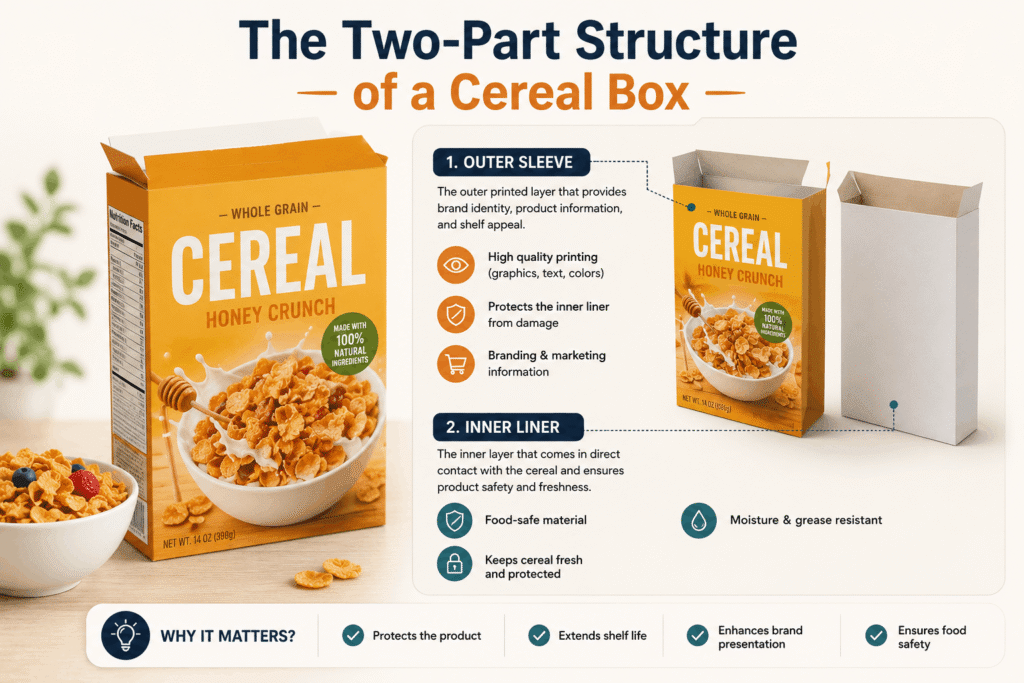
Before diving into materials, it helps to understand that a standard cereal box isn’t a single layer of cardboard. It’s actually two components working together:
The outer carton — the rigid, printed box you see on the shelf. This provides structural strength, branding space, and protection during shipping and stacking.
The inner liner bag — the plastic or paper bag inside that directly contacts the cereal. This layer does the real work of keeping the product fresh, blocking moisture and air, and preventing contamination.
Both components matter. A beautiful outer box means nothing if the inner liner fails and your cereal goes stale in three days. Likewise, a perfect liner won’t save your product if the carton collapses under the weight of pallet stacking.
The Main Materials Used for Cereal Box Outer Cartons
1. Cardboard (Paperboard)
Cardboard — or more precisely, paperboard — is the most widely used material for retail cereal boxes. It’s thick enough to hold its shape, light enough to keep shipping costs down, and smooth enough to hold sharp, full-color print with vibrant detail.
Cereal packaging typically uses one of three grades of paperboard:
SBS (Solid Bleached Sulfate): Made from 100% virgin bleached wood pulp, SBS is white and smooth on both sides. It’s the gold standard for premium cereal packaging because it produces the sharpest print quality and meets FDA food-contact safety standards. If your cereal brand targets health-conscious adults or premium shoppers, SBS is the natural choice.
CCNB (Clay Coated News Back): Made from recycled paper with a gray back and a white clay-coated front surface for printing. It’s significantly more affordable than SBS and is the go-to option for budget-friendly or high-volume cereal lines. The print quality is good, though not quite as crisp as SBS.
CRB (Coated Recycled Board): Another recycled-content option that offers solid print quality and a strong sustainability story. Brands that want to emphasize eco-credentials without paying the premium for SBS often land here.
Why brands choose cardboard:
- Excellent printability — colors pop, fonts stay sharp, mascots look vivid
- Food-safe and compliant with packaging regulations
- Easy to die-cut into custom shapes, puzzle pieces, or window cutouts
- Recyclable at the end of its life
- Available in multiple thicknesses to match different box sizes and weights
2. Kraft Paper and Kraft Board
Kraft has a completely different feel from standard cardboard. It’s naturally brown, made from wood chips using a sulfate pulping process, and carries an unmistakably earthy, natural aesthetic.
In the cereal world, kraft is the material of choice for brands that sell granola, muesli, organic cereals, or anything positioned as wholesome, natural, or minimally processed. The packaging signals what’s inside before a consumer even reads the label.
What makes kraft stand out:
- 100% biodegradable and compostable in most conditions
- Recyclable and often made from sustainably sourced wood
- Naturally porous surface that accepts eco-friendly inks well
- Strong enough to protect product during transit
- Zero chemical additives that could affect food safety
3. Corrugated Cardboard
You won’t typically find corrugated cardboard used for individual retail cereal boxes — it’s too bulky and heavy for a grocery shelf. But it plays a critical role in the cereal supply chain.
Corrugated boxes — those with a fluted middle layer sandwiched between two flat liner sheets — are used for shipping and bulk wholesale packaging. They absorb impact, resist compression under heavy stacking, and protect against moisture during transit.
If you’re shipping cereal from a production facility to a distributor, or packaging bulk quantities for warehouse club retailers, corrugated is the material that gets the product there in one piece.
4. Bux Board (Greyboard)
Bux board is a recycled-fiber material that comes in two common forms: grey board (grey on both sides, lower print quality) and white-back bux board (grey on one side, white on the other, better print quality on the white face).
It’s a cost-effective option for secondary packaging, point-of-sale displays, or situations where print sharpness isn’t the top priority. It’s worth noting that bux board is not FDA-approved for direct food contact, so it should never be used as an inner liner or in direct contact with cereal.
What About the Inner Liner Bag?
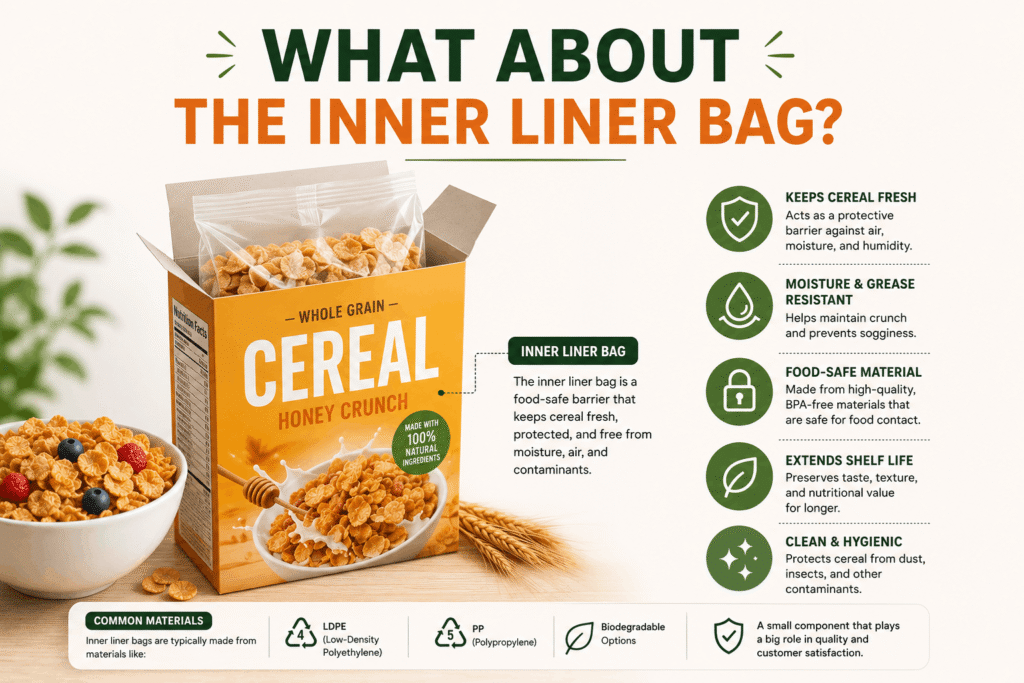
The outer carton will keep your cereal safe from crushing. When it comes to freshness, it’s the inner liner that does the lifting and keeps it safe from the elements.
Industry standards are traditional liner bags, which are normally constructed of Polypropylene (PP) or Polyethylene (PE) plastic. They’re very good at excluding moisture and air, maintain the crispness of the cereal for months, and are heat-sealable during the manufacturing process. The downside is that plastic liners make recycling more complicated: Most curbside programs will not accept plastic-lined bags, and they make it more difficult for eco-conscious consumers to recycle.
Particularly for brands with a strong sustainability commitment, Paper liner bags are becoming an increasingly popular alternative. They’re fully recyclable with the carton, which makes it much easier to dispose of responsibly. The downside to paper liners is that they are slightly less moisture resistant than plastic, which is relevant in humid climates or for products with a long shelf-life.
There is a middle ground solution, that of biodegradable plastic liners. They could offer a comparable performance to the traditional plastic in the same way, but they degrade faster under industrial composting conditions. However, they are costlier and enable brands to sell a fully sustainable package.
How to Choose the Right Material for Your Cereal Brand
Selection of materials is not only a technical question, but a brand question as well. The following is a brief outline:
To reach families and kids: Use SBs cardboard. The graphics are eye-catching, and their bold coloration stands out against the smooth white surface. Strong, food safe and economical at a larger scale.
When you choose to sell organic, natural, or health-oriented cereal, you are telling your brand’s story before your customer reads a word. Combine with a paper liner for an environmentally friendly package.
For a high-end adult cereal: Laminate again, but matte or soft-touch. This raises the perceived value and makes it a tactile experience that is separate on the shelf.
For cost, you can expect solid print quality, but at a lower price per unit from CCNB cardboard than SBS.
Corrugated cardboard, which fits inside your retail boxes efficiently, is the ideal shipping box for B2B and wholesale shipments.
Sustainability: What the Packaging Industry Is Moving Toward
Cereal packaging is changing due to consumer and regulatory expectations of the environment. Here are a couple of trends you should be aware of:
Recycled content requirements are increasing. There is a growing number of big retailers that demand a percentage of recycled fiber in their packaging. These requirements are met by CRB and CCNB boards naturally; however, an increasing number of boards from the SBS manufacturer are now available as recycled-content.
FSC certified (Forest Stewardship Council) indicates that the pulp used for your packaging is from responsibly managed forests. A number of brands are now asking for the minimum base requirement of the FSC board.
The liner bag problem is getting solved. Paper liners and film that is compostable are indeed a movement that is progressing rapidly. Five years ago, it was hard to do for mid-size brands, but now it’s a thing.
Coatings matter too. Cereal boxes are traditionally coated with a glossy film that may contain plastic compounds, which decrease the recyclability. Water-based coatings (aqueous) offer the same protection and have much lower environmental profiles.
Cereal Box Thickness: Does It Matter?
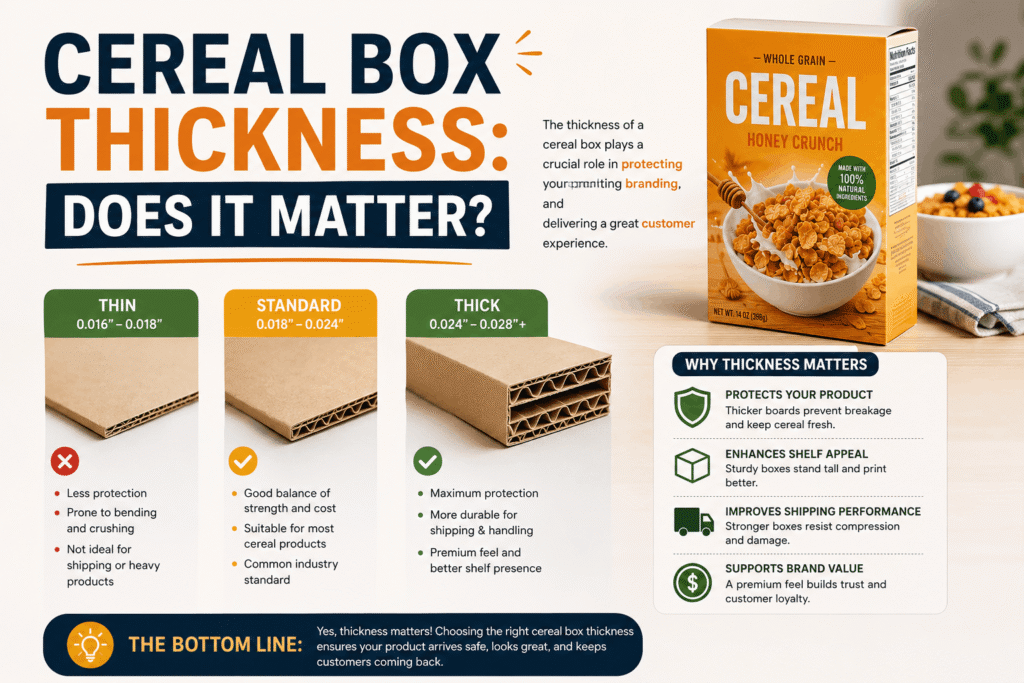
Yes — and it’s not always considered. Box thickness, measured in points or square meters per gram, will determine the box’s ability to retain its shape when stacked, its performance during humid storage, and how it will feel in the consumer’s hands.
A narrow box will fall from the shelf or break in shipping. A superfluous box is heavier and more expensive to make. The optimum size for most standard retail cereal boxes is 18-24pt SBS board. The thickness of the stock used for a particular box will depend on the size of the family box; the larger the box, the thicker the stock should be.
You can ask your packaging supplier or converter for the appropriate caliper for your box size and product weight.
Quick Reference: Cereal Box Materials at a Glance
| Material | Best For | Print Quality | Eco Profile | Cost |
| SBS Cardboard | Premium & standard retail | Excellent | Good (recyclable) | Medium-High |
| CCNB Cardboard | Budget retail | Very Good | Better (recycled content) | Low-Medium |
| CRB Board | Eco-focused retail | Good | Best (recycled + recyclable) | Low-Medium |
| Kraft Board | Natural/organic brands | Good (limited light colors) | Excellent | Medium |
| Corrugated | Shipping & wholesale | Basic | Good (recyclable) | Low |
| Bux Board | Secondary/display packaging | Fair | Good (recycled content) | Low |
Final Thoughts
Cereal boxes are much more than just boxes, and much more important than most brands realize — and they are engineered in a quiet way, too. The material you select is going to influence the shelf life of your product, the appearance of your product in a crowded retail shelf, the performance of your product during shipping, and the information your product will convey before you get to the point of reading a single word.
Keep your brand positioning in mind, work back to the right material, and identify a packaging partner that can help you optimise for both performance and cost. Once those basics are working correctly, the box will get the job done in a surprising way.