If you sell coffee online, your packaging has a harder job than packaging sold in a café or grocery aisle. It has to survive a delivery truck, a hot mailbox, a rough handoff at the doorstep, and still taste like it did the day it was roasted. Retail packaging is designed to get picked up off a shelf. E-commerce packaging is designed to get picked up off a shelf, thrown in a bin, stacked under six other boxes, and opened three days later by someone who’s judging your brand on first impression alone.
That’s a different design problem, and most guides on this topic treat coffee packaging as one category. It isn’t. Below is a practical breakdown of what actually matters when your packaging has to survive shipping — not just look good in a photo.
Why Shipping Changes the Packaging Equation
Coffee has three enemies regardless of where it’s sold: oxygen, moisture, and light. Heat speeds up all three. A bag sitting in a climate-controlled café doesn’t face the same stress as a bag sitting in a delivery van on a 95°F afternoon or a mailbox in direct sun for six hours.
For an online order, you’re also adding:
- Impact and crush resistance — boxes get stacked, dropped, and compressed in transit
- Weight-based shipping costs — every extra ounce of packaging material is a cost you pay on every single order
- Unboxing as marketing — for a DTC coffee brand, the unboxing moment is often the only physical touchpoint a customer has with you
- Return-to-sender tolerance — packaging has to survive a failed delivery attempt and a second trip without failing
Any packaging decision that ignores one of these four factors will eventually cost you money, either in damaged product, high shipping bills, or bad reviews about stale coffee.
The Core Packaging Formats, Compared Honestly
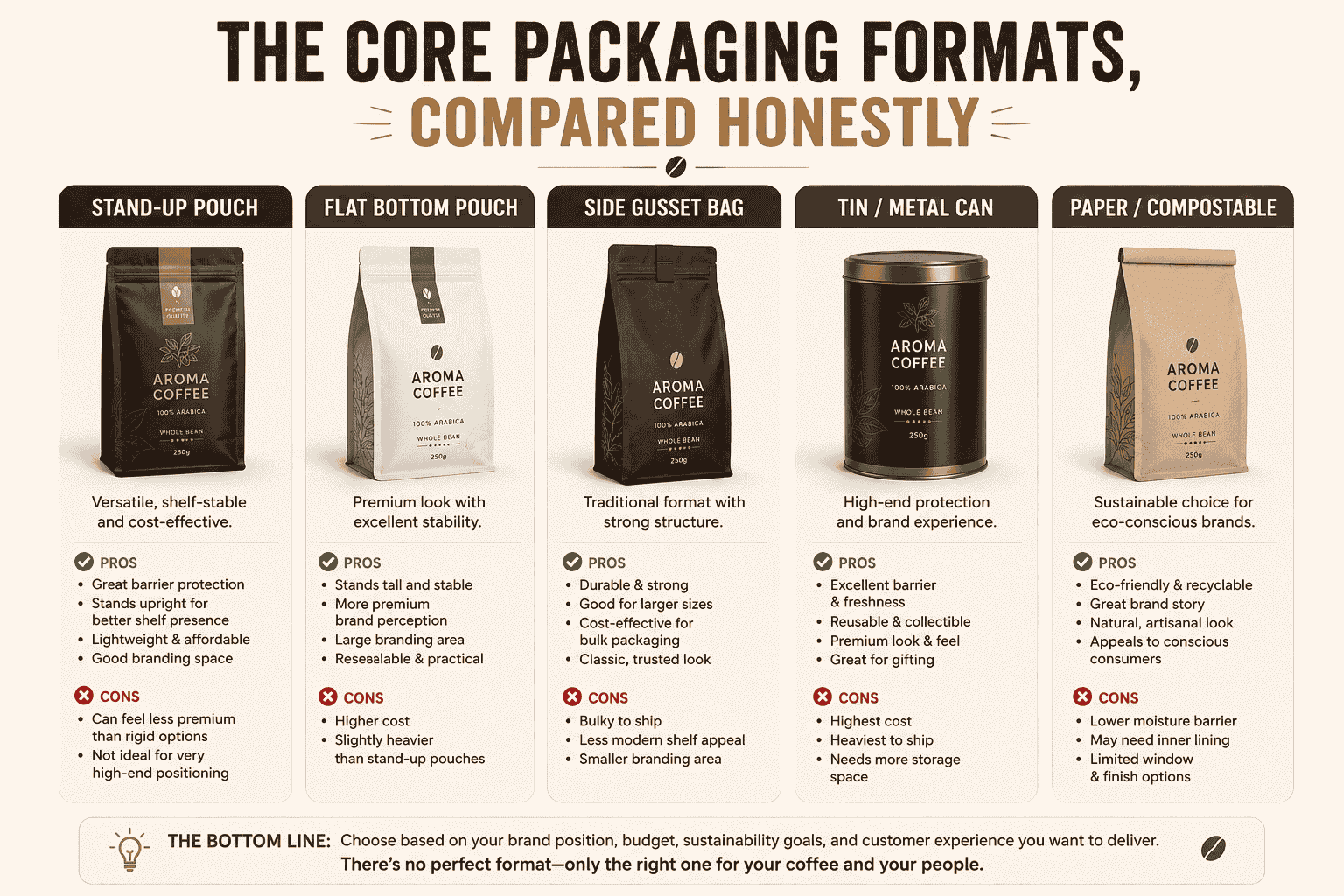
Stand-up pouches with a one-way degassing valve are the default for a reason. Freshly roasted beans release CO2 for days after roasting — if the bag is fully sealed with no outlet, it either bloats or bursts in transit. The valve lets gas escape without letting oxygen back in, which is what actually preserves the roast. For most coffee brands shipping direct to consumer, this is the packaging to build a launch around.
Flat-bottom and side-gusset pouches trade a little bit of shelf stability for a lower material cost and lighter shipping weight. If your margins are tight on subscription orders, this is often where the savings show up.
Mylar or foil-lined bags matter more than people expect. A kraft paper bag looks great, but paper alone is a poor oxygen and moisture barrier. Most kraft coffee bags on the market are actually kraft-look laminates with a foil or poly barrier layer underneath — the outside is paper, the inside is doing the real preservation work. If you’re sourcing “kraft” bags, confirm what’s laminated to the inside, not just what the outside looks like.
Rigid boxes, tins, and jars protect beans exceptionally well but are heavy and expensive to ship. These make sense for gift sets or premium single-origin releases where the unboxing experience justifies the shipping surcharge, not for your everyday reorder SKU.
Corrugated mailer boxes around a pouch add crush protection for orders that include multiple bags, merchandise, or fragile add-ons like ceramic mugs. For a single bag of coffee, this is usually overkill — you’re paying for box weight and dimensional shipping charges to protect something that a well-sealed pouch already protects on its own.
Comparison at a Glance
| Packaging Type | Freshness Protection | Shipping Weight | Best For |
| Stand-up pouch w/ valve | High | Low | Everyday retail & subscription orders |
| Flat-bottom/side-gusset pouch | High | Low | High-volume, cost-sensitive brands |
| Kraft-look laminate bag | Medium–High | Low | Brands prioritizing eco-visual branding |
| Rigid box or tin | Very High | High | Gift sets, premium/limited releases |
| Corrugated mailer + pouch | High (added crush protection) | Medium–High | Multi-item or bundled orders |
Sustainability, Without the Greenwashing
“Eco-friendly” gets used loosely in this industry. A few things actually matter:
- Recyclability depends on material, not marketing. A foil-laminated pouch is often not curbside recyclable even if it’s labeled “kraft.” If sustainability is part of your brand story, look at compostable mono-material pouches — they cost more per unit but hold up under scrutiny if a customer checks.
- Right-sizing the package reduces waste and cost simultaneously. Oversized mailer boxes for a single coffee bag waste material and inflate dimensional shipping weight — that’s a cost problem and a sustainability problem at the same time.
- Water-based inks and low-VOC printing are a smaller lever, but they’re worth mentioning on packaging or product pages if you’re using them — customers increasingly ask.
Design Decisions That Actually Affect Conversion

A few things influence whether a first-time buyer becomes a repeat customer:
- A visible or die-cut window builds trust for whole-bean coffee — people like seeing the roast level before opening.
- Resealability (zipper, fold-and-tape closure) matters more for subscription customers who don’t finish a bag in one sitting.
- Roast date printed clearly, not buried in small print, signals quality to a coffee-literate buyer.
- A packing insert with brewing suggestions costs almost nothing and increases the odds of a repeat order, because it helps a new customer actually get a good cup out of the bag they bought.
Common Mistakes Coffee Brands Make with E-Commerce Packaging
- Using retail-only bags for online orders. A bag designed for a café counter, without a proper barrier layer, degrades in an unclimate-controlled delivery van in a way it never would sitting indoors.
- Skipping the degassing valve to save a few cents per unit, then dealing with returns and reviews about “burst” or “puffy” bags.
- Over-boxing single-bag orders, which increases dimensional shipping weight and cost without meaningfully improving protection.
- Under-testing packaging in real shipping conditions. A bag that survives a desk test doesn’t necessarily survive a week in a hot delivery truck. If you’re switching suppliers or materials, order a small batch and actually ship it to yourself before committing to a large production run.