Funny thing about coffee — the ritual doesn’t actually begin with the kettle. It begins the moment someone picks up the bag or box and starts sizing it up, half-consciously deciding whether it looks worth the money. You could’ve spent three weeks dialing in a roast profile and none of that matters in the first four seconds. The packaging talks first.
Bags do the basic job — stand-up pouches, quad-seal, whatever you’re using, they hold the beans and keep most of the air out. But wrap a proper box around that bag and something shifts. It stops looking like a commodity sitting on a shelf and starts looking like something somebody chose to buy on purpose. That shift is basically what this whole guide is about.
Why Coffee Brands Need Custom Packaging Boxes
Pouches are fine for basic storage, nobody’s arguing that. But once you put a rigid or folding carton into the mix, you pick up a few advantages that are easy to dismiss until you see them side by side with a competitor’s shelf.
Start with how a box just sits better. A bag slouches — it leans, it flops over, it doesn’t stand at attention the way a box does. That structural stiffness alone makes a brand look more put together, even if nothing else about the product changed.
Then there’s the space you get to actually say something. Coffee people want to know where the beans came from, what the roast tastes like, whether the farm got paid fairly. A pouch gives you two decent panels if you’re lucky. A box gives you six sides of flat surface, and that’s the difference between cramming a paragraph into a corner and actually telling a story someone might read while waiting for their pour-over to finish.
And shipping — if you’re running a subscription box or selling direct online, a bag by itself gets crushed or punctured more often than you’d think. Slide it into a sturdy box first and it shows up looking the way it left your roastery, not like it went through a wrestling match at the sorting facility.
Popular Styles of Coffee Packaging Boxes
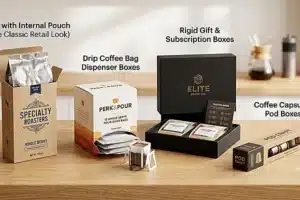
What you’re selling — whole beans, ground, drip bags, pods — pretty much decides which box style makes sense.
Box with Internal Pouch (The Classic Retail Look)
This one’s the standard. Nice printed carton or kraft box on the outside, sealed foil bag doing the actual freshness work underneath. Picking one up off a shelf, it just feels substantial in a way a bare pouch never quite does. Most specialty roasters selling whole beans or grounds lean on this format.
Drip Coffee Bag Dispenser Boxes
Drip bags — the individual pour-over filters — have really taken off the past few years, and they usually ship in cartons with a little perforated tear strip along the bottom. Once that’s opened, the box basically becomes a dispenser sitting on the counter. It’s a small thing, but it’s genuinely useful, not just packaging dressed up to look clever.
Rigid Gift & Subscription Boxes
Limited releases, gift sets, monthly subscriptions — this is where you spend the money on thick rigid stock, sometimes with a magnetic lid. People photograph these. If unboxing content is part of your marketing at all, this is the format that earns it.
Coffee Capsule / Pod Boxes
Pods need precision more than any other format here. They have to sit tight enough in the box that they don’t rattle around during shipping, and the box itself has to fit in a drawer or beside a machine without looking bulky. Get the dimensions even slightly wrong and customers notice immediately.
The Science of Keeping Coffee Fresh
Coffee doesn’t stop changing once it’s roasted, which surprises people who assume “fresh” just means “recently packaged.” Beans keep releasing CO2 for days after roasting — degassing, it’s called — and the whole time, oxygen, moisture, light, and heat are quietly working against whatever’s inside the bag.
                  External Threats
      Oxygen  |  Moisture  |  Light  |  Heat
         \         \           /         /
          \         \         /         /
           v         v       v         v
        +---------------------------------+
        |     Custom Coffee Box Outer     |
        |  +---------------------------+  |
        |  |   High-Barrier Inner Bag  |  |  <--- Keeps Oxygen Out
        |  |   with One-Way Valve      |  |  <--- Lets CO2 Escape
        |  +---------------------------+  |
        +---------------------------------+
                         |
                         v
               Fresh, Aromatic Cup
That’s why almost every serious coffee bag has a small one-way valve stuck on the front somewhere. It lets the built-up CO2 vent out so the bag doesn’t puff up like a balloon or split at the seam, while still blocking oxygen from sneaking in and turning the oils rancid. It looks like a minor detail on the package, but skip it and even a great roast tastes flat within a week.
Key Design Elements for Impactful Coffee Boxes
Colour Psychology
Dark tones — matte black especially — read as bold and expensive, the kind of look that suits an intense espresso blend. Greens and browns lean earthy, which fits when the story is about the farm or single-origin sourcing. Bright pastels or gradients tend to land better with younger buyers, and usually signal something lighter or more experimental on the inside, like a fermented or anaerobic process roast.
Tactile Finishes
People touch boxes before they buy them, whether they realize it or not, and that touch matters. A soft-touch matte lamination has this velvety feel that’s hard to walk past without running a thumb over it. Spot UV on just the logo creates a bit of shine against a flat matte background — small contrast, big effect. Embossed lettering does something similar; it raises the brand name just enough that fingers want to trace it.
The Move Toward Sustainable Coffee Packaging
Coffee drinkers, more than a lot of other shoppers, seem to actually care whether their morning habit is doing quiet damage somewhere down the supply chain. Sustainable packaging isn’t a bonus feature at this point — it’s closer to an expectation.
| Packaging Component | Conventional Option | Sustainable Alternative |
|---|---|---|
| Outer Box | Plastic-coated bleached paperboard | FSC-certified kraft paper or recycled corrugated board |
| Inner Pouch | Multi-layer plastic/aluminum film | Commercially compostable or recyclable mono-plastic film |
| Printing Inks | Petroleum-based inks | Soy-based or water-based eco-friendly inks |
Even something as small as printing recycling instructions directly on the box tells a customer you’ve actually thought this through, not just slapped a green leaf icon on the front and called it a day.
Checklist for Sourcing Your Coffee Boxes
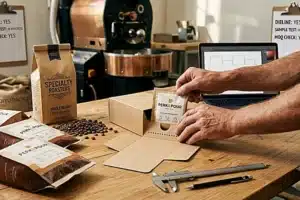
Before you actually place an order, a few things are worth nailing down with whoever’s manufacturing for you.
Get the dieline template first — that’s the exact flat structural layout — before any artwork gets finalized. Skip that step and there’s a real chance your design ends up clipped or crooked once the thing is folded into shape.
Order an actual structural sample, blank if needed, and test it with your real coffee bags inside. You’re looking for a fit that’s snug enough nothing rattles around in shipping, but not so tight that packing it becomes a chore every single time.
And ask about minimum order quantities early, especially if you’re a smaller roaster doing seasonal or limited flavors. Manufacturers offering digital printing tend to be far more forgiving here — lower MOQs, no expensive plate fees every time you tweak a design.
Conclusion: Crafting an Unforgettable Brew Experience
Good coffee takes patience, and so does good packaging — neither one happens by accident. Put real thought into a custom box and you’re not just protecting beans from going stale, you’re giving your brand actual presence on a shelf and handing customers a little moment worth remembering when they open it. Get the materials right, don’t skip on sustainability, and let the box carry a bit of your story on every side. That’s usually what turns a one-time buyer into someone who reorders without a second thought.