
There’s a specific kind of letdown that comes from ordering a candle online, waiting a week, and then opening a box that looks like whoever designed it has never actually bought a candle in their life. Flimsy, generic, forgettable within seconds. And then there’s the opposite feeling — the one where the box makes you pause a second before you’ve even touched the wax. That second version isn’t luck. Somebody picked the right style, on purpose.
Candles are a weirdly tricky thing to package, when you actually think about it. Heavy for their size, prone to cracking if they shift around too much in transit, and often bought as a gift rather than something for yourself. That last bit matters more than people give it credit for — a gift needs packaging doing some of the emotional work on its own, before the person even lifts the lid. So which style actually earns its keep? Here are the four that keep showing up for a reason.
1. Rigid Boxes: The Go-To for Premium
If you’ve ever bought a candle from a nicer brand, there’s a decent chance it showed up in a rigid box, even if you never stopped to wonder why.
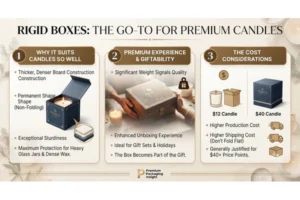
Why It Suits Candles So Well
Rigid boxes don’t fold flat — they’re built from thicker, denser board that holds its shape permanently, sort of like the box a good watch comes in. That extra sturdiness matters a lot here specifically, since glass jars and dense wax add real weight, and a flimsier box just isn’t going to protect that properly once it’s bouncing around in a delivery van.
It’s About the Weight in Your Hands
There’s something about how heavy a rigid box feels that signals “this cost more” almost instantly, before the lid even comes off. That’s a big part of why gift sets and holiday collections lean on this style so much — the box itself becomes part of the gift, not just something protecting what’s inside it.
The Catch
None of this is cheap, though. Rigid boxes cost more to make and more to ship, since they can’t collapse flat, and that cost usually lands on the customer eventually. For a candle priced at twelve dollars, this style probably doesn’t add up. For one priced at forty, it usually does.
2. Kraft Boxes: Honest, Earthy, Unbothered
Not every candle brand wants to feel luxurious, and that’s fine — plenty want to feel handmade and a little rustic instead, and kraft packaging nails that almost instantly.
Why It Works for a Certain Kind of Brand
Kraft paperboard has that raw, uncoated brown look that reads as eco-conscious and unpretentious before a single word of copy explains anything at all. For brands built around soy wax, essential oils, small-batch production, anything positioned as “made with care” instead of “made in a factory” — kraft basically does half the branding job on its own, without trying too hard.
Where It Really Shines
This style also pairs nicely with minimal printing — one logo stamped in black or a deep color, maybe a simple botanical sketch, and honestly that’s enough. It doesn’t need fancy finishes to feel intentional, which keeps costs sane even for a small batch run.
One Thing to Watch
Just be careful with durability here. Standard kraft board can feel thin if it’s not specified correctly, so it’s worth actually confirming the board weight with your supplier instead of just assuming “kraft” automatically means sturdy — it doesn’t, necessarily.
3. Window Boxes: Let the Candle Do the Talking
Sometimes the candle itself is the best sales pitch you’ve got — the color of the wax, the texture, maybe dried flowers pressed into the top. Hiding that behind solid cardboard is, honestly, kind of a waste.
Why a Window Changes Things
A die-cut window, whether it’s a plain circle or something more custom-shaped, lets people actually see what they’re buying before committing — which matters a lot more for candles sold on a physical shelf than ones sold online with good product photos doing the work instead. People trust their own eyes more than a label’s description, every time.
What You Actually Need to Balance
The tricky part is visibility versus structural strength. Too big a window, and the box gets noticeably weaker, especially with something as heavy as a candle sitting in it. Most well-made window boxes keep the cut-out to a portion of one panel, with enough surrounding cardboard left to reinforce it, rather than one giant hole that leaves the whole thing floppy.
Where This Style Actually Pays Off
This one does best with candles that have something genuinely interesting to look at — layered wax colors, embedded botanicals, an unusual jar shape. If your candle is just a plain single-color pour in a standard jar, a window might not add much, since there’s not really anything dramatic hiding in there to show off.
4. Sleeve and Base Boxes: Quiet, but Effective
This one doesn’t get talked about nearly as much as the other three, but it’s quietly become one of the more popular picks for mid-range candle brands, and there’s a good reason for that.
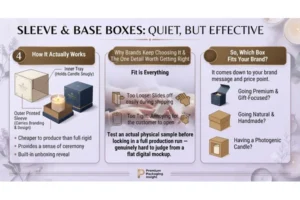
How It Actually Works
A sleeve and base setup is basically two pieces — an inner tray that holds the candle snugly, and an outer printed sleeve that slides over the whole thing. The sleeve carries the branding and the design work, while the base handles the actual job of protecting the product.
Why Brands Keep Choosing It
It sits in a nice middle ground between cost and presentation. Cheaper to produce than a full rigid box, but that sliding motion still gives a small sense of ceremony that a basic tuck-top box just doesn’t have. There’s a tiny built-in reveal, and that matters more than people expect for anything marketed as a gift.
The One Detail Worth Getting Right
The fit between sleeve and base is the whole game here. Too loose, and the sleeve slides off in shipping or slips around awkwardly once someone’s holding it. Too tight, and it just gets annoying to open. Worth testing an actual physical sample before locking in a full production run — this is one of those things that’s genuinely hard to judge from a flat digital mockup on a screen.
So, Which One Actually Fits You?
Honestly, it mostly comes down to price point and what your brand is trying to say without saying it out loud. Going premium and gift-focused points toward rigid. Going natural and handmade points toward kraft. Having a genuinely photogenic candle points toward a window box. Wanting something between cost and ceremony points toward sleeve and base.
There’s no single “best” answer sitting out there — just the one that actually matches what you’re selling, and who you’re selling it to.
Bottom Line
A candle’s box does more work than most people give it credit for. It’s not just there to survive the trip to somebody’s doorstep — it’s usually the first physical thing that tells a customer what kind of brand they just bought into. Pick a style that actually fits that story, and the box stops being an afterthought. It becomes part of the reason someone remembers you at all.