In the food business, packaging isn’t just something you throw a meal into — it’s the first physical thing a customer touches before they even get to the taste. For burgers specifically, the box is basically the bridge between your kitchen and whatever table (or car seat) the customer ends up eating at.
Designing a burger box that actually works, and looks good doing it, is trickier than people assume. You’re balancing heat retention, brand identity, and the whole experience of opening the thing. If you own a burger spot and you’re thinking about upgrading your packaging, here’s what actually matters.
Why Custom Packaging Matters for Your Burger Brand
Before jumping into design decisions, it’s worth understanding why custom boxes are worth the investment in the first place.
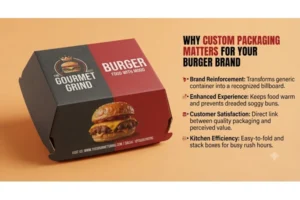
A generic box doesn’t say anything about your brand — it’s just a container. A custom one works more like a small billboard, reinforcing your logo, your colors, whatever makes your place recognizable. It also shapes the actual experience of eating the food — good packaging keeps things warm and helps you dodge the dreaded soggy bun problem, which directly affects how satisfied a customer feels. And practically speaking, boxes that are easy to fold and stack make a real difference in a busy kitchen during a rush.
The Fundamentals of Burger Box Design
Burgers are messy — hot, juicy, greasy — and the design has to account for all of that.
Thermodynamics: Keeping It Hot and Fresh
The biggest issue with hot food delivery is steam. Seal a burger up completely and that steam has nowhere to go — it condenses right on the bun, and suddenly you’ve got a soggy mess.
The fix is small ventilation holes placed strategically in the box. They let steam escape while still holding onto enough heat to keep the burger at a decent temperature.
Moisture and Grease Resistance
A grease-stained, flimsy box just feels cheap, and customers notice.
Stick with food-grade material that has some kind of natural grease barrier. Some boxes also use an internal liner or coating that repels oil specifically, which keeps things sturdy and clean the whole way through delivery.
Structural Integrity
A loaded burger — extra patty, sauce, toppings — has real weight, and it needs a stable base to sit on.
This is exactly why fold-over lids and clamshell-style boxes are so common. They create a kind of tray that keeps the burger centered and stops it from tipping over mid-delivery.
Designing Your Branding Elements
Once the structural side is handled, this is where your brand’s personality actually gets to show up.
Choose Your Color Palette
Colors trigger real psychological responses. That’s why a lot of fast-food giants lean on red and yellow — both are known to stimulate appetite. But if your thing is gourmet, organic, or health-focused, that loud combo probably works against you. Earth tones — kraft brown, sage green, muted charcoal — tend to fit that vibe much better. Whatever you go with should feel consistent with the actual look of your restaurant.
Typography and Messaging
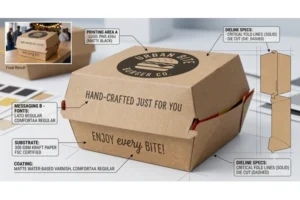
Your logo should be the main focal point, but leave room for some personality too. A bit of humor or a warm note on the inside of the lid — something like “enjoy the bite” or “hand-crafted just for you” — helps create a small emotional connection with whoever’s opening the box.
Incorporating Your Logo
Put your logo where people will actually see it — usually when the box is stacked or sitting closed on a counter. If you’re working with kraft paper as a base, a simple one-color print often reads as more premium than a busy design, especially for brands going for that modern, minimalist look.
Sustainability: The Modern Standard
Customers care a lot more now about what happens to their takeout container after the meal, and single-use plastic keeps falling out of favor.
Recycled or FSC-certified paperboard is the obvious starting point — biodegradable, compostable, recyclable. Sometimes less really is more with the design itself. Soy-based or water-based inks are worth using too, since they skip the chemical residue that comes with older petroleum-based printing, which makes recycling the box afterward that much easier.
And it’s worth saying so out loud. A small “please recycle me” line, or a note that says “made from 100% recycled materials,” reassures the customer that their choice actually lines up with what they care about.
Technical Specifications for Printing and Production
None of this matters if the manufacturing details fall apart, so work closely with whoever’s producing your boxes.
Measure your actual finished burger — bun height, toppings, all of it — before locking in dimensions. Too small and you’ll crush it closed. Too large and it’ll shift around during delivery.
Finish matters too:
Matte – gives a soft, premium feel.
Gloss – makes colors pop and adds a bit of extra moisture protection.
Natural/Uncoated – perfect if you’re going for that rustic, eco-conscious look.
The Roadmap to Launching Your Custom Packaging
Start by nailing down your brand’s actual vibe — modern, retro, gourmet, whatever fits. From there, sketch a rough version of your box dimensions and where the branding will sit. Reach out to a packaging supplier and hand them your measurements along with your branding files in vector format.
Before committing to a full production run, order a small test batch first. Put a hot burger inside, close it up, let it sit for about 15 minutes like a real delivery would, then open it. Check for sogginess, stability, and whether it’s easy to open without falling apart. Once you’re happy with how it performs, go ahead and scale up to full production.
Final Thoughts
Designing a custom burger box pays off in ways that go beyond just holding a meal together. Get the thermodynamics right so the food stays good, lean into sustainable materials for the customers who care, and let some real branding personality show through — and a simple burger delivery starts to feel like something closer to a branded event.