
A jar candle that survives your warehouse can still arrive at a customer’s door with a hairline crack, a shifted wick, or wax that’s pooled unevenly from heat exposure in transit. None of that shows up until the box is already opened — and by then, it’s a refund, a bad review, or a customer who quietly doesn’t reorder.
That’s really the starting point for why candle packaging matters at all. It’s not about making a pretty box. It’s about solving three problems that generic packaging can’t: breakage, brand invisibility, and compliance friction. Here’s how each one plays out, and what to actually do about it.
1. Candles Break in Ways Other Products Don’t
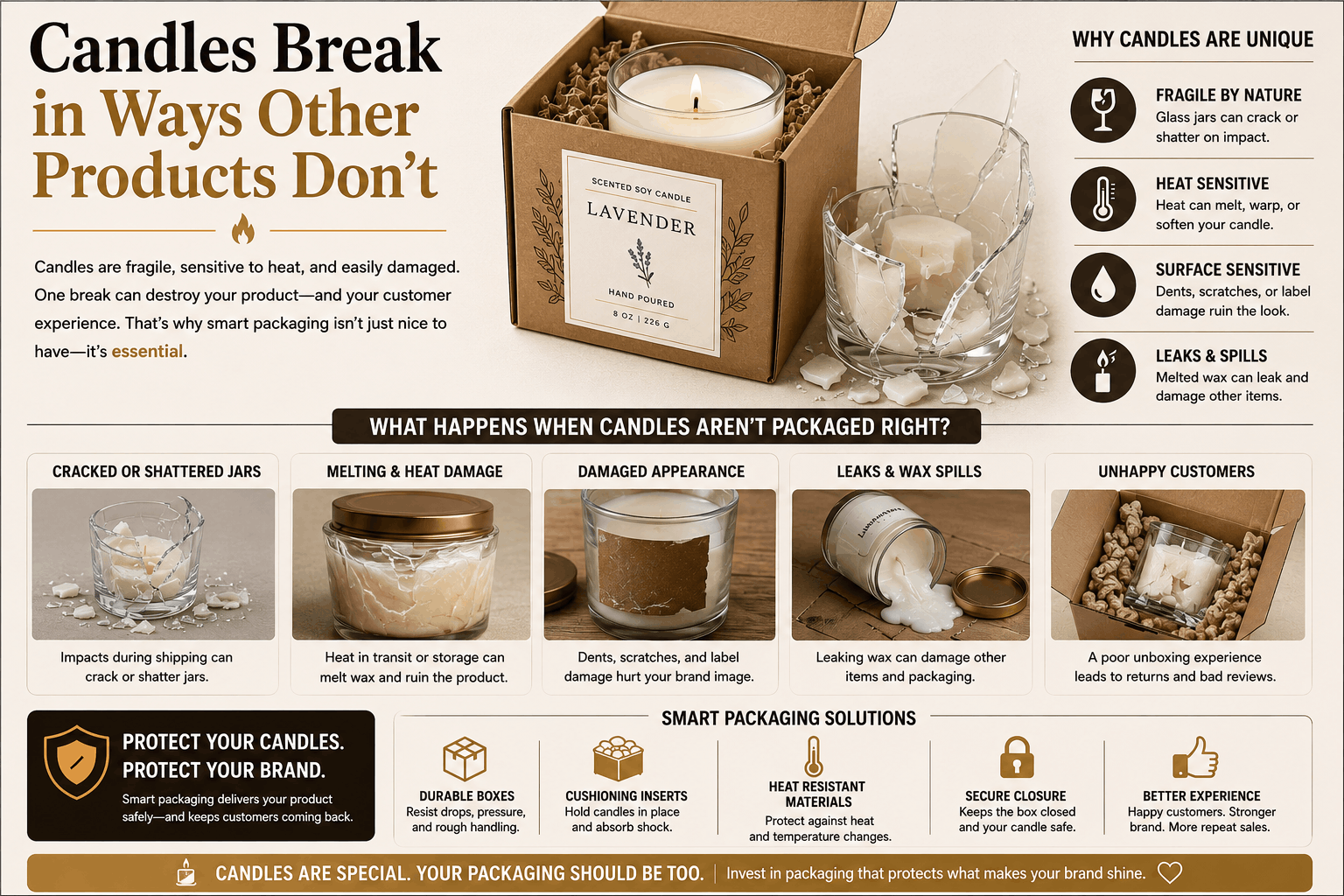
Most products just need to avoid getting crushed. Candles have extra failure points:
- Glass and ceramic vessels crack from impact or from expanding and contracting with temperature swings.
- Wax itself is soft. Heat during transit can cause it to sink, sweat, or separate from the sides of the jar — even if the container never breaks.
- Wicks shift if a candle isn’t held firmly in place, throwing off how it burns once it reaches the customer.
Standard shipping boxes with a layer of bubble wrap don’t solve any of this — they just slow down the damage. What actually works is packaging built specifically for candles: snug inserts that stop movement, rigid outer walls that resist crushing, and in some cases double-wall construction for glass jars going any real distance.
Think of it less as “a box” and more as a small containment system — inner cushioning, a fitted shell, and an outer shipper if it’s going by mail. Get that system right once, and breakage-related refunds and reviews drop off almost entirely.
2. On a Shelf or a Doorstep, Packaging Is the First Impression
Here’s the uncomfortable truth: most candle brands smell and burn about the same as their competitors. What actually separates them — especially at first glance — is what the customer sees before they even light one.
A plain kraft box or a generic mailer doesn’t tell a customer anything. Packaging with your logo, a defined color story, and finishes that match your brand (matte lamination, foil accents, embossing, a printed insert) does three things at once:
- Signals quality before the product is even touched — which matters a lot when candles are frequently bought as gifts.
- Makes the unboxing shareable. Candle buyers post unboxings more than almost any other product category — good packaging design is free marketing every time that happens.
- Builds recognition over time, so a repeat customer knows your brand on sight, not just by scent.
This is also where retail and DTC needs split. If you’re selling direct-to-consumer, the box needs to survive a shipping carrier and look good in a photo. If you’re going into retail, it needs to stand out on a shelf next to a dozen other candle brands under store lighting — which usually means bolder color contrast and clearer branding at a glance, since there’s no unboxing moment to rely on.
3. Retailers and Regulators Both Ask Questions Your Packaging Needs to Answer
If you’ve ever tried to get a candle line into a boutique, gift shop, or larger retail chain, you’ve probably run into a vendor checklist. It usually asks some version of:
- Does the packaging include required fire-safety warnings and burn instructions?
- Is labeling accurate for wax type, wick material, and burn time?
- If the product needs child-resistant closures (for certain wax melts or novelty formats), does it meet that standard?
None of this is negotiable with a serious retailer — it’s often the difference between getting shelf space and getting passed over. And it’s much cheaper to build compliant packaging from the start than to reprint a whole production run because a compliance line was missing.
The fix is straightforward: work with a packaging partner who can pre-build fire-safety text, care instructions, and (when needed) child-resistant formats into your die line, instead of treating it as an afterthought you bolt on later.
So What Should You Actually Order?
It depends on how you sell:
| If you… | Consider… |
| Ship directly to customers | Folding cartons with fitted foam or paperboard inserts |
| Sell premium jar or tin candles | Rigid setup boxes or magnetic-closure boxes for a heavier, higher-end feel |
| Sell gift sets or seasonal collections | Paper tube packaging — naturally giftable and shelf-distinct |
| Sell wax melts or novelty formats | Certified child-resistant packaging |
| Sell wholesale to retailers | Cartons plus a compliance one-pager ready for vendor onboarding |
Most brands actually need a combination of two or three of these — one primary box for the core product line, and a secondary format for gift sets or seasonal runs.
The Bottom Line
Candle packaging isn’t a cosmetic upgrade — it’s risk management and marketing rolled into one box. Skip it, and you’re absorbing breakage costs, losing the differentiation that actually drives repeat purchases, and risking friction with every retailer that asks for compliance documentation.
Get it right, and the box stops being a cost center. It becomes one of the few parts of your product experience a customer actually remembers.