If a customer can’t see, touch, or picture your product before they buy it, packaging has to do that job for you. That’s the entire reason die-cut boxes exist. Instead of a plain rectangular box that hides what’s inside, die-cutting lets you cut windows, shapes, handles, and inserts directly into the box structure — so the product itself becomes part of the design.
This guide covers what die-cut boxes actually are, how the process works, which materials make sense for which products, and how to design one that looks good on a shelf and survives shipping.
What Is a Die-Cut Box, Exactly?
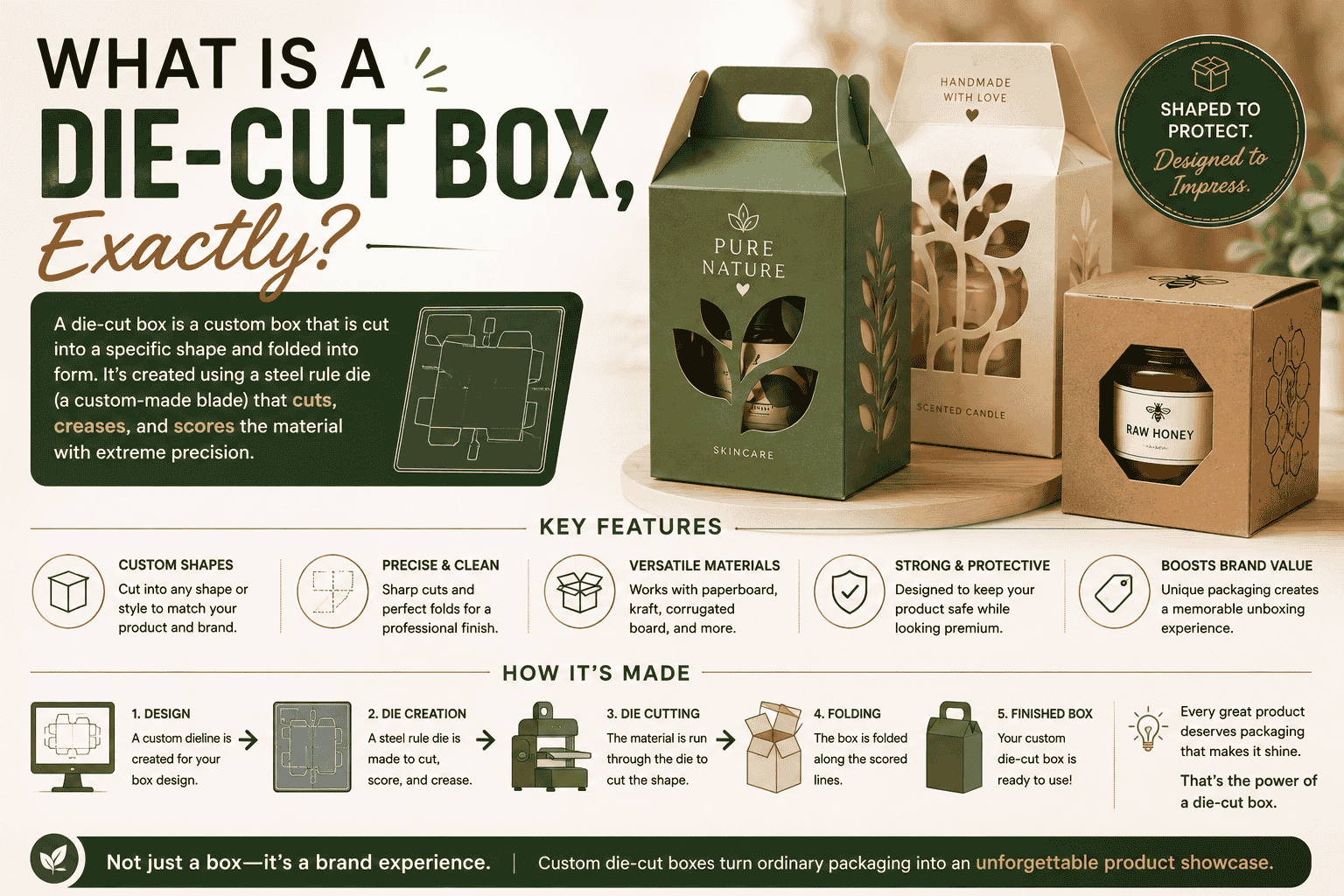
A die-cut box is any box made using a steel rule die — a custom-shaped cutting tool, similar to a giant cookie cutter — that stamps out a precise pattern from a flat sheet of cardboard, kraft, or rigid board. That single cut can create the box’s fold lines, tabs, and locking mechanism, plus any windows, cut-outs, or decorative shapes, all in one pass.
This is different from a standard tuck-end or mailer box, which uses a handful of straight cuts and folds. A die can cut curves, angles, circles, and irregular silhouettes — which is what makes die-cut packaging useful for anything from a display box with a see-through front panel to a box shaped like the product it holds.
Why Brands Use Die-Cut Boxes for Product Display
Customers buy what they can see. A window die-cut into the front or top panel lets shoppers see color, texture, and finish without opening the box — which matters most in cosmetics, food, and retail, where the product’s appearance sells it.
Less material, tighter fit. Because the die is cut to the exact dimensions of the product, there’s no wasted board and no product rattling around inside an oversized box. That means lower material cost and better protection in one move.
Shape becomes branding. A die-cut silhouette — a box shaped like the product, or with a distinctive cut-out pattern — is far more memorable on a shelf than a plain rectangle, and it’s much harder for a competitor to copy than a printed logo.
One box, multiple functions. A die-cut structure can double as a display stand, a tray insert, or a self-locking case with no glue or tape required — useful for retailers who want boxes that go straight from carton to shelf.
Choosing the Right Material
The die-cutting process works across several substrates, and the right one depends on the product’s weight, the look you’re going for, and where the box will end up.
| Material | Best for | Strength | Look |
| Kraft paperboard | Cosmetics, soap, artisanal/food products, eco-focused brands | Moderate | Natural, unbleached, earthy |
| Cardstock/cardboard (SBS) | Retail display boxes, electronics, subassemblies | Moderate to high | Smooth, print-ready, vibrant colors |
| Corrugated board | Shipping-grade display boxes, heavier products | High | Sturdy, less refined finish |
| Rigid board | Premium/luxury packaging, gift boxes | High (with wrap) | High-end, structured |
If the box only needs to look good on a retail shelf and won’t take much handling, cardstock or kraft is usually enough. If it’s also functioning as a shipper — a display box that arrives already assembled — corrugated or a corrugated/kraft hybrid holds up better in transit.
Where Die-Cut Boxes Get Used
- Cosmetics and skincare — window boxes that show the product color or texture, which matters more here than almost any other category
- Food and confectionery — display trays and window boxes for bakery items, candy, and gift sets
- Retail counter displays — small footprint boxes designed to sit on a checkout counter or shelf edge
- Subscription and gift boxes — shaped inserts that hold multiple items in fixed positions
- Electronics and accessories — fitted trays that cradle a product securely without foam
Design Details That Actually Matter
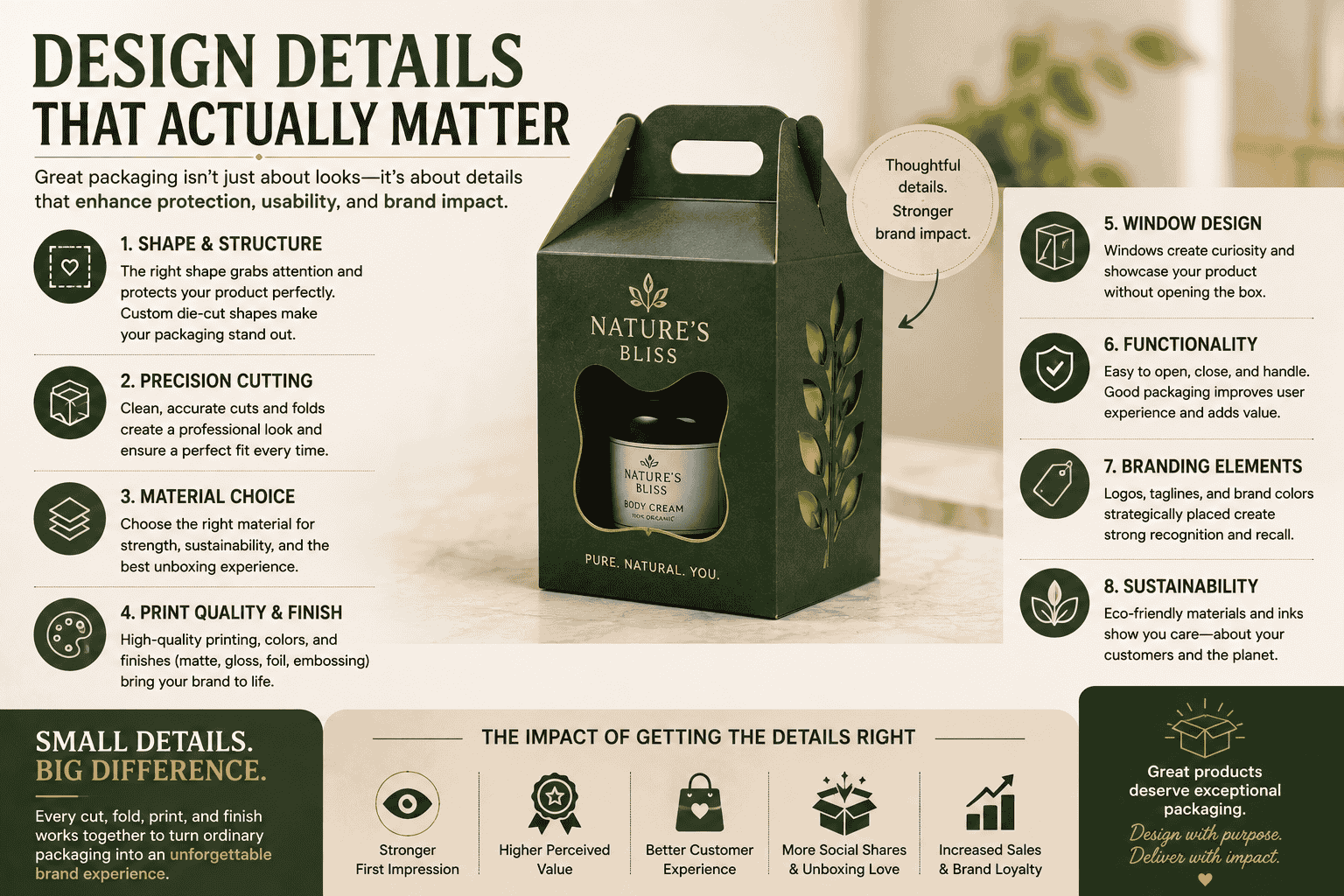
Window placement and material. A die-cut window can be left open, backed with clear PVC/PET film for protection, or covered with a printed acetate sheet for a premium look. Open windows are cheapest but expose the product to dust and handling.
Structural integrity around the cut. Every window or cut-out removes material, which can weaken the box. A good structural design compensates with reinforced edges or a slightly heavier board weight so the box doesn’t sag or tear at the die-cut line.
Finishing options. Spot UV, foil stamping, embossing, and matte or gloss lamination all read differently depending on the base material — foil and gloss tend to look sharper on cardstock, while embossing and debossing show up best on uncoated kraft.
Print-to-cut registration. If there’s printed artwork around a die-cut shape, the print and the cut need to line up precisely — this is where working with an experienced packaging supplier (rather than a generic printer) actually shows.
Sustainability Considerations
Die-cutting is inherently material-efficient — the die is sized to the product, so there’s less trim waste than with a standard box template that gets cut down to size. Kraft and uncoated cardboard die-cut boxes are also widely recyclable and, if left unlaminated, compostable. If sustainability is a selling point for your brand, avoid glossy laminates and plastic windows, and use a water-based or soy-based ink for any printing.
Getting a Custom Die-Cut Box Made: What to Expect
- Share your product dimensions and quantity. The die is built around the exact size of what you’re packaging.
- Choose material and structure. Based on weight, fragility, and whether the box needs to survive shipping or just retail handling.
- Approve a structural proof (dieline) before printing. This confirms fit and fold before any artwork is finalized.
- Finalize artwork and finishing. Windows, foil, embossing, coatings.
- Production run. Die-cutting is a one-time tooling cost; once the die exists, reorders are faster and cheaper.