Walk down the frozen food aisle and think about what actually makes you reach for one product over another. It’s rarely just the price – it’s the packaging doing a lot of that work. Frozen food’s a tricky category too, since the box has to survive extreme cold, moisture, rough handling during shipping, and somehow still look appetizing enough to pull someone away from the fresh food section.
If you’re running a food brand, that box is really the only thing standing between your product and looking like a mystery block of ice. So let’s get into what actually goes into designing frozen food packaging that protects the product and still makes your brand stand out on a crowded shelf.
Why Frozen Packaging Isn’t Like Regular Packaging
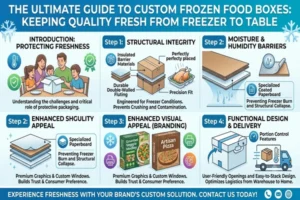
You can’t just grab a normal cardboard box and toss it in a freezer and expect it to hold up. Frozen food packaging needs its own kind of engineering. Regular paperboard soaks up condensation fast, turns soggy, and eventually just falls apart structurally.
Moisture Resistance Is the Whole Game
Custom boxes here need an actual protective barrier – usually specialized coatings or laminates that shield against moisture and frost buildup. Skip that step and you’re not just risking an ugly box, you’re risking mold or actual food safety issues. This isn’t really “building a box” so much as building a tiny protected environment around the product.
Temperature Swings Are Constant
The box has to survive what’s basically a freeze-thaw cycle over and over – getting loaded onto a truck, sitting on a store shelf, then finally landing in someone’s home freezer. Through all of that it can’t crack, warp, or fall apart.
Getting the Design Right: Making Frozen Food Look Appealing
In this aisle, you’re not really selling raw ingredients – you’re selling the idea of a finished meal. So the design needs to bridge that gap between “frozen” and “actually looks like dinner.”
Photography Has to Do the Heavy Lifting
This part really isn’t optional. Since the customer can’t see the actual food, the photo basically becomes the product. Go with high-resolution, vibrant images that show texture, maybe some steam, anything that signals quality. One thing that helps a lot – keep the lighting on the food warm-looking, which creates a nice contrast against the whole “frozen” vibe of the packaging itself.
Color Choices Send a Message Too
Food photography should feel warm and inviting, but the background design can lean cooler – deep blues, crisp whites, bright greens. These colors have basically become industry shorthand for “fresh” and “properly stored,” even if nobody consciously thinks about why.
Keep Labeling Clear and Upfront
Frozen food shoppers tend to be either health-conscious or just short on time. Whatever your main selling points are – gluten-free, high protein, ready in five minutes – keep them front and center. Don’t bury the exact reason someone should grab your product over the one next to it.
Choosing Materials That Actually Hold Up
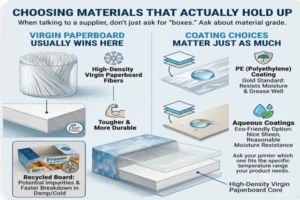
When talking to a packaging supplier, don’t just ask for “boxes.” Ask specifically about material grade.
Virgin Paperboard Usually Wins Here
Frozen goods generally need high-density, food-grade virgin paperboard. It’s tougher and holds up better than recycled board, which can sometimes carry impurities that break down faster once things get cold and damp.
Coating Choices Matter Just as Much
PE (polyethylene) coating is basically the gold standard – a thin, plastic-like layer that resists moisture and grease well.
Aqueous coatings are a more eco-friendly option, giving a nice sheen while still holding up reasonably well against moisture. Worth asking your printer which one actually fits the temperature range your product needs.
Making Even a Frozen Box Feel Like an Experience
Believe it or not, frozen food can still have its own little unboxing moment.
Easy-Open Tabs Make a Real Difference
Few things are more annoying than fighting a frozen box open with scissors or a butter knife. A clever perforated tab that opens easily makes the whole product feel a bit more premium, and it’s the kind of small detail people actually remember next time they’re shopping.
Print Something Inside the Box Too
A simple “enjoy your meal” or a quick recipe idea printed on the inside flap turns a chore – cooking dinner – into something a little more engaging. It’s cheap to add and punches well above its cost in terms of brand impact.
Sustainability Is a Real Issue in This Category
Frozen packaging’s historically leaned heavy on plastic, which is exactly the kind of thing eco-conscious shoppers notice and avoid. This is actually a good spot to differentiate your brand.
- Compostable barriers – more suppliers now offer plant-based liners instead of traditional PE coatings.
- Recyclability messaging – if the box is fully recyclable, put a clear icon on the back somewhere. People are actively looking for brands that make sorting their trash a little easier.
A Few Practical Things to Check Before Production
Before locking in a design, a few details are worth double-checking.
Test it in your own freezer first. Before committing to a 10,000-box run, build a prototype and leave it in a freezer for a week. Watch what happens – does the ink smudge, does the box soften up over time? Testing early saves a lot of pain later.
Coordinate the glue zones. Same issue as other moisture-resistant packaging – the coating that protects against moisture can also mess with how well glue bonds. Make sure your design team and printer are on the same page about where the glue tabs actually go, so boxes don’t pop open mid-shipment.
Don’t skimp on typography. These boxes often get viewed from a bit of a distance, and sometimes through a thin layer of freezer frost. Bold, clean fonts read a lot better than anything thin or cursive in that kind of setting.
Final Thoughts
A custom frozen food box is really the only thing standing between your customer and what could be their new favorite dinner. It needs to survive sub-zero temperatures and still look good enough to earn a spot in someone’s cart.
Get the moisture-resistant materials right, pair that with design that actually makes people hungry, and suddenly you’re not just another frozen meal on the shelf – you’re the brand that manages to bring real quality to the table. Don’t let good work go to waste over packaging that can’t keep up. Invest in something that actually holds the promise all the way from the freezer to the plate.