Here’s a decision that seems trivial until you’re actually the one making it — hang tag or label? It shows up late in the packaging process, usually after the box design, the color scheme, and the logo placement are all locked in, and it still somehow trips people up. Both do roughly the same job on paper: they tell the customer what the product is, who made it, and sometimes what it costs. But they do that job in genuinely different ways, and picking the wrong one can quietly undercut everything else you got right.
So let’s actually sort through this properly — what each option is good at, where it falls short, and how to figure out which one fits your product instead of just guessing.
What’s the Actual Difference Between the Two?
Before getting into pros and cons, it’s worth being clear about what separates a hang tag from a label, since the line gets blurry for some products.
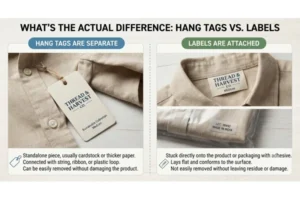
Hang Tags Are Separate, Labels Are Attached
A hang tag is its own standalone piece, usually cardstock or thicker paper, connected to the product with string, ribbon, or a small plastic loop. A label, on the other hand, gets stuck directly onto the product or its packaging — adhesive on the back, no dangling, no separate piece to lose or remove.
The Physical Feel Is Genuinely Different
Hang tags have a bit of weight and rigidity to them, since they’re usually printed on cardstock thick enough to hold its shape. Labels are flatter, thinner, and conform to whatever surface they’re stuck onto, which matters a lot depending on the shape of what you’re selling.
The Case for Hang Tags
Hang tags show up constantly in clothing, accessories, and gift items, and there are some solid reasons this particular format has stuck around for so long.
They Carry a Sense of Occasion
There’s something about a swinging tag that just feels a bit more premium than a flat sticker. It’s the same instinct that makes a clothing brand’s tag feel more “official” than a printed label sewn into a seam — a hang tag has presence, and presence is part of what a lot of brands are paying for when they choose this option.
They Give You More Room to Work With
Because a hang tag is its own separate piece, it isn’t constrained by the shape or size of the product itself. Care instructions, brand story, sizing charts, pricing, a QR code — there’s simply more real estate available compared to squeezing all that onto a small adhesive label stuck to a curved surface.
They Can Be Removed Without a Trace
This matters more than people initially think. A hang tag comes off cleanly, snip the string and it’s gone, with nothing left behind. A label, especially a poorly made one, can leave adhesive residue or a torn edge once removed, which becomes a real problem if the customer wants a clean-looking product after unboxing it.
Where They Fall Short
Hang tags cost more to produce and attach, since there’s a physical connection step involved that a label just doesn’t need. They’re also easier to lose or accidentally cut off during shipping, and for products without an obvious place to attach a string or loop, this option might not even be structurally possible in the first place.
The Case for Labels
Labels dominate categories where a hang tag either doesn’t make sense structurally or would genuinely get in the way of using the product.

They Work on Almost Anything
Bottles, jars, boxes, bags, flat products — labels stick to basically any surface, which makes them the default choice for skincare, food packaging, candles, and countless other categories where there’s no natural place to attach a swinging tag.
They’re Cheaper and Faster to Apply
No separate attachment step, no string or loop to source, no manual tying involved. Labels get applied by machine at high speed for large production runs, which drops the per-unit cost significantly compared to hang tags, especially once you’re scaling into the thousands.
They Keep a Low Profile
For some products, a dangling tag genuinely gets in the way — imagine trying to use a candle or open a skincare jar with a tag swinging around and catching on things. Labels stay flat against the product, out of the way, doing their job without adding physical bulk to the experience of actually using what you bought.
Where They Fall Short
Labels have less surface area to work with, especially on small products, which forces tighter, sometimes cramped design choices. And unlike hang tags, labels are meant to stay on, which means removal isn’t always clean — something worth considering if your customers might want to reuse the container afterward.
So Which One Should You Actually Pick?
This really comes down to what you’re selling and what job the tag or label is supposed to do beyond just carrying information.
Consider the Shape of Your Product First
Anything with a natural attachment point — a strap, a seam, a neck, a handle — can support a hang tag easily. Anything smooth, curved, or without an obvious loop point, like a bottle or a box, usually points toward a label instead, simply because there’s nowhere sensible to tie a string.
Think About What Story You’re Actually Telling
If your brand leans into craftsmanship, tradition, or a slightly elevated retail experience, a hang tag tends to reinforce that story better, since it carries a bit of ceremony a flat label just doesn’t. If your brand is more about everyday practicality or a clean, minimal aesthetic, a label often fits that identity more naturally without feeling like an unnecessary flourish.
Factor In Your Actual Production Scale
Small batch, higher-margin products can usually absorb the extra cost and manual labor a hang tag requires. High-volume, tighter-margin products generally need the speed and lower per-unit cost that labels offer, since that difference multiplies fast once you’re producing thousands of units a month.
Some Brands Genuinely Use Both
It’s worth mentioning this isn’t always an either-or decision. A lot of clothing brands, for instance, use a hang tag for pricing and brand storytelling, while a separate care label gets sewn directly into the garment. There’s no rule saying you have to pick just one, if your product and budget can reasonably support using both for different purposes.
Bottom Line
Neither hang tags nor labels are objectively better — they’re just built for different situations. Hang tags bring a sense of occasion and extra room for storytelling, at a higher cost and with a physical attachment requirement. Labels bring speed, low cost, and versatility across almost any product shape, at the expense of some surface area and that clean, removable feel. Match the choice to your product’s shape, your brand’s personality, and your actual production volume, and this decision stops being a coin flip and starts being pretty obvious.