A discount code gets someone to buy once. Packaging is what gets them to buy again — and tell three friends about it while they’re at it.
Most brands treat packaging as an afterthought to a sales campaign: pick a box, slap a logo on it, ship the product. But the box is the first physical thing a customer touches after they’ve clicked “buy.” It arrives at the exact moment their attention is highest and their guard is lowest. That’s not a shipping detail — that’s a marketing channel most brands are leaving on the table.
Here’s how to actually use custom packaging boxes as part of a sales campaign, not just as a container for one.
Why Packaging Belongs in Your Campaign Budget, Not Just Your Fulfillment Budget
When packaging gets budgeted under “operations,” it gets optimized for cost per unit. When it gets budgeted under “marketing,” it gets optimized for impact per unit — and those are two very different boxes.
A few numbers worth knowing:
- Roughly 72% of consumers say packaging design influences their purchase decision, according to research cited widely in packaging and retail industry reports.
- Unboxing videos routinely pull millions of views on platforms like TikTok and YouTube — free advertising that only exists because the packaging was worth filming.
- Retailers report that shelf-ready, well-branded packaging measurably outperforms generic packaging in noticing and pickup rates during in-aisle tests.
None of that requires a bigger budget. It requires treating the box as part of the pitch.
Match the Box to the Campaign, Not the Other Way Around
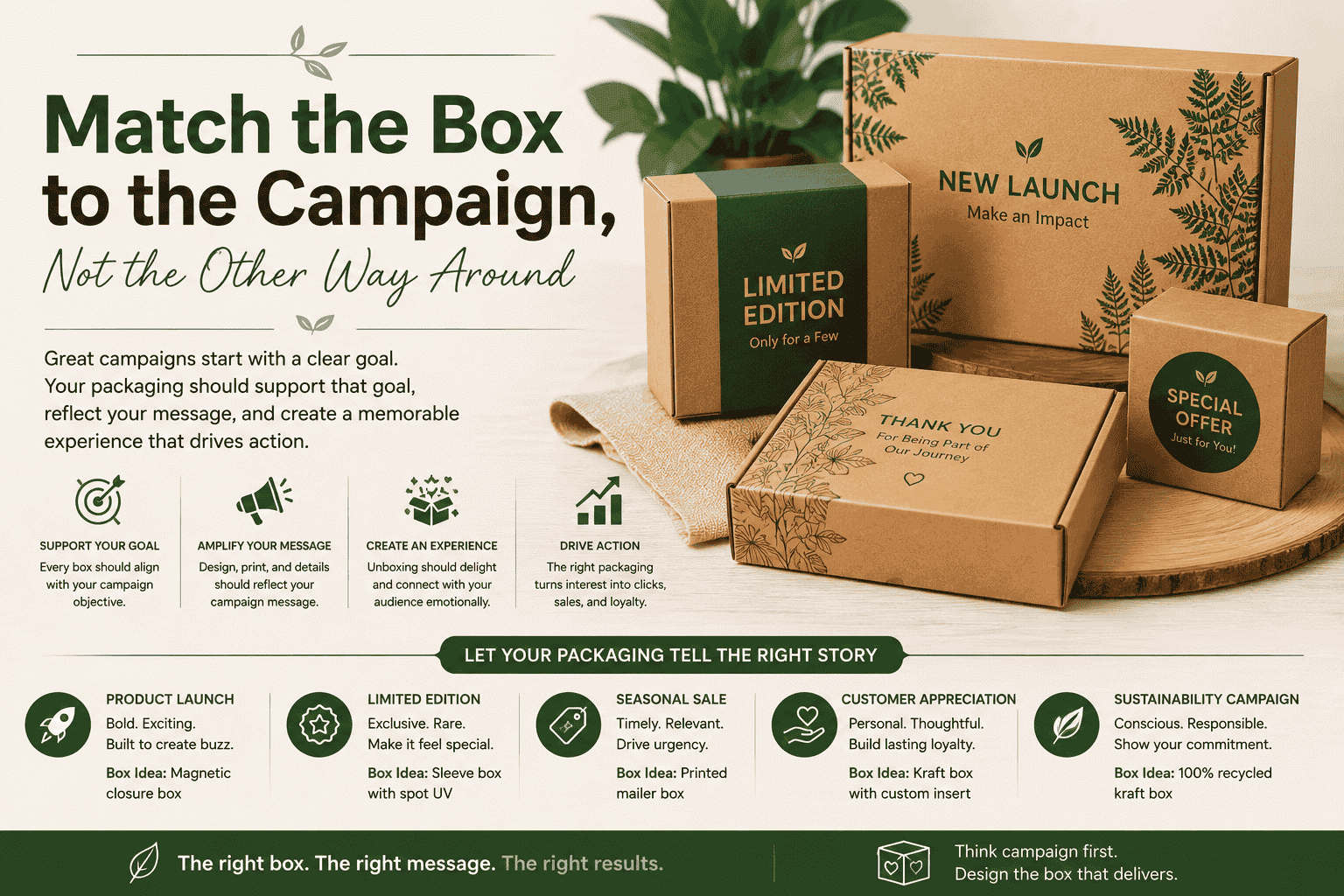
A common mistake: designing one packaging style and reusing it for every promotion. A holiday flash sale, a new product launch, and a loyalty reward all need different psychology — and different boxes.
Seasonal and flash-sale campaigns benefit from limited-edition packaging — a different color run, a holiday sleeve, or a stamped “limited batch” detail. Scarcity cues on the box reinforce the urgency of the sale itself.
New product launches need packaging that explains the product in five seconds flat: clear hierarchy, the benefit up front, minimal clutter. This is where a customer decides whether to keep scrolling or actually read the panel.
Loyalty and repeat-purchase campaigns can use packaging as the reward mechanic — a nicer box, a handwritten-style thank-you card, or a small free add-on visible the moment the lid comes off. Customers who feel a purchase was noticed are more likely to write a review or repost.
Retail and shelf campaigns live or die on stand-out. Bold color blocking, a distinct silhouette, or a die-cut window that shows the product often outperforms clever copy, because shoppers decide in seconds, not paragraphs.
Five Elements That Actually Move Sales Numbers
Not every packaging upgrade pays off. These five consistently do:
- A clear, fast value statement on the primary panel. Whatever the campaign is selling — an ingredient, a guarantee, a limited quantity — put it where the eye lands first, not buried in a paragraph.
- Consistent brand color and typography across every SKU. Campaigns that use one-off packaging per product lose the compounding recognition effect. Customers should recognize the brand from across a room before they can read the label.
- An unboxing moment worth sharing. Tissue paper in brand colors, a printed interior flap, a QR code linking to a campaign-specific landing page — small additions that turn a delivery into content.
- Material that signals the price point. A premium product in a flimsy box undercuts its own pricing. Matching box weight, finish, and structure to the price the customer paid closes that credibility gap.
- A next step printed on the box itself. A discount code for the next order, a referral prompt, or a scannable code for a review — placed where the customer will actually see it, not just in a follow-up email they may never open.
Where Sustainability Fits Into the Sales Pitch
Eco-conscious packaging isn’t just a values statement anymore — it’s a purchase driver, particularly with kraft, recycled, and FSC-certified materials that visibly signal “sustainable” without a customer needing to read fine print. Campaigns built around a values message (a percentage donated, a plastic-free promise, a recyclable mailer) tend to perform best when the packaging itself backs up the claim at a glance, rather than only mentioning it in the ad copy.
That said, sustainability messaging only helps a campaign if it’s true and visible. A recyclable box that looks identical to a non-recyclable one wastes the advantage.
Common Mistakes That Undercut a Packaging-Led Campaign
- Designing the box before defining the campaign goal. A box built for “looks nice” instead of “drives repeat purchase” or “gets unboxed on camera” ends up doing neither well.
- Ignoring the unboxing sequence. What the customer sees in the first three seconds — lid, inner flap, first item visible — matters more than what’s printed on the outside once they already own the product.
- Skipping a print/production proof. Colors and finishes shift between screen and physical print more than most teams expect; a physical proof catches this before a full production run locks it in.
- Treating packaging as fixed cost instead of testable. Running two packaging variants across a campaign split — even informally — surfaces which version actually drives reorders or reviews.
A Simple Framework for Your Next Campaign
Before locking in packaging for a sales campaign, run it through four questions:
- What is this campaign actually trying to do — first-time conversion, repeat purchase, or shelf visibility?
- What does the customer need to understand within the first five seconds of holding the box?
- What’s the one action we want them to take after opening it?
- Does the packaging itself look like it costs what the product costs?
If the packaging can’t answer all four, it’s worth a revision before the campaign goes live — not after the first batch ships.
Getting It Made
Once the design direction is set, the production side matters just as much: turnaround time, minimum order quantities, and whether a supplier will produce a physical sample before committing to a full print run. A packaging partner that can turn around a proof quickly makes it realistic to actually test different versions before a campaign launches, rather than betting the whole run on one design.