Custom Potato Chips Packaging: What Actually Goes Into a Good Bag
If you’ve ever stood in a snack aisle and picked one chip brand over another before even reading the flavor, that was the packaging doing its job. For a product where the contents look almost identical bag to bag, the bag itself is doing most of the selling.
This guide walks through the decisions that actually matter when you’re sourcing custom potato chips packaging — material, size, printing, cost, and compliance — based on what we see brands get wrong (and right) when they place their first order with us.
Start With the Material, Not the Design
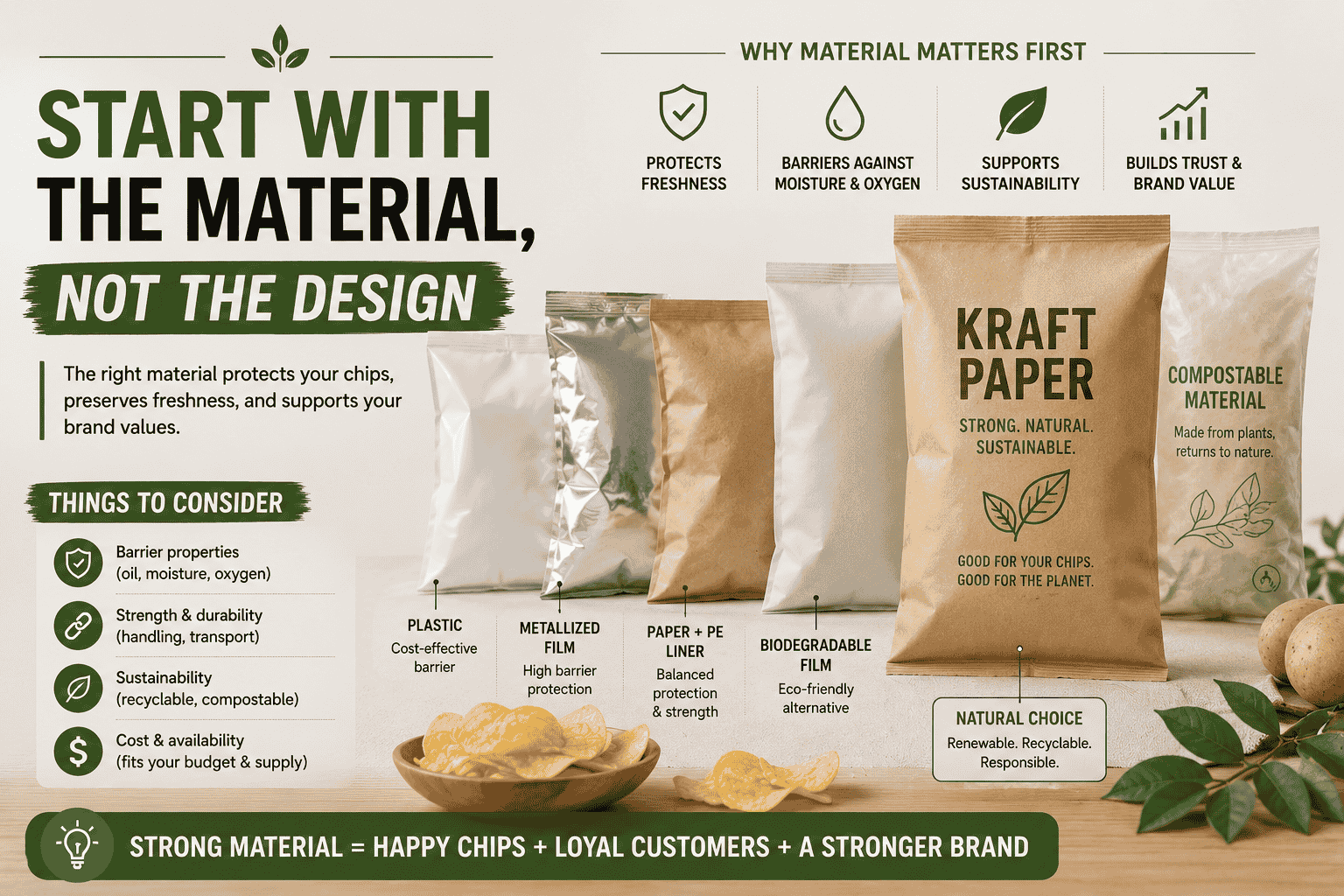
It’s tempting to jump straight to colors and logos, but the material decision comes first because it determines shelf life, cost, and even which printing methods are available to you.
Metallized/mylar film is the industry default for a reason. It’s a multi-layer laminate — usually PET on the outside, a metallized or foil layer in the middle, and a heat-seal layer on the inside — that blocks light, oxygen, and moisture. Chips go stale from oxidation and rancid fat, not just staleness of texture, so this barrier matters more than people expect. Most grocery-shelf chip bags you can picture right now are mylar.
Kraft paper (with an inner liner) gives you that visible, “artisanal” look — popular with small-batch and better-for-you brands. On its own, kraft paper isn’t a moisture or oxygen barrier, so it needs a poly or foil liner laminated to the inside if you want more than a couple weeks of shelf life. Worth knowing before you fall in love with the look.
Compostable/eco film (often PLA or a kraft-poly compostable blend) is the newest option and the one the competition tends to skip over. It costs more per unit — typically 15-30% above standard mylar — but it’s become a genuine differentiator for brands selling to health-food stores, farmers markets, or any retailer with sustainability requirements written into their vendor agreements.
Cardboard/rigid boxes show up less often for chips specifically, but some premium and gift-oriented brands use them for stackable shelf presence or to house multiple single-serve bags.
[IMAGE: side-by-side material swatches — mylar, kraft, compostable film]
Get the Size Right Before You Get the Design Right
Ordering the wrong bag size is the most common — and most expensive — mistake first-time snack brands make, because resizing means reprinting artwork and sometimes retooling the bagging equipment.
| Format | Typical fill weight | Common use |
| Single-serve | 1 – 2 oz | Vending, lunch boxes, foodservice |
| Snack/sharing | 5 – 8 oz | Grocery shelf standard, party trays |
| Family/movie-night | 9.5 – 13 oz+ | Big-box retail, bulk buyers |
Quick conversion for your spec sheet: 1 oz = 28.3 g, so an 8 oz bag holds roughly 227 g of product.
Two things worth deciding now rather than after your first print run:
- Gusset or flat-bottom? Gusseted bags (the classic pillow-shaped chip bag) are cheaper and standard for grocery shelves. Flat-bottom/stand-up pouches display better on a counter or in a subscription box but cost more per unit.
- Do you need a resealable zipper? Family-size bags almost always benefit from one; single-serve bags almost never need it.
Printing and Finish: Where the Bag Actually Earns Its Shelf Space
Once material and size are locked, printing is where your brand identity lives.
Rotogravure and digital are the two realistic options for most orders. Rotogravure gives you the most vibrant, consistent color at high volume but requires a higher minimum order because of plate costs. Digital printing has no plate cost, so it’s the better route for smaller runs, seasonal flavors, or A/B testing two designs before committing to a bigger order.
For finish, most brands pick from:
- Matte — reads as premium and “clean label,” and it hides fingerprints better than gloss
- Gloss — punchier color, more of a traditional “grocery shelf” look
- Spot UV or foil accents — used sparingly on a logo or flavor callout, not the whole bag
A practical note: whatever flavor variant a bag represents, keep a consistent base layout across your line and change only the accent color and flavor imagery. It keeps your shelf block recognizable as one brand even with five different flavors sitting side by side — something a lot of new brands skip and then wonder why their line doesn’t “read” as a set.
[IMAGE: flavor line-up showing consistent layout, varied accent colors]
What Has to Be on the Bag, Not Just What Looks Good
This part isn’t optional. In the US, FDA labeling rules require:
- Nutrition Facts panel
- Full ingredient list, in descending order by weight
- Net weight statement (both imperial and metric, e.g. “8 oz (227 g)”)
- Major allergen declaration (the “Contains: ___” line)
- Manufacturer/distributor name and address
Skipping or fudging any of these isn’t just a design oversight — it’s a compliance issue that can get a product pulled from a retailer’s shelf. If you’re working with a packaging supplier, ask up front whether they’ll proof your label copy against FDA requirements or whether that’s on you.
What It Actually Costs, Roughly
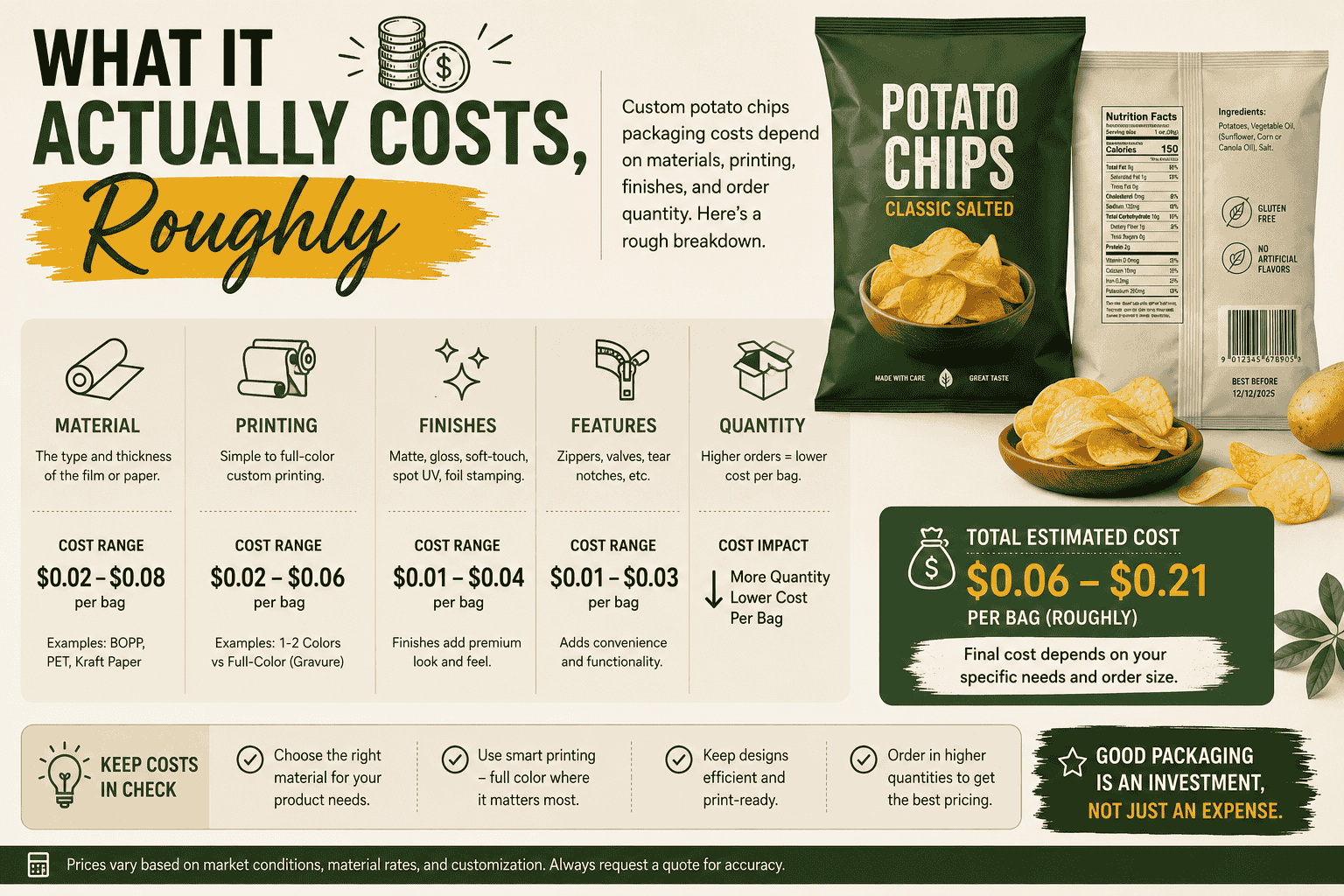
Exact pricing depends on material, print method, and order volume, but as a general shape:
- Standard mylar, gravure print, large volume (50,000+ units): lowest per-unit cost
- Standard mylar, digital print, small-to-mid volume (1,000-10,000 units): moderate per-unit cost, no plate fees
- Compostable film: add roughly 15-30% over standard mylar at comparable volume
- Custom sizes or a resealable zipper: small per-unit add-on, but can affect your MOQ
If a supplier won’t give you even a rough range without a 20-minute sales call, that’s worth noting before you commit.
A Straightforward Order Checklist
Before you request a quote, have these ready — it’ll speed up your quote turnaround and reduce back-and-forth:
- Fill weight and target bag size
- Preferred material (or ask for a recommendation based on your shelf-life needs)
- Estimated order volume and how often you’ll reorder
- Final artwork or a design brief if you need help creating one
- Nutrition facts and ingredient list, reviewed and final
- Any retailer-specific requirements (some big-box retailers have their own packaging specs)