Introduction
Trillions of dollars worth of products are traded over oceans, borders, and continents throughout the year. And each of those products depends on one thing to reach its destination in perfect condition: packaging.
Packaging in the global supply chain is not as straightforward as it seems. The incorrect box is crushed by the cargo load. Without a compliance label, customs delays your shipment for weeks! Domestic packaging doesn’t work at all in an overseas warehouse with humidity.
This guide aims to inform product businesses, importers, exporters, and brand owners about the implications of smart packaging at the global level – and how to make smart packaging decisions before, not after, they cause a problem.
What Is a Global Supply Chain, and Where Does Packaging Fit In?
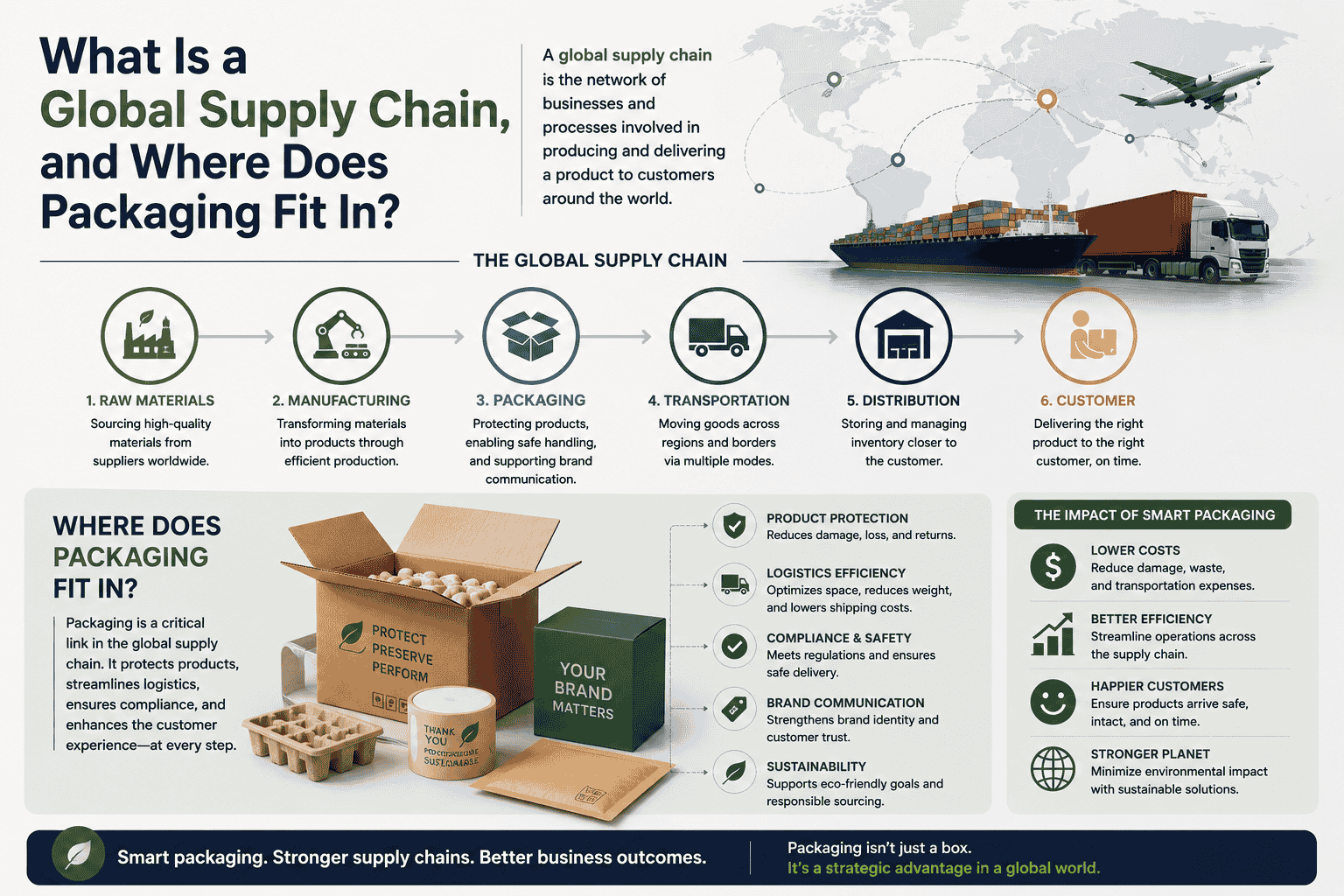
A global supply chain is a series of steps that must be taken to move a product from its raw material to the end customer (typically across several countries and continents).
- Packaging, in each and every step of that journey, is real responsibility:
- Solves a problem of handling, stacking, and long-distance transport of products.
- It conveys essential data to customs, warehouse personnel, and end customers
- It acts as a compliance document to regulatory authorities in destination markets.
- This is the brand ambassador when a customer opens the box.
Why Getting Packaging Right Matters More Than Ever
The global packaging market is worth more than $1.2 trillion, which is a testament to just how much a part of the global trade. However, in addition to the size of the market, there are three business realities that make packaging decisions more complicated than ever:
- Worldwide shipping damage rates are high. Damaged or spoiled products are an expense to businesses in the form of replacement stock, shipping expenses, and loss of customer trust. Protective packaging is not an extra expense; it’s insurance.
- There are varying regulatory environments. What’s an acceptable label in the US may be missing required fields in the EU or violating specific symbol requirements in Japan. This error results in delays, fines, or denial in delivery to the customer.
- Now, sustainability is a buying criterion. Survey after survey indicates that a larger share of today’s global consumers — typically more than 80% — would like to purchase goods that are packaged in a sustainable manner. Eco-friendly packaging isn’t only about doing the right thing for the environment; it’s the right thing for business.
Choosing the Right Packaging Material for Global Shipments
One of the most important choices made in global supply chain packaging is the material choice. The best material will vary based on your product, your path, and the conditions your shipment will face.
Corrugated Cardboard is still the most popular for most of the international shipping. It is designed in multiple layers for shock absorption, fits into containers easily and is universally recognised by the logistics carriers. Heavy or fragile items can be used with double-wall or triple-wall corrugated boards.
Rigid Boxes are best suited for high-value/high quality products where presentation is important even after shipment. There is a strong structural protection, but they are heavy, hence expensive to ship.
For brands that care about sustainability, Kraft Packaging offers a recyclable and light alternative. It is suited to normal transportation requirements and is attractive for the eco market.
For soft goods, apparel, and waterproofing, Poly Bags and Flexible Packaging are suitable. They’re lightweight, which means that they reduce shipping weight and dimensional weight charges.
Outer packaging is filled with specialty materials such as foam inserts, air pillows or molded pulp to cushion fragile products or keep products in place.
Sustainable Packaging in Global Supply Chains
Sustainability has become a minimum requirement in international markets, especially in Europe and North America.
The logic behind this change is the circular economy, which is a business model focused on ensuring that packaging materials are reused, recycled, or composted and are kept in circulation, instead of being disposed of in landfills.
This means there are a number of practical measures that can be implemented for businesses in global supply chains:
Using FSC-Certified Materials
FSC (Forest Stewardship Council) certified paper/cardboard for packaging means that the paper/cardboard originates from responsibly managed forests. One of the most visible eco-credentials in international trade is a sign of credibility to international buyers.
Choosing Biodegradable Options
Biodegradable packaging is environmentally friendly packaging that degrades without leaving any harmful residue. When the product line is generally plastic, changing to biodegradable plastics lowers the impact on the environment and contributes to the compliance of regulations that are increasingly prohibiting single-use plastics in markets.
Right-Sizing Packaging
Extra-sized packaging is not only a waste of materials, but also a waste of shipping space — an increase in dimensional weight can lead to higher shipping fees. Efficient packaging – both from an environmental and economic perspective – is achieved when packaging is used to contain products precisely.
Eliminating Unnecessary Layers
Any excess packaging, void fillers, or unnecessary wrapping will be a weight and waste. The packaging design can be optimized, and it often requires less, rather than more, packaging material to effectively protect a product.
Anti-Counterfeiting: Using Packaging to Protect Your Brand Globally
Counterfeiting is a serious problem for brands operating internationally. The World Customs Organization estimates that counterfeit goods represent hundreds of billions of dollars in trade annually. For brands, fake products damage revenue and reputation simultaneously.
Packaging has become one of the most effective lines of defense:
QR Codes Linked to Verification Systems
A QR code on your packaging can take customers directly to a product authentication page, confirming they’re holding a genuine item. When tied to serialized tracking data, each code is unique and can’t be reused on fakes.
AR (Augmented Reality) Markers
More sophisticated than standard QR codes, AR markers trigger visual experiences when scanned — animations, product information, or brand content that counterfeiters cannot replicate economically.
Holographic or Tamper-Evident Labels
Physical security features on packaging — foil seals, holographic stickers, breakable closures — make copying much harder and signal authenticity at a glance.
Educating Your Customers
Anti-counterfeiting technology only works if customers know to look for it. Running campaigns that show customers what genuine packaging looks like, and encouraging them to report suspicious products, turns your customer base into an extension of your brand protection efforts.
Packaging Hazardous Materials for International Shipping
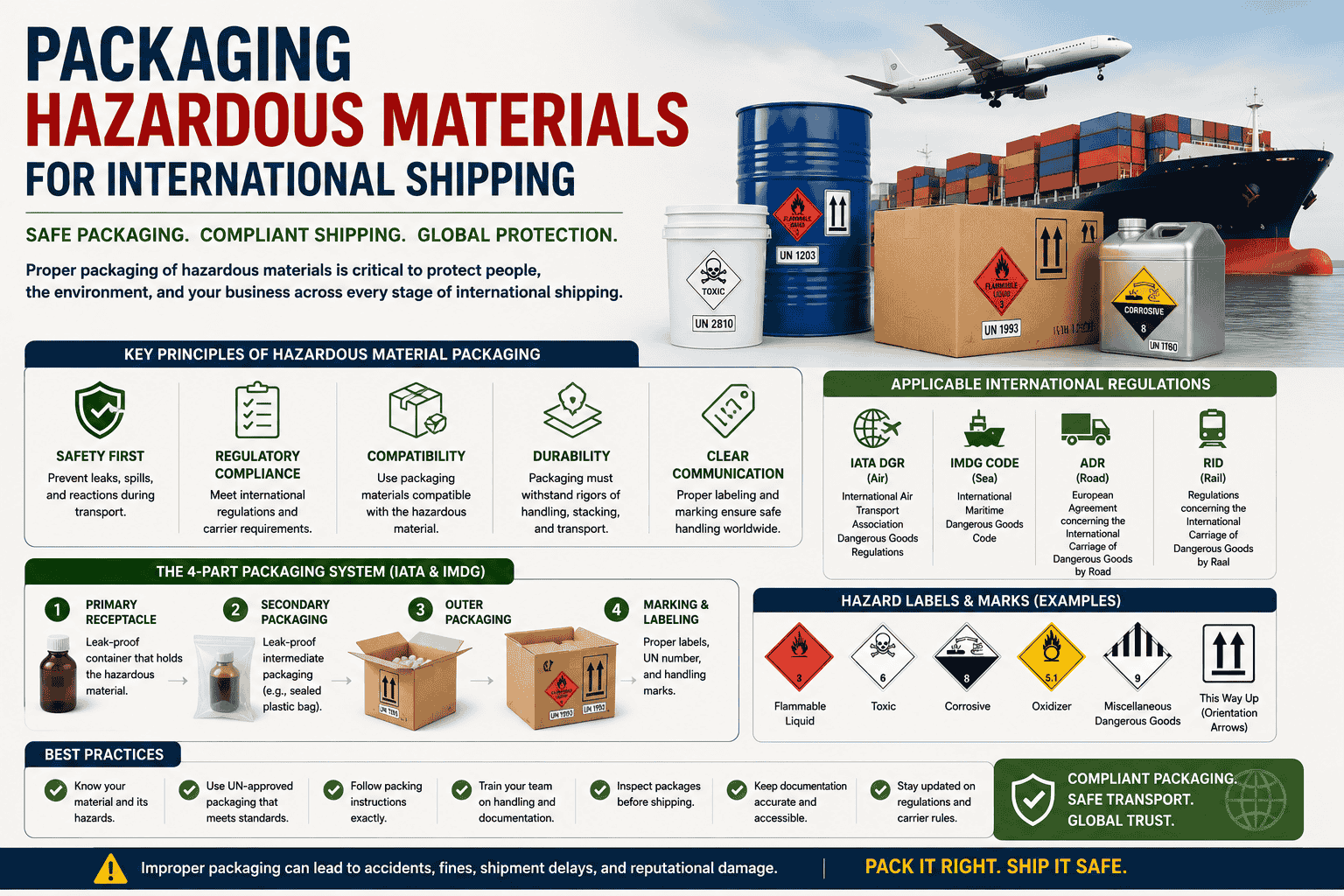
Products classified as hazardous require a completely different packaging and labeling approach. Explosives, compressed gases, flammable liquids, corrosives, and oxidizers all fall under international hazmat regulations that carriers, customs, and destination countries enforce strictly.
The primary framework for international hazmat shipping is the UN Model Regulations, which most countries have adopted either directly or through their own derivative standards. The IATA Dangerous Goods Regulations govern air freight, while IMDG covers ocean shipping.
Key practices for hazmat packaging:
Match Packaging to UN Performance Standards
Hazardous goods must be shipped in UN-certified packaging — containers that have been tested and marked to show they meet specific performance thresholds for the hazard class being transported.
Label: Label in a correct and complete manner.
The same symbols are used to identify hazards around the world. The symbols, colors, and formats of the various classes of hazardous materials are designated accordingly. Shipments may be rejected or seized for having the wrong or missing labels.
Train Your Team
All persons who pack or handle hazardous materials on a ship should be trained. This includes warehouse staff, logistics coordinators, and documentation teams. The consequences of wrong declarations of hazardous goods can be serious.
Document Everything
Hazmat shipments to other countries must be accompanied by Safety Data Sheets, shipper’s declaration and in some instances, advance notification to destination authorities. One of the most popular reasons for hazmat shipping delays is due to incomplete documentation.
Conclusion
For most businesses, months are used to plan manufacturing, routes, and even market entry before the packaging is finished in the final weeks before transit. That’s unnecessary risk.
Packaging choices impact product protection, transportation costs, compliance with regulations, branding, and the environmental impact. Those stakes are magnified with each mile that the product moves in a global supply chain.
The companies that have found success with packaging understand it as a strategic asset: they partner with packaging professionals at the outset, test it extensively, and remain abreast of the ever-changing packaging policy and environmental requirements of their target markets.