
Walk into any retail store and you’ll notice something without even trying — some products just seem to grab your attention from three aisles away, while others, sitting in perfectly fine boxes, blend into the shelf completely. That’s rarely about the product itself. Most of the time, it comes down to one box being built to sell, and the other one just being built to survive shipping.
That difference is basically the whole point of display packaging, and it’s a bigger distinction than most people realize until they’ve actually had to choose between the two for their own product.
What Exactly Is a Display Box?
A display box is packaging designed specifically to be seen and to sell a product while it’s sitting on a shelf, counter, or floor stand, rather than packaging built mainly to protect something during shipping.
Its Whole Job Is to Get Noticed
Unlike a shipping carton, which mostly just needs to survive a delivery truck without falling apart, a display box needs to catch someone’s eye from a few feet away, in a store full of competing products all trying to do the exact same thing. That changes almost every decision that goes into designing one.
It’s Often Meant to Be Seen, Not Just Opened
A lot of display boxes are built with the product actually visible — through a window, an open front, or a fully see-through panel — because the whole point is letting a customer see what they’re buying before they pick it up. Shipping boxes almost never do this, since there’s no one around to look at them mid-transit anyway.
How Display Boxes Differ from Shipping Packaging
These two categories often get lumped together in conversation, but they’re solving completely different problems.
Different Priorities Entirely
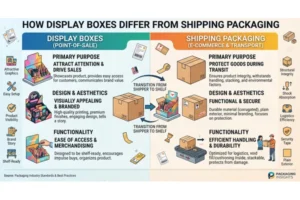
Shipping packaging is built around one core question: will this survive the trip? Corners get reinforced, materials get chosen for impact resistance, and appearance is basically an afterthought as long as the box arrives in one piece. Display packaging flips that priority almost completely — appearance comes first, and durability just needs to be “good enough” to survive being handled by dozens of customers on a shelf, not a bumpy truck ride.
Where Each One Actually Lives
Shipping boxes exist mostly in warehouses, delivery trucks, and doorsteps — places where nobody’s really looking at them critically. Display boxes exist entirely in customer-facing spaces, which means every single surface has to look intentional, since there’s no “back of the box that nobody sees” the way there sometimes is with shipping cartons.
Branding Intensity Is Completely Different
A shipping box might carry a small logo and some basic handling instructions. A display box usually carries the brand’s full visual identity — colors, taglines, product information, sometimes even secondary graphics meant purely to catch the eye from a distance, since that’s genuinely part of its job description.
How Display Boxes Differ from Standard Product Boxes
This comparison is a bit more subtle, since both types are customer-facing, but they still serve pretty different functions.
One Is Meant to Be Picked Up, the Other to Be Looked At First
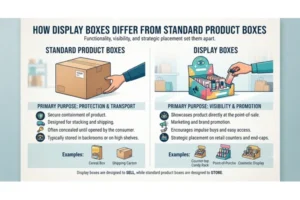
A standard product box — think the box a phone or a set of skincare products comes in — is designed around the unboxing moment, the experience of opening it once the customer already owns it. A display box is designed around the moment before the sale even happens, when the product is still sitting on a shelf and the customer hasn’t decided anything yet.
Structural Design Serves a Different Purpose
Standard product boxes usually need to close completely and often need to protect the item during storage after purchase. Display boxes are frequently open-faced or have large cut-out windows, since concealing the product entirely would defeat the entire purpose of using this packaging style in the first place.
Display Boxes Often Do Double Duty as a Fixture
Some display boxes aren’t just packaging for one item — they’re built to hold multiples, functioning almost like a mini shelf or counter unit themselves. A single display box might hold twenty of the same product, arranged in a way that looks intentional and full, rather than being a one-to-one container the way a standard product box usually is.
How Display Boxes Differ from Bulk or Wholesale Packaging
This is maybe the clearest contrast of all, since these two exist almost at opposite ends of the packaging spectrum.
Bulk Packaging Isn’t Meant for Customer Eyes at All
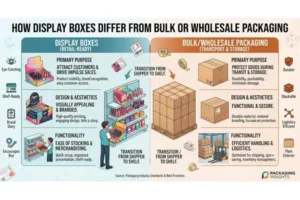
Wholesale and bulk packaging is designed to move large quantities of product efficiently between businesses — think plain corrugated cases stacked on a pallet. Nobody’s designing that box to be attractive, because the only audience for it is a warehouse worker checking inventory, not a customer deciding whether to buy something.
Quantity vs. Presentation
Bulk packaging is optimized entirely around fitting as much product as possible into as little space as possible, since that directly affects shipping cost. Display packaging sacrifices some of that efficiency on purpose, using extra space, unusual shapes, or eye-catching cut-outs specifically because looking good matters more here than maximizing how tightly everything is packed.
Where One Ends and the Other Begins
In a lot of supply chains, bulk packaging actually gets broken down at the retail level, and the individual products get transferred into display packaging once they arrive at the store. The two aren’t really competing formats — they’re sequential steps in getting a product from a factory to a customer’s hands, each optimized for a completely different stage of that journey.
Why This Distinction Actually Matters for Businesses
Understanding these differences isn’t just a design technicality — it directly affects how much money gets spent in the wrong place.
Using the Wrong Type Wastes Money
A business that over-invests in decorative shipping packaging is paying for aesthetics nobody in a delivery truck actually sees. A business that under-invests in display packaging, using something closer to plain shipping material for a shelf product, is quietly losing sales to competitors whose products simply look more appealing sitting right next to theirs.
Different Retail Channels Need Different Approaches
A product sold purely online through a website might barely need display packaging at all, since there’s no physical shelf competing for attention — the product photos on the site are doing that job instead. The same product sold in a physical retail store absolutely needs display-focused packaging, since it’s now competing visually against dozens of other products within arm’s reach.
Bottom Line
Display boxes, shipping boxes, standard product boxes, and bulk packaging all technically do the same broad job — getting a product from one place to another intact. But each one is solving a completely different problem along the way, and mixing them up usually means either wasting money on the wrong kind of durability, or losing sales because a product simply doesn’t stand out where it needs to. Knowing which type your product actually needs, and at which stage of its journey, is honestly half the battle of getting packaging right in the first place.