
Introduction
Most businesses obsess over their product inventory. But packaging inventory? That often gets managed through guesswork, spreadsheets, and last-minute supplier calls.
The result? You run out of boxes mid-shipment. You overorder bubble wrap that sits in a corner for six months. You pay rush fees because nobody noticed the label stock was running low.
If any of that sounds familiar, you’re not alone. Packaging inventory is one of the most overlooked operational challenges for growing businesses — and fixing it can have a direct impact on your costs, your customer experience, and your team’s sanity.
The Real Challenges of Packaging Inventory Management
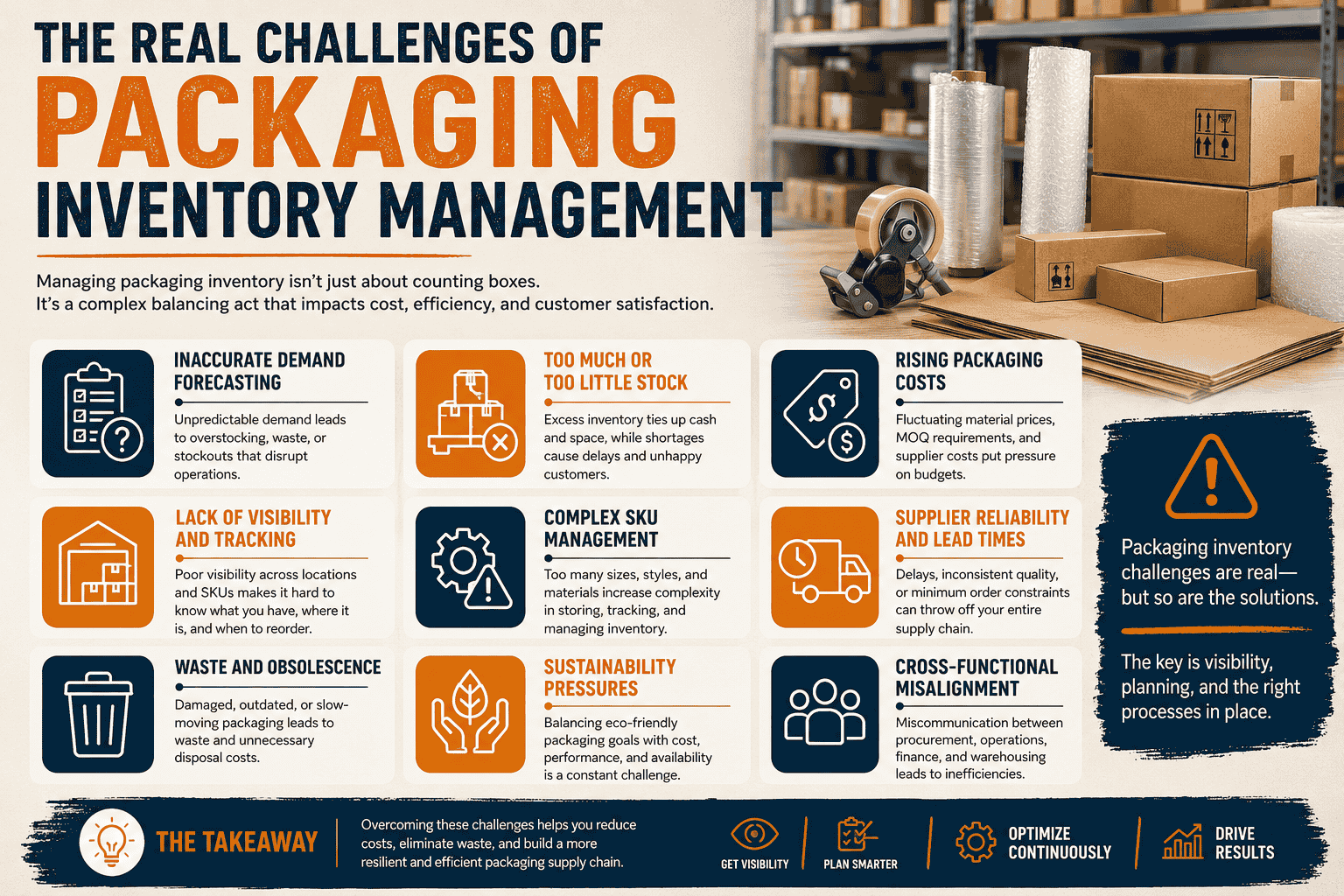
Before getting to solutions, it helps to understand the specific pain points that make packaging inventory tricky to manage.
1. Too Many SKUs, Too Little Visibility
Even a small business can end up managing 20–30 different packaging materials. Once you factor in multiple box sizes, custom-printed items, seasonal packaging, and product variations, that number climbs fast. Without a centralized system, nobody has a clear picture of what’s actually in stock.
2. Demand Fluctuations Catch Businesses Off Guard
Packaging needs don’t stay constant. A promotional push, a viral product moment, or a seasonal spike can burn through your inventory faster than expected. If your reorder process is manual or reactive, you’re always playing catch-up.
3. Storage Space Gets Wasted (or Runs Out)
Packaging materials — especially corrugated boxes and rigid packaging — are bulky. Without smart storage systems, warehouses fill up with excess stock in some areas while running low in others. Holding costs for unsold or unused inventory can account for 45–55% of total inventory value, a figure that eats into margins quietly.
4. Supplier Lead Times Create Gaps
Custom packaging — especially printed boxes with your branding — can take 10–20 business days or more to produce and ship. If you’re not tracking inventory levels in advance, you’ll find yourself in situations where you’ve placed an order but can’t ship for two weeks.
5. Inconsistent Materials Hurt Your Brand
When reorders don’t match previous specs, products arrive in slightly different boxes with different textures, print quality, or dimensions. That inconsistency chips away at the unboxing experience and the brand trust you’ve worked to build.
How to Manage a Packaging Inventory Effectively: 7 Proven Strategies
1. Start With a Complete Packaging Audit
Before you can manage your inventory, you need to know exactly what you have. Walk your warehouse or storage area and catalog every packaging item — what it is, how much you have, where it’s stored, and how fast you typically use it.
This baseline audit does three things:
- Reveals items you forgot you had (and may not need to reorder)
- Flags materials that are damaged, outdated, or in excess
- Gives you real usage data to build accurate reorder points
2. Centralize Your Inventory Tracking
Spreadsheets are where packaging inventory goes to get lost. They’re manually updated, error-prone, and don’t give you real-time visibility. If your team is managing inventory through a shared Google Sheet, it’s time to upgrade.
Modern inventory management systems like Zoho Inventory, Cin7, Fishbowl, or NetSuite allow you to:
- Track packaging stock levels in real time
- Set automatic low-stock alerts
- Generate usage reports to forecast demand
- Integrate with your order management system so packaging consumption is tracked automatically
3. Set Reorder Points for Every Item
A reorder point (ROP) is the inventory level at which you automatically place a new order for more stock. Without one, restocking happens reactively — someone notices the shelf is empty and panics.
4. Implement a Just-In-Time (JIT) Approach for Predictable Items
Just-In-Time inventory means ordering materials as close as possible to when you actually need them — minimizing what’s sitting in storage at any given time. For packaging items that have reliable lead times and steady demand, JIT reduces storage costs significantly.
The key is having a trustworthy supplier relationship and enough lead time visibility to make it work. JIT breaks down when you’re ordering from slow or unreliable suppliers, or when demand is unpredictable — so combine it with safety stock calculations for your most critical materials.
5. Optimize Your Storage Layout
How you store packaging materials affects how quickly your team can pick, pack, and ship. A few principles that make a real difference:
- Store fast-moving materials closest to your packing station. If your team reaches for small mailer boxes 100 times a day, those shouldn’t be across the warehouse.
- Use vertical space. Shelving systems that go high free up floor space for operations.
- Label everything clearly. Every shelf, bin, and pallet position should be labeled so anyone can find what they need without asking.
- Use collapsible or flat-pack materials where possible. Flat corrugated boxes, for instance, take up a fraction of the space of pre-assembled ones.
- Separate primary from tertiary packaging. Mixing printed retail boxes with plain shipping cartons creates pick errors and slows down fulfillment.
6. Build Strong Supplier Relationships
Your packaging supplier isn’t just a vendor — they’re a partner in your fulfillment chain. Businesses that treat supplier relationships strategically tend to get better lead times, priority production slots during busy seasons, and early warnings when materials are running low on the supplier’s end.
Things that strengthen supplier relationships:
- Forecast your needs in advance and share that data with your supplier so they can plan production
- Consolidate orders where possible rather than placing small, frequent ones
- Communicate early if your demand is changing — don’t wait until you’re out of stock
- Have a backup supplier for your most critical items so you’re never fully dependent on one source
7. Track Usage Data and Forecast Demand
Historical data is your best tool for avoiding both stock-outs and overstock. Once you’ve been tracking inventory for a few months, you’ll be able to see patterns — which items you go through fastest, which seasons drive higher packaging consumption, and how long different materials actually last.
Use this data to:
- Adjust reorder points seasonally (Q4 demand is rarely the same as Q2)
- Identify slow-moving packaging you can reduce or phase out
- Negotiate better bulk pricing on high-volume items
- Plan for promotions or product launches before they hit your packaging supply
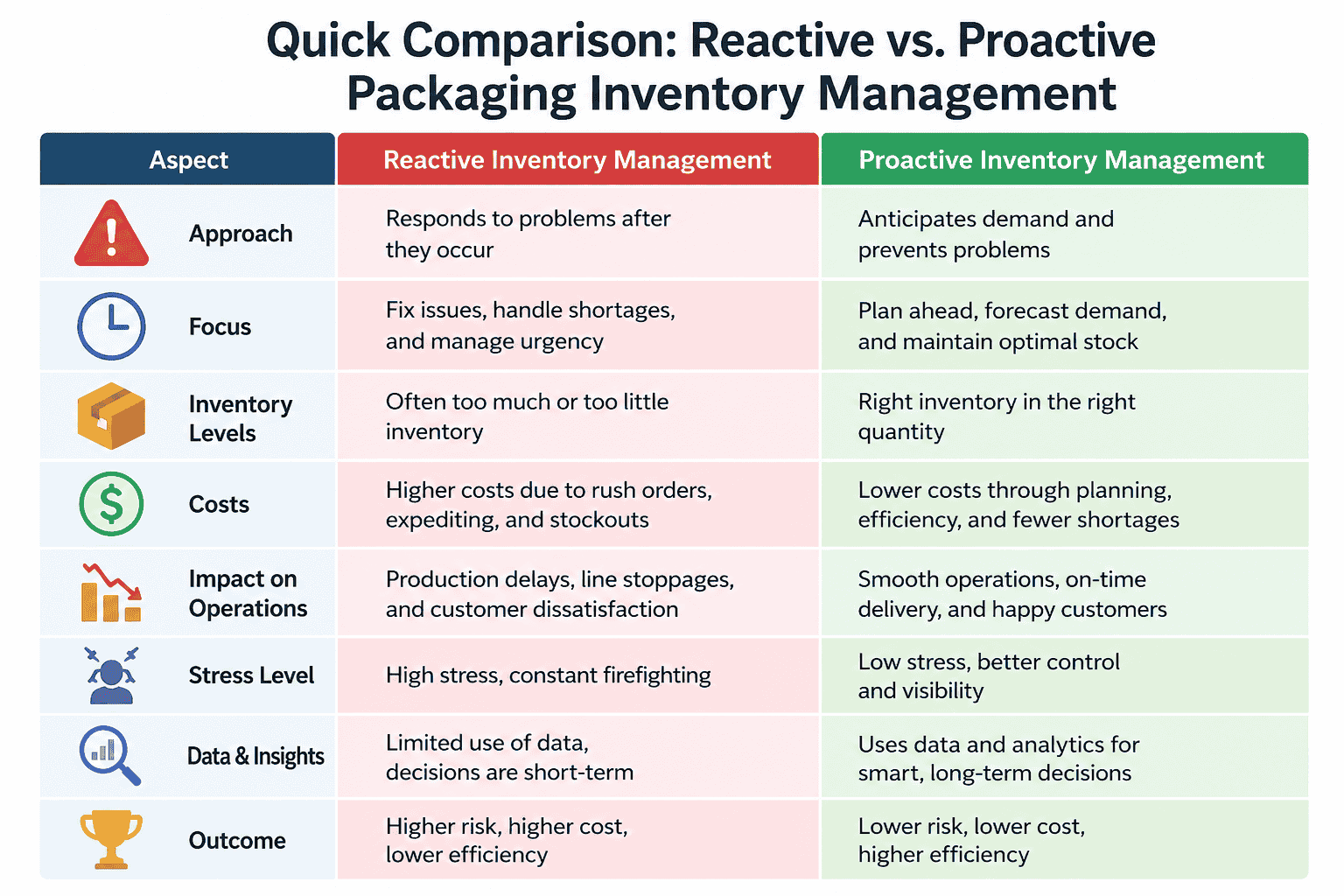
Quick Comparison: Reactive vs. Proactive Packaging Inventory Management
| Factor | Reactive Management | Proactive Management |
| Reorder Trigger | Running out | Hitting reorder point |
| Tracking Method | Spreadsheet / memory | Inventory software |
| Supplier Contact | Emergency calls | Planned, scheduled orders |
| Stock-out Frequency | Common | Rare |
| Storage Cost | High (overstock buffers) | Optimized |
| Team Stress | High | Low |
| Customer Impact | Delayed shipments | Consistent on-time delivery |
Choosing the Right Packaging Partner Matters
All the systems and strategies in the world only work if the packaging materials themselves are reliable. Consistent quality, accurate specs, and dependable lead times from your supplier make every part of inventory management easier.
When evaluating a packaging partner, look for:
- Low minimum order quantities so you can keep inventory lean without large upfront commitments
- Fast turnaround on custom-printed orders
- Consistent print quality and material specifications order to order
- Responsive account management so issues get resolved quickly, not after a week of email chains
- Eco-friendly material options that meet your sustainability goals without sacrificing protection
Final Thoughts
Managing packaging inventory isn’t glamorous, but getting it right makes a measurable difference in how your business runs. It lowers costs, speeds up fulfillment, keeps customers happy, and removes a persistent source of operational stress.
Start with a proper audit of what you have. Build a centralized tracking system. Set reorder points based on real data. And work with a supplier you can count on.
These aren’t complicated steps — but they’re the ones that separate businesses that are always scrambling from businesses that ship consistently, efficiently, and profitably.