A Comprehensive Guide on How to Customize Jewelry Boxes: Elevate Your Brand’s Sparkle
Here’s the thing about jewelry – nobody’s really buying a piece of metal or a stone. They’re buying a memory, maybe a milestone, sometimes literally a symbol of love they’re going to keep for decades. So when they finally open that package, there should be a little spark of excitement in the room. Stick that jewelry in some plain, unbranded box and you’ve basically skipped the best part of the whole story – the unboxing.
Customizing your jewelry boxes is what turns a plain transaction into something people actually remember. This guide gets into how to make packaging feel like it belongs with the jewelry, not just something wrapped around it as an afterthought.
Why Jewelry Packaging Messes With People’s Heads a Little
Ever notice how the big jewelry houses obsess over their boxes? There’s a reason. The box builds anticipation before anyone’s even opened it. You see a certain shade of blue, or feel a certain texture, and something in your chest tightens a bit because you already know something good’s waiting inside.
The Box Becomes Part of Your Identity, Whether You Plan It or Not
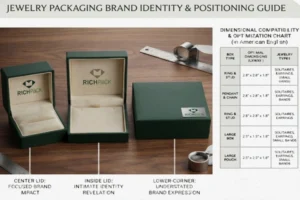
Packaging is the first physical thing someone touches from your brand, before the jewelry itself even. If your pieces are modern and minimal, the box needs clean lines and a matte finish to match. Going vintage instead? Then aged, rich textures make more sense. When the box actually lines up with what’s inside, trust just kind of happens on its own – you don’t have to say anything.
Elegance Without Protection Isn’t Really Elegance
Jewelry’s fragile stuff, so customizing a box isn’t only about a logo – there’s real engineering underneath that people don’t think about. Velvet inserts, foam slots, all of it needs to be sized right so a necklace doesn’t end up tangled or a ring doesn’t slide around during shipping. A box that protects what’s inside is basically telling the customer, without words, that you take their purchase seriously.
Breaking Down What Actually Goes Into Custom Jewelry Packaging
Sounds like a lot until you split it into a few pieces.
1. The Outside – Texture and Finish
This is the first impression, before the lid’s even lifted.
- Matte lamination – clean, understated, feels modern.
- Soft-touch coating – velvety to the fingers, reads as luxury almost instantly.
- Textured paper – if you’re going for handmade or artisan vibes, this does a lot of heavy lifting before anyone even opens the box.
2. Printing and Foiling Choices
The logo’s the star here, but how it’s applied changes the whole feel.
- Hot foil stamping – gold, silver, rose gold, whatever fits the brand. Gives it shine, and honestly it’s a look that’s never really gone out of style in jewelry.
- Debossing vs. embossing – both create depth. Debossing presses the logo inward, feels subtle. Embossing raises it, feels bolder and more tactile under the fingers.
3. What’s Sitting Inside the Box
Don’t skip this part – the interior’s literally where the piece gets its moment.
- Velvet vs. satin – velvet gives you that plush backdrop that makes gold and diamonds pop harder. Satin’s sleeker, fits better with sharper, more modern pieces.
- Custom die-cut inserts – useful when something needs to stay dead center, like a statement pendant. Keeps it exactly where it should sit for the reveal.
Measurements Aren’t Something to Guess At
Worth saying again – measure twice, order once. Seriously.
Getting the Fit Right Matters More Than People Think
Too small and the necklace shows up tangled, which is the opposite of the reaction you’re going for. Too big and the piece rattles around inside, which over time can lead to tiny scratches nobody wants to see on a new ring.
Leave roughly 5mm of clearance around the piece on all sides. And don’t forget height either – a ring with a tall prong setting needs more vertical room than something with a flat band.
Why a Custom Box Beats a Sticker Every Time
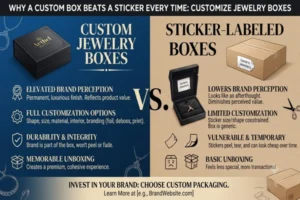
A lot of small business owners ask why they can’t just buy plain boxes in bulk and stick a label on. Cheaper short-term, sure. Rarely worth it long-term though.
The Problem With Just Slapping On a Sticker
Stickers peel eventually. They fade, they scratch, and they just look tacked on. A box that’s actually printed or foiled looks like it was meant to be that way from the start. It tells people your brand knows what it’s doing, rather than looking like someone winging it.
It’s Also Protecting Your Prices
People will pay more for jewelry that feels expensive the second they pick it up. Put even a small slice of your budget into decent packaging and you can genuinely justify a higher price point. The box kind of lifts whatever’s sitting inside it.
Today’s Buyers Actually Care About Sustainability
Jewelry buyers these days tend to think about the ethics behind mining and production more than they used to. Carrying that same mindset into the packaging just makes sense at this point.
Luxury and Eco-Friendly Aren’t Opposites Anymore
Recycled paperboard, FSC-certified wood – both can still look and feel premium. Add a small card inside mentioning the sustainability angle and suddenly the packaging’s doing two jobs at once: looking good and building loyalty with younger buyers who actually pay attention to that stuff.
The Unboxing Is the Actual Performance
The box is really just the stage. What happens when it opens is the whole point.
A handwritten note tucked inside adds something no machine can fake. And some higher-end jewelers go even further and lightly scent the packaging with something subtle and signature – it creates a memory tied to more than one sense, and that tends to stick with people way longer than they’d expect.
Final Thoughts
None of this is really about flexing a logo. It’s about giving something people are going to keep for years an actual home worth keeping too – down to the texture of the paper, the shine on the foil, even how much resistance the lid gives when it lifts open.
Put the same care into the packaging that you put into the jewelry, and people notice, even if they can’t say exactly why. A lot of them end up keeping the box right alongside the piece itself. So pull out the sketches, talk to whoever’s handling your packaging, and build something that actually matches what’s inside it.