
A friend of mine runs a small candle business. Last month she ordered custom mailer boxes and basically guessed the measurements because she was in a rush. The candles arrived rattling around inside like dice in a cup — too much room, no cushioning, and two of them cracked before they even left the printer’s warehouse. She had to eat the cost and reorder the whole batch. Lesson learned the expensive way.
That’s really the thing with box dimensions. Get them wrong and it’s rarely a minor mistake. It usually costs you money, time, or a damaged product showing up at someone’s door. So let’s actually go through how to measure this stuff properly, without the guesswork.
Why This Actually Matters
It’s easy to eyeball a box size when you’re trying to get packaging ordered quickly. But even half an inch off in any direction throws off everything that comes after it.
Your Shipping Bill Depends On It
Most carriers charge based on dimensional weight now, not just how much your package actually weighs. So a box that’s bigger than it needs to be can cost more to ship, even if it’s mostly empty inside. Get the size close to your product and you stop paying to ship air.
Your Product Needs to Survive the Trip
Too tight, and things don’t fit or get crushed trying to force them in. Too loose, and your item slides around during transit — which is exactly how fragile stuff ends up chipped, dented, or cracked by the time it reaches someone’s front door.
It Just Looks Better
A box with weird proportions looks off, both on camera for your product photos and in person when a customer opens it. People notice packaging that feels like an afterthought more than brands realize.
The Three Numbers That Matter
Every box comes down to length, width, and height. Simple in theory, but people mix these up constantly.
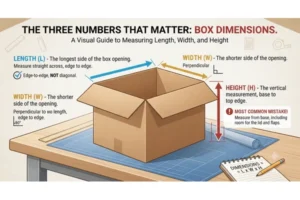
Length is the longest side of the box opening. Measure straight across, edge to edge, not diagonally.
Width is the shorter side of that same opening, running perpendicular to the length. Same rule — straight line, edge to edge.
Height is the vertical measurement, base to top edge, box standing upright. This is the one people get wrong most, usually because they forget to leave room for the lid or the flaps.
Measure Your Product Before You Even Think About the Box
This part gets skipped more than it should. If you don’t have accurate product measurements first, everything after this is just guessing with extra steps.
Measure at the Widest Point
Lay the item flat and measure at the absolute widest part on each side. If it’s something irregular — a gift set, something with handles, anything not perfectly boxy — measure at whatever point sticks out the most.
Leave Room for Padding
Once you’ve got the raw product size, add space for whatever cushioning you’re using — bubble wrap, tissue paper, air pillows, foam. Most suppliers suggest somewhere around half an inch to an inch on each side, depending on how fragile the item is.
If It’s Multiple Items, Measure Them Together
Don’t measure each product separately if the box is going to hold more than one thing, or a product plus a card or a little freebie. Measure it all together the way it’ll actually sit once packed.
Measuring Specifically for Shipping
Packaging and shipping aren’t always the same conversation, and shipping brings a couple extra things to think about.
Interior Numbers vs Exterior Numbers
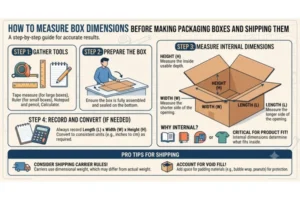
Suppliers usually want interior dimensions, since that’s what tells them whether your product actually fits. Carriers, on the other hand, calculate shipping based on exterior dimensions — that’s the actual space the box takes up in a delivery van. You’ll want both numbers written down somewhere.
Dimensional Weight, Briefly
Take the exterior length, width, and height in inches, multiply them together, then divide by the carrier’s dimensional divisor — usually somewhere between 139 and 166, depending who you’re shipping with. Whichever number ends up higher, that or your actual weight, is what determines your shipping cost.
Watch the Size Limits
Every carrier has a max size before your box gets bumped into oversized pricing, and that jump in cost isn’t small. Worth double-checking your carrier’s current limits before you lock in a box size, especially for anything bulky.
Tools Worth Having on Hand
Nothing fancy needed, but a few basics make this a lot more accurate.
A rigid tape measure or a metal ruler beats a soft cloth one — you’ll get straighter, more reliable numbers, especially on anything with hard edges. For small or detailed items, calipers give you a much tighter measurement than tape ever will. And since shipping cost hinges on weight too, a decent digital scale saves you from any surprises at checkout when you’re printing labels.
Mistakes That Come Up Again and Again
A handful of things trip people up constantly, so worth flagging them directly.
Measuring the bare product without accounting for wrapping is probably the number one reason boxes come out too small — always measure it wrapped if that’s how it’ll ship. Rounding up “just to be safe” by half an inch or more on every side sounds harmless but adds up fast, and can knock you into a pricier dimensional weight bracket without you realizing it. People also forget that the box material itself has thickness, which eats into your usable interior space — a box listed at certain exterior dimensions will always be a bit smaller inside than the number suggests.
And honestly, the biggest one: skipping the sample. Ordering a full production run before testing with your actual product is a mistake I’ve seen more than once. Always get a sample box first, pack the real thing in it, and check that it fits the way you expected before you commit to a bulk order.
Bottom Line
Getting your box dimensions right isn’t just some small packaging detail — it affects what you pay to ship, whether your product survives the trip, and how put-together your brand looks the moment someone opens the box. Measure the product carefully, leave room for padding and box thickness, and always run a sample before ordering in bulk. It takes a little more time upfront, sure, but it beats paying for a reorder nobody budgeted for.