
How to Measure Cake Box Dimensions
Ever had a cake come out of the box looking nothing like how it left the kitchen? That’s a packaging problem, not a baking one. Most people blame the drive, or the weather, or whoever was carrying it. Nine times out of ten, it’s the box.
I’ve packed hundreds of cakes at this point, tiered ones, single layer birthday cakes, the occasional weird custom shape someone insisted on. The box is never an afterthought if you want the cake to survive the trip. It’s part of the product, whether you treat it that way or not.
Why Packaging Deserves Real Attention
Your customer touches the box before they see the cake. That’s just how delivery works. So if the box feels cheap, or the cake’s rattling around inside it, that’s the first impression — and it happens before they’ve tasted a single bite.
Keeping the Cake Safe During Transit
Too big, and the cake slides. Too small, and it gets crushed against the walls. Both ruin the frosting. Both ruin the piping work you spent an hour on. What actually works is a snug-but-not-tight fit, with just enough space around the edges for padding. Takes maybe five minutes extra to measure properly before you cut or order boxes. I’d rather spend the five minutes than redo a cake at 11pm.
Making Your Workflow Faster
There’s a selfish reason to get this right too — it’s faster for you. A box that fits doesn’t need three attempts to close. You’re not fighting the lid while six other orders are waiting behind it. On a slow day this doesn’t matter much. On a Saturday before a wedding season weekend, it matters a ton.
Giving Customers a Better Unboxing Moment
People film these things now. Unboxing a cake is basically content. A box that fits well looks better on camera — there’s room for a ribbon, a little card, whatever finishing touch you like, without it looking stuffed. And your logo, if you print one, actually reads clearly instead of getting stretched across a box that’s bigger than the cake needs.
Quick Reference: Cake Box Dimensions Chart
Save this somewhere. I still pull mine up on my phone every time a new size order comes in — nobody memorizes ten different box sizes.
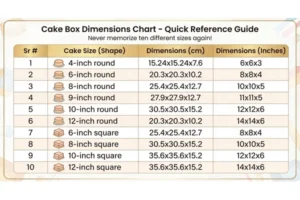
| Sr # | Cake Size (Shape) | Dimensions (cm) | Dimensions (Inches) |
| 1 | 4-inch round | 15.24×15.24×7.6 | 6x6x3 |
| 2 | 6-inch round | 20.3×20.3×10.2 | 8x8x4 |
| 3 | 8-inch round | 25.4×25.4×12.7 | 10x10x5 |
| 4 | 9-inch round | 27.9×27.9×12.7 | 11x11x5 |
| 5 | 10-inch round | 30.5×30.5×15.2 | 12x12x6 |
| 6 | 12-inch round | 20.3×20.3×10.2 | 14x14x6 |
| 7 | 6-inch square | 25.4×25.4×12.7 | 8x8x4 |
| 8 | 8-inch square | 30.5×30.5×15.2 | 10x10x5 |
| 9 | 10-inch square | 35.6×35.6×15.2 | 12x12x6 |
| 10 | 12-inch square | 35.6×35.6×15.2 | 14x14x6 |
Thinking Beyond the Measurements
Once the sizing’s sorted, there’s a second thing worth thinking about: what the box does for you beyond just holding the cake.
Pick a Closure That Works Both Ways
It needs to stay shut during a bumpy car ride, and it needs to open easily without the customer smearing frosting on their hands trying to figure out the lid. A lot of boxes nail one of these and completely miss the other.
When to Call in a Specialist
If most of your orders are big, tiered, or genuinely weird shapes, a standard size chart stops being enough. That’s when it’s worth an actual conversation with a packaging specialist rather than guessing. Costs a bit of time upfront, saves you a lot of ruined boxes down the road.
A Simple Guide to Measuring Properly
Nothing here is complicated. People just skip steps when they’re busy, and that’s when boxes come out wrong.
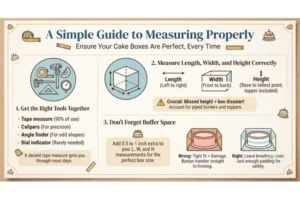
1. Get the Right Tools Together
You probably already own most of these:
- A tape measure — for everyday stuff, this is 90% of what you’ll use
- Calipers — only when you need to be really precise
- An angle finder — handy for odd-shaped or non-standard boxes
- A dial indicator — honestly, most bakeries never touch this one
Don’t overthink the tool list. A decent tape measure gets you through most days.
2. Measure Length, Width, and Height Correctly
Three measurements. That’s the whole job:
- Length — left edge to right edge
- Width — front to back
- Height — from the base up to the tallest point, decorations included
Miss the height measurement and that’s usually where things go wrong — people forget to account for a topper or piped border.
3. Don’t Forget Buffer Space
Here’s where people mess up. They measure the cake exactly and cut the box to that exact size, thinking tighter equals safer. It doesn’t. No room for padding means every bump in the road transfers straight to the frosting. Leave a little breathing room. Not a lot — just enough.
Don’t Skip the Material
Size isn’t everything — thickness matters too. A heavy, multi-tier cake on thin cardboard is a disaster waiting to happen; the base sags, and once the base goes, everything on top follows. Whatever you’re spending on box printing, don’t cut corners on the cardboard itself.
Final Thoughts
Packaging happens after the “real” work, so it’s easy to treat it like an afterthought. It isn’t one. A cake that looks perfect in the kitchen and arrives a mess because of a bad box is still, to the customer, just a bad cake. Measure it properly, keep the chart handy, and give the box the same attention you gave the frosting.