
I’ve seen this mistake more times than I can count — someone measures a box wrong, orders five hundred of them, and then finds out the product either doesn’t fit or rattles around inside with a ton of dead space. Both mistakes cost real money. And both are so avoidable it’s almost annoying.
Measuring a box sounds like the easiest task on earth. Length, width, height, done, right? Sort of. There are enough small traps hiding in there that even people who’ve done this for years still mess it up occasionally. So let’s actually walk through it properly, no skipping steps.
Why This Actually Matters More Than You’d Think
It’s easy to assume a few millimeters off won’t change much. It does, though — more than most people expect.
Too small, and the flaps won’t close right, or the product gets crushed somewhere in transit. Too big, and the item slides around, takes damage from all that movement, and you end up paying to ship air, basically — a lot of carriers charge based on dimensional weight now, not just what the thing actually weighs. Nail the measurements, and you save on materials, shipping, and the returns headache all in one go.
Know the Order: Length, Width, Height
Before you even pick up a ruler, it helps to know how the industry writes these numbers, because suppliers and shipping companies all follow the same convention.
What Each Dimension Means
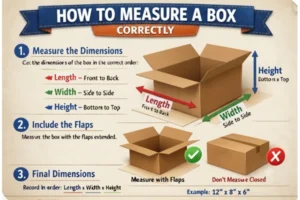
Length is the longest edge of the opening — usually the side running parallel to the flaps. Width is the shorter edge of that same opening. Height is straight up, from the floor of the box to the top edge.
Why the Order Trips People Up
So “12 x 8 x 6” means length first, then width, then height. Always that order. Mixing this up is honestly one of the most common reasons people end up ordering a box shaped completely wrong for what they needed.
Step One: Measure Inside, Not Outside
This one trips people up constantly, and it’s such a simple fix once you know it. If you’re figuring out what box size a product needs, you measure the inside — the actual usable space — not the outer cardboard shell.
When to Measure Interior Dimensions
Open the box all the way and run your measurement from inner wall to inner wall for length and width. For height, go from the interior floor up to where the flaps start folding, not all the way to the cardboard’s outer edge.
When to Measure Exterior Dimensions Instead
If instead you’re describing a box you already own — for storage or shipping paperwork — exterior measurements are what you want, since that’s what determines how it sits on a shelf or fits in a container. Figure out which one you actually need before grabbing a tape measure, because these two numbers won’t match. Sometimes not even close, depending on how thick the cardboard is.
Step Two: Nail Down Length and Width
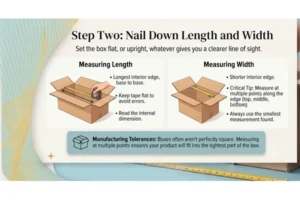
Set the box flat, or upright, whatever gives you a clearer line of sight.
Measuring Length
For length, run your tape along the longest interior edge, base to base, wall to wall. Keep it flat — a sagging tape measure causes more errors than you’d think, especially on wider boxes.
Measuring Width
Same idea for width, along the shorter edge. And here’s something people don’t expect: a surprising number of “rectangular” boxes aren’t perfectly square, just due to normal manufacturing tolerances. So measure at two or three points along each edge and go with the smallest number you get. Better to assume the tightest fit, since that’s the actual limit your product has to squeeze into.
Step Three: Height Is Where Everyone Gets Confused
Height causes more confusion than length and width put together, mostly because people aren’t sure exactly where to stop measuring.
Where to Start and Stop the Measurement
Stand the box up with the flaps open. Measure straight up, floor to the point where the walls end and the flaps begin folding outward. Don’t measure to the tip of the flap itself — that part’s just the material that folds over to seal things shut, it’s not usable space.
Accounting for Inserts or Padding
Got padding or a divider or an insert already sitting in there? Measure to the top of that instead. That’s your real usable height.
Step Four: Actually Test It With the Product
Numbers on a page are one thing. Physically putting your product in the box before finalizing anything is a whole different level of certainty — and it only costs you five minutes.
The Three-Point Check
Drop the product in, close the flaps, and check three things. Does it close without straining? Is there some breathing room, but not a ridiculous amount of empty space? Does it sit flat, or does it lean and shift when you tilt the box a little? If anything feels wrong, go back and re-measure. Don’t just assume your first numbers were “close enough.”
Why This Matters Even More for Bulk Orders
This step matters even more when you’re ordering custom boxes in bulk. A mistake here doesn’t cost you one box — it costs you the whole production run.
Step Five: Don’t Forget Product Variation
If what you’re packaging isn’t perfectly uniform — handmade candles, baked stuff, oddly shaped gifts — don’t just measure one and assume you’re done. Measure a handful, especially if you already know there’s some natural variation.
Sizing for the Largest, Not the Average
Go with the largest reasonable size you find, then add a bit extra on top. It’s a lot easier to deal with a box that’s slightly roomy for your smallest items than to discover your biggest ones just don’t fit.
Tools That Genuinely Help
A basic tape measure gets most jobs done, but a few extra tools speed things up and cut down on errors.
For Everyday Measuring
A metal or rigid plastic ruler works well for smaller boxes — it won’t sag the way fabric tape sometimes does.
For Tighter Tolerances
Calipers come in handy if you’re dealing with tight tolerances, like electronics packaging or a snug custom insert.
For Keeping Track of Numbers
Just a notepad, honestly. Writing measurements down the second you take them beats trying to remember three numbers in your head — you’d be surprised how often that’s where the mistake actually happens.
Bottom Line
Measuring a cardboard box isn’t hard, exactly. It’s just full of small decisions that quietly change the final number — inside or outside, where height actually stops, whether your product varies in size at all. Get those right once, and ordering the correct box stops being a guessing game. It just becomes a quick step you do before every order, instead of a problem you discover after five hundred boxes show up at your door.