If you’ve ever stood over your recycling bin holding a wad of bubble wrap, wondering whether to toss it in or throw it away, you’re not alone. It’s one of the most common packaging questions we get from customers — and the honest answer is a little more nuanced than a simple yes or no.
Here’s the short version: bubble packaging is recyclable, but you almost certainly can’t put it in your curbside bin. It needs a different path. Below, we’ll break down why, where it actually needs to go, and what you can do if you’d rather avoid the hassle altogether.
What Is Bubble Packaging Made Of?
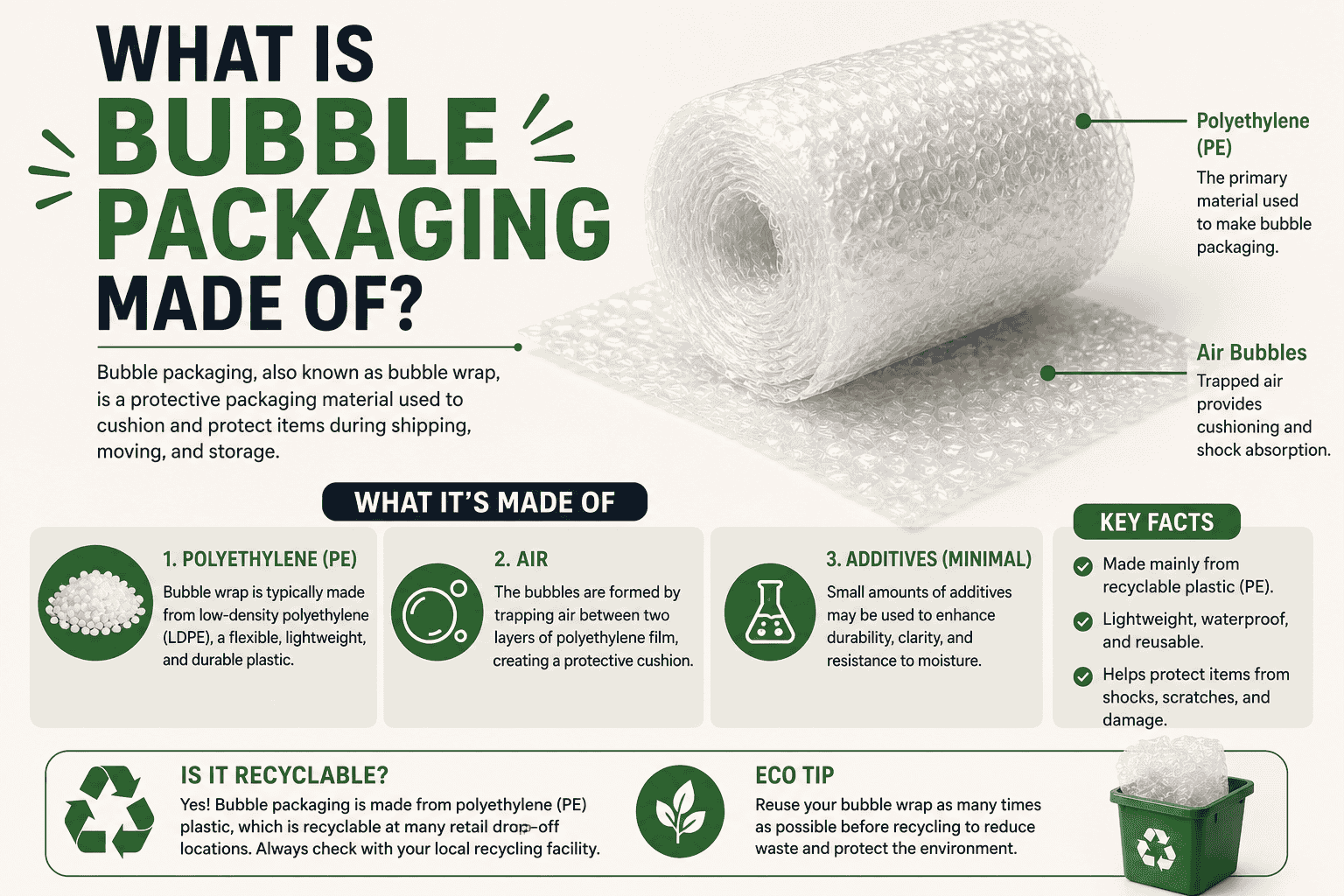
Most bubble wrap and bubble mailers are made from low-density polyethylene (LDPE), marked with the #4 resin code. This is the same family of plastic used in bread bags, dry-cleaning bags, and shrink wrap. LDPE is prized for packaging because it’s flexible, lightweight, and cushions well — exactly the qualities that make it good at protecting your products in transit.
The catch is that those same qualities make it a poor fit for standard recycling equipment.
So Why Can’t It Go in the Curbside Bin?
This is the part most people don’t realize: recyclability and curbside-acceptance are not the same thing. Bubble wrap falls into a category recyclers call “plastic film” — thin, flexible plastic that behaves very differently from rigid items like bottles and jugs.
At a typical materials recovery facility (MRF), sorting machinery is built around rigid containers. Thin plastic film does the opposite of what it’s supposed to: instead of dropping cleanly onto conveyor belts, it stretches, tangles, and wraps around rotating equipment. This causes jams, slows down entire sorting lines, and in some cases damages the machines. Because of this, nearly every municipal curbside program in the U.S. explicitly excludes bags, wraps, and films — bubble packaging included.
That doesn’t mean it can’t be recycled. It just means it needs a separate collection stream.
Where Bubble Packaging Actually Gets Recycled
The main path for LDPE film is a system known as store drop-off recycling. Many grocery stores and large retailers keep collection bins near their entrances specifically for clean, dry plastic film — the same bins you’d use for shopping bags, produce bags, or shipping envelopes.
A few things to keep in mind before you drop off bubble packaging:
- It needs to be clean and dry. Any leftover tape, labels, food residue, or moisture can contaminate an entire batch.
- Look for the label. The industry uses a “Store Drop-off” designation (through the How2Recycle program) to indicate which films are accepted this way.
- Not all locations take everything. Some retailers only accept bags and simple films, not laminated or multi-material items, so it’s worth checking with the specific store.
Once collected, the film is baled, sold to reclaimers, and eventually reprocessed into pellets that get turned into things like composite decking, new bags, and plastic lumber — not usually back into more bubble wrap, but kept out of the landfill and given a second life.
What About Bubble Mailers?
This is where it gets a little trickier. A lot of “bubble mailers” on the market are actually a paper-plastic hybrid — a kraft paper exterior with a plastic bubble lining glued inside. That combination is genuinely difficult to recycle, because separating the two materials isn’t practical at scale. Unless a mailer is clearly labeled as all-poly (a single plastic material, no paper), it’s safest to assume a padded paper mailer belongs in general waste rather than any recycling stream.
If you’re shipping products and care about the end-of-life impact of your packaging, it’s worth choosing mailers designed with recyclability in mind from the start, rather than trying to sort out a mixed-material product after the fact.
What Happens If It Ends Up in Landfill?
Because so much film packaging isn’t sorted correctly or simply gets tossed in the trash, a large share of it ends up in landfills. LDPE doesn’t break down quickly — estimates for plastic film range anywhere from a decade to several centuries depending on conditions. That’s the core reason recycling programs and manufacturers are under growing pressure to make film packaging easier to divert from the waste stream.
A Quick Note on Labeling Rules
Packaging claims are getting more scrutiny, not less. Regulations like California’s SB 343 are tightening what companies can legally print on packaging regarding recyclability, specifically targeting film products that claim to be “recyclable” without a realistic path to actually being recycled by most consumers. For brands, this means recycling claims need to point people toward the correct disposal method (like store drop-off) rather than a generic chasing-arrows symbol that implies curbside acceptance.
How to Recycle Bubble Packaging: A Simple Checklist
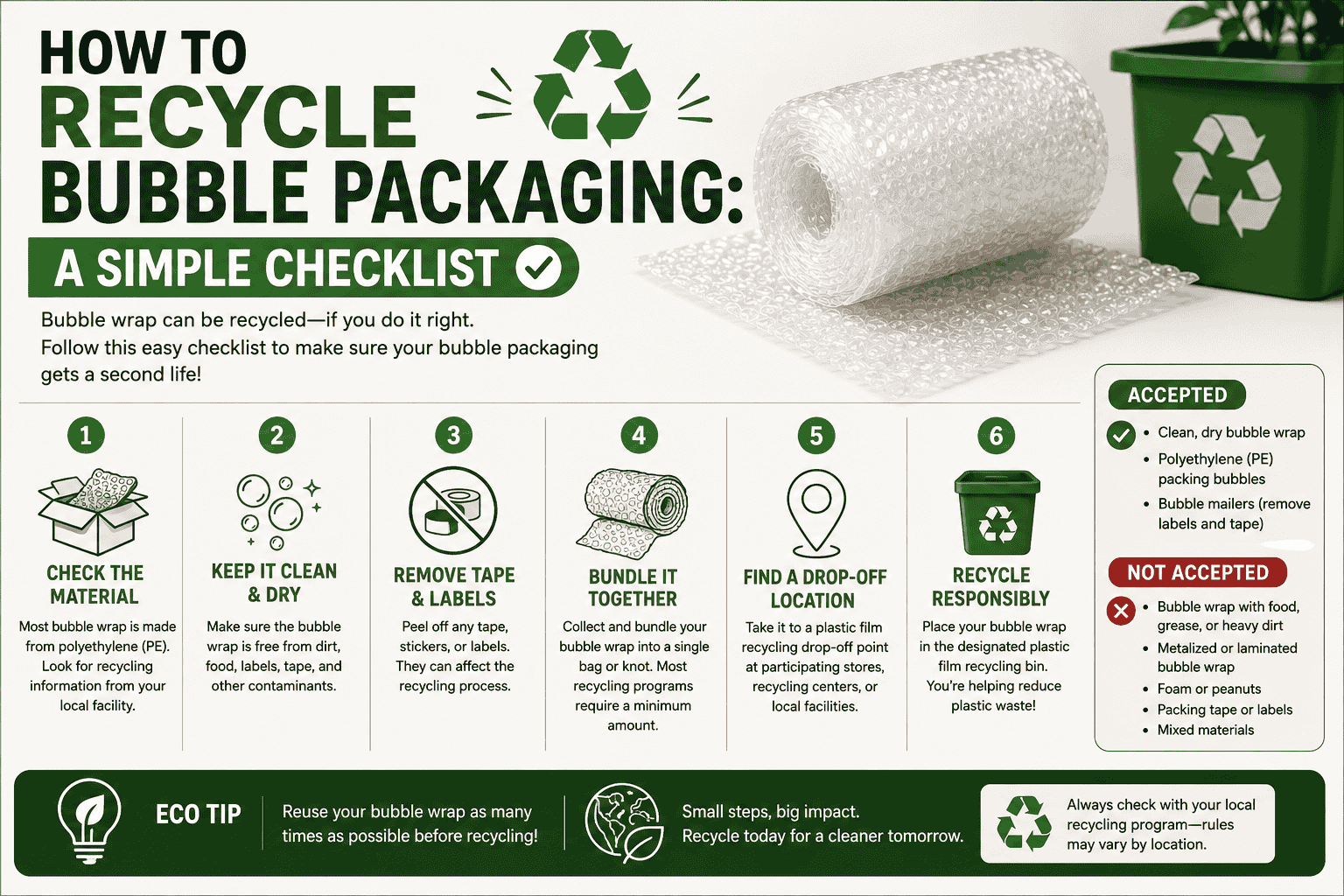
- Check the material. Look for a #4 or “LDPE” mark, or confirm it’s a plastic-only bubble wrap/mailer.
- Keep it clean and dry. Remove tape, labels, and any residue.
- Bundle it with other film. Combine with shopping bags, bread bags, and similar soft plastics.
- Bring it to a store drop-off bin, not your curbside cart.
- When in doubt, ask. Your local grocery or big-box retailer can confirm what they accept.
Choosing Packaging That’s Easier to Recycle From the Start
If you’re a business owner shipping products, the most effective move isn’t just recycling smarter after the fact — it’s choosing packaging that’s easier to deal with in the first place. That might mean:
- Sticking to single-material (mono-material) LDPE film rather than mixed paper-plastic mailers, so it’s clearly eligible for store drop-off.
- Exploring recycled-content bubble wrap, which reduces the amount of new plastic entering circulation.
- Considering paper-based cushioning alternatives for products that don’t need heavy-duty protection.
- Adding clear, accurate disposal instructions on your packaging so customers actually know what to do with it.
The Bottom Line
Bubble packaging is recyclable — just not through your curbside bin. It belongs in the plastic film / store drop-off stream, alongside bags and other soft plastics, provided it’s clean and dry. Understanding that distinction is the difference between packaging that actually gets a second life and packaging that quietly ends up in a landfill.
If you’re rethinking your packaging with sustainability in mind, we can help you choose materials that protect your products and make disposal simple for your customers. [Get in touch with our team] to talk through options that fit your products, your budget, and your sustainability goals.